Stablecoin Treasury Management: How Fintechs Secure, Move, and Reconcile Digital Assets

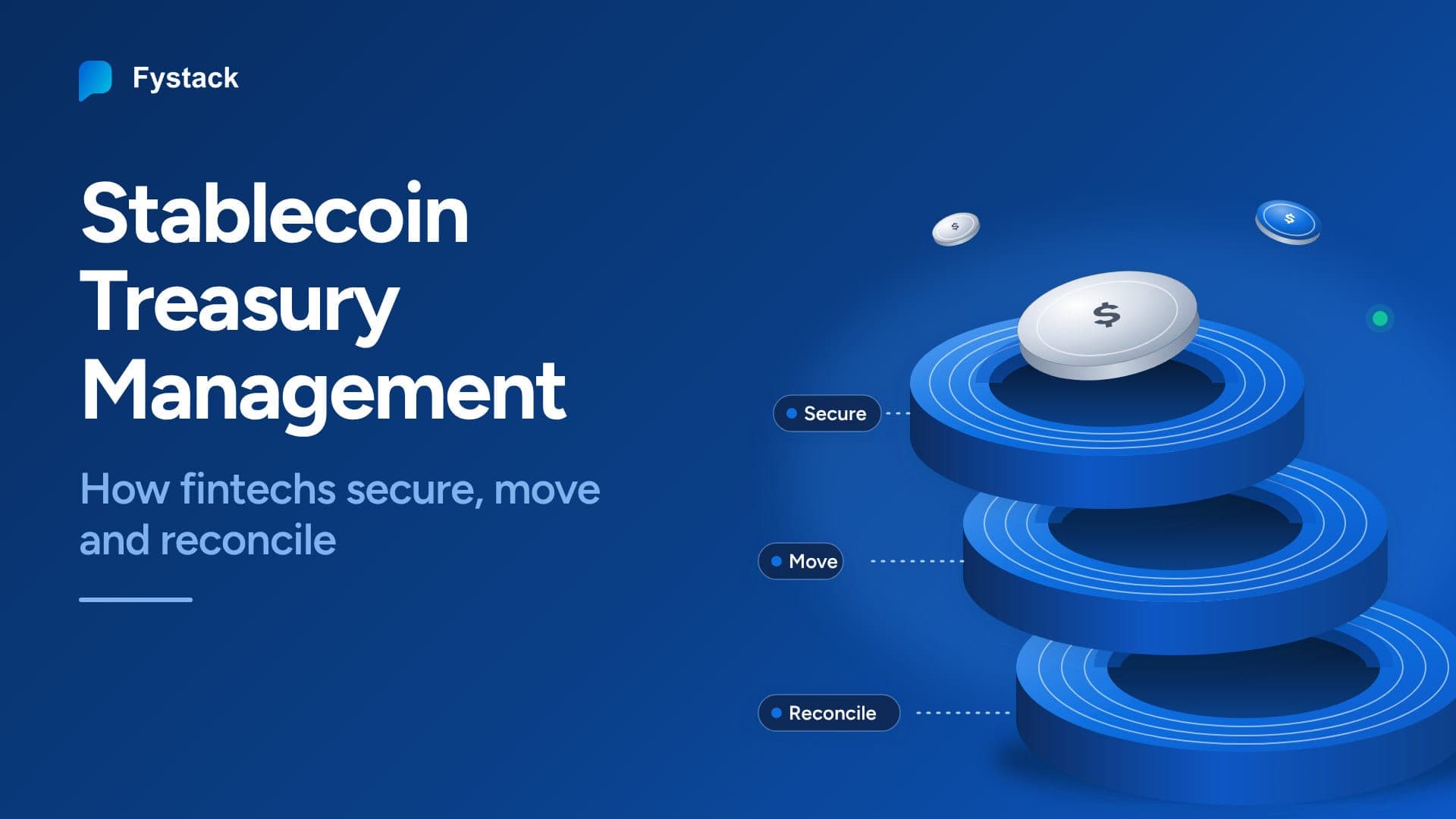
Stablecoin treasury management is the work of keeping a company's stablecoins safe, moving them to where they are needed, and proving every movement in the books. For a fintech that collects and pays out customer money in USDT or USDC, it is less about holding digital dollars and more about running them: thousands of deposits, many chains and a ledger that has to match the blockchain.
Take one example we will follow through this guide. A Southeast Asian cross-border payment company collects USDT and USDC from about 3,000 business customers, roughly $8 million a month, across TRON, Ethereum and Solana. It pays suppliers and partners out of the same balances. Its finance team has three people and no blockchain engineers. The question it faces is not "should we use stablecoins?" It already does. The question is how to run them without a spreadsheet, a shared seed phrase and a weekly scramble to match transfers to invoices. This is where stablecoin treasury automation starts to matter.
Key takeaways
- Stablecoin treasury management covers custody, collection, approvals, payouts and reconciliation, not only holding a balance.
- Bank-based treasury systems were not built for 24/7 settlement, wallet addresses, gas fees or many blockchains.
- A working setup follows one loop: Collect, Consolidate, Approve, Pay out, Reconcile, on top of a secure custody layer.
- Choose a provider by asking who can move funds, where keys and data live, and how the cost grows with your volume.
What Is Stablecoin Treasury Management?
Stablecoin treasury management is the set of tools, rules and routines a business uses to custody, move and account for stablecoins it holds or processes. It answers four questions every day: where is our money, who can move it, where does it need to go, and does our ledger agree with the chain?
There are two very different readers for this topic. A corporate treasurer may hold a small stablecoin balance to pay overseas suppliers faster, and guides such as Circle's primer for treasurers cover that well. A fintech, payment processor or exchange is in a different position: stablecoins flow through it on behalf of customers, often in high volume. For them treasury is an operations system, closer to running a payment network than managing a cash account. This guide is written for the second group.
One naming trap is worth avoiding. "Digital asset treasury" usually refers to public companies that hold crypto on their balance sheet as an investment. That is a different topic from operating stablecoin flows.
Why Traditional Treasury Systems Fall Short
Traditional treasury systems fall short because they assume bank accounts, business hours and one ledger per bank. Stablecoins settle around the clock, live at wallet addresses on many separate blockchains and cost a network fee (gas) to move.
| Question | Bank-based treasury | Stablecoin treasury |
| When money settles | Business days, bank cut-off times | Any time, 24/7, in seconds to minutes |
| Where money sits | A few bank accounts | Wallet addresses on several blockchains, often thousands of deposit addresses |
| Cost to move money | Bank and FX fees | A network fee (gas) on every transfer, paid in each chain's own token |
| Records to watch | One statement per bank account | One record per chain and token, matched to your own ledger |
| Can a payment be reversed? | Sometimes, through recall or chargeback | No. A signed transfer is final, so checks must happen before signing |
| What proves a payment | Bank reference and statement | Transaction hash, sender and receiver address, amount and time |
For our payment company, these gaps show up in ordinary days. A customer pays at 2 a.m. on a Sunday and expects the payout to start. A USDT transfer arrives on TRON but the outgoing payment has to leave from Ethereum. A deposit address runs out of the token used to pay gas, so funds cannot be moved until someone tops it up. None of this is exotic. It is simply work that a bank-era system never had to do.
Stripe's guide to stablecoin treasury management makes the same point from the corporate side: the familiar disciplines of limits, approvals and reconciliation still apply, but the systems underneath them have to change.
Stablecoin Treasury Architecture: The Treasury Loop
A stablecoin treasury architecture has one custody layer at the bottom and five recurring jobs on top of it. We call those jobs the Treasury Loop: Collect, Consolidate, Approve, Pay out, Reconcile. Every stablecoin operation, from a $50 deposit to a $2 million supplier payment, passes through it.
- Collect. Receive customer funds, usually at a unique deposit address per customer so each payment can be matched to a payer.
- Consolidate. Move scattered deposits into a central operating wallet, a process called sweeping.
- Approve. Check every outgoing transfer against rules and, above set limits, against people.
- Pay out. Sign and send the transfer on the right chain, with enough gas to land it.
- Reconcile. Match every on-chain transaction to an entry in your own ledger.
Underneath sits custody: the wallets and keys that make any of this possible. If custody is weak, the loop only moves money faster toward the wrong person. If one stage is manual, the whole loop runs at the speed of that stage. For our payment company today, Collect and Pay out work, while Consolidate, Approve and Reconcile are done by hand. That is the usual starting point.
Wallet Management and MPC Custody
Wallet management decides how many wallets you run, what each one is for and who controls the keys that sign for them. Most operating teams use tiers: a hot wallet for daily payouts, a warm wallet that refills it under approval, and a cold reserve for funds that rarely move.
The key question is how signing works. A single private key on one server is a single point of failure: whoever copies it owns the funds. Multi-party computation (MPC) solves this by splitting signing authority into shares held on separate machines, so the complete key never exists in one place. Our MPC wallet guide explains the mechanics.
The second question is where those shares live. With a fully hosted service, the provider runs the signing machines. With self-hosted MPC wallet infrastructure, your team runs them in its own cloud or data centre. The first is faster to start. The second gives you direct control over keys and data, which matters when a bank partner asks during due diligence, "Who can stop or move your customers' funds?" Our payment company will hear that question the first time it applies for a new banking relationship.
How Do You Automate Stablecoin Deposit Sweeps?
You automate stablecoin deposit sweeps by setting rules that move funds from deposit addresses into an operating wallet once a balance passes a threshold, and by funding the gas each sweep needs automatically. Done well, nobody has to watch thousands of addresses by hand.
Per-customer deposit addresses make collection easy to match, but they scatter money. Our payment company has about 3,000 addresses, and each one holds small balances that cannot pay a supplier on their own. Sweeping on a schedule wastes gas on tiny amounts. Sweeping by threshold, for example when an address holds more than $500, keeps fees in proportion to the money moved. Our breakdown of how automated sweeping works covers the rules in detail.
Gas is the hidden cost. Every sweep on TRON needs network resources called energy, and buying them per transfer is expensive at volume. Renting energy instead can cut TRON network fees by up to 60%. On Ethereum and Solana, a gas station that tops up addresses before a sweep keeps funds from getting stuck.
Transaction Approval and Access Control
Transaction approval and access control decide who can send money, how much, where to and under which conditions. In stablecoin treasury this matters more than in banking, because a signed blockchain transfer cannot be reversed or recalled.
Good controls work in layers. Roles define who can create, approve and view transfers. Policies check each transfer automatically: amount limits, approved destination addresses, how new an address is, how much has left in the last hour and allowed time windows. Approval groups add people above a threshold, for example two finance managers for any payout over $100,000. A policy engine that runs before signing is the difference between "we have a rule" and "the rule is enforced". We describe how programmable approval policies turn written limits into checks that run every time.
For our payment company, this is also what an auditor will test. A spreadsheet of approvers is a document. A policy that blocks an unapproved address is a control.
How Can a Treasury Team Manage Stablecoin Liquidity and Reconciliation Across Chains?
A treasury team manages stablecoin liquidity across chains by setting a target balance per wallet and chain, getting alerts when a balance drifts, and rebalancing before payouts fail. It reconciles by matching every on-chain transaction hash to an entry in its own ledger, ideally as events arrive rather than at month-end.
Liquidity problems are usually location problems. Our payment company might hold enough USDC in total but not enough on Solana for today's payouts. Balance threshold alerts sent to Slack or Telegram give the team time to move funds before a payment fails, instead of after a partner complains.
Reconciliation is where most of the hours go. Each deposit and payout produces a transaction hash, an address, an amount and a time, and all of it has to match an invoice, a customer and an accounting entry. Signed webhooks that push deposit and withdrawal events to your systems in real time make matching continuous. Our guide to stablecoin B2B reconciliation shows the data each record needs.
How to Choose a Stablecoin Treasury Infrastructure Provider
Choose a stablecoin treasury infrastructure provider by testing it against your business risks, not its feature list. The useful questions are who can move funds, where keys and data live, how cost grows with volume, which chains are covered and what it takes to leave.
| Business question | Why it matters | What a good answer looks like |
| Who can move funds? | Bank partners and auditors will ask this first. | Named roles, policies enforced before signing, approval groups above set limits |
| Where do keys and data live? | Some regulators and banks expect control in your own environment. | A clear choice between hosted and self-hosted, with key shares split across machines |
| How does cost grow with volume? | Pricing tied to volume or assets held can grow faster than revenue. | A pricing model you can model at today's volume and at 3x |
| Which chains and tokens are covered? | Customers pay on the chain they prefer. | The chains and stablecoins you use today, plus a path for the next one |
| What will you still run yourself? | Every manual step is a cost and a risk. | Sweeps, gas top-ups, alerts and ledger events handled by the platform |
| What does it take to leave? | Switching later can mean new addresses and moving funds. | Exportable records, documented APIs and no lock-in on deposit addresses |
Our payment company should also run one practical test before signing: send a small amount through the full Treasury Loop on each chain it uses, from a customer deposit to a reconciled payout, and time how many manual steps remain.
Fystack is one option, built as self-hosted custody infrastructure for fintechs that want to run the loop on their own servers. Signing runs on mpcium, its open-source MPC engine. On top of it, the platform covers threshold-based sweeps, a gas station with TRON energy rental, a policy engine with approval groups, signed webhooks for deposits and withdrawals, and balance alerts. Setup is documented in the Fystack docs and the self-host scripts on GitHub. Fystack is ISO/IEC 27001 certified and its backend was independently audited by Adevar Labs. The trade-off is that self-hosting means your team runs and maintains the servers. If you want a third party to hold and operate everything for you, a fully hosted provider is the simpler choice.
FAQ
What is stablecoin treasury management?
It is how a business custodies, moves and accounts for the stablecoins it holds or processes. For fintechs it covers deposit collection, sweeping, approvals, payouts and reconciliation across chains.
How is stablecoin treasury different from a bank treasury system?
Stablecoins settle 24/7, sit at wallet addresses on many blockchains and need gas to move, while bank systems assume business hours and bank accounts. The controls stay similar, but the tooling has to change.
How can I automate stablecoin deposit sweeps into treasury?
Use deposit addresses per customer, set a balance threshold that triggers a sweep into an operating wallet, and fund gas automatically so sweeps never get stuck.
What is the safest way to custody stablecoins for a fintech?
Use MPC so no single machine holds a complete key, split funds across hot, warm and cold wallets, and enforce transfer policies before signing.
What should I ask a stablecoin treasury infrastructure provider?
Ask who can move funds, where keys and data live, how pricing grows with volume, which chains and tokens are supported, and how you would migrate away.
What Comes Next
Stablecoin volume is moving from trading desks into everyday payments, payroll and supplier settlement. As it does, treasury becomes less about holding digital dollars and more about operating them reliably.
The teams that scale will be the ones that automate the Treasury Loop early, before 3,000 deposit addresses become 30,000.
If you are designing your own stablecoin treasury, see how Fystack's policy engine and sweeps are set up.
About Fystack: Fystack is a self-hosted custody platform for fintech teams. Its core signing infrastructure, mpcium, is open-source on GitHub. Fystack supports Ethereum, Base, Solana, Polygon, BNB Chain, Bitcoin, TRON, Stellar and more.