Real-Time Digital Asset Treasury Alerts: Balance Threshold Monitoring

As enterprises move treasury operations on-chain, visibility is no longer optional. Finance teams cannot rely on periodic balance checks or manual monitoring when transactions are irreversible and liquidity gaps can halt operations instantly.
In traditional finance, alerts, thresholds, and dashboards are foundational treasury controls. On-chain treasury requires the same discipline but enforced at the system level, not dependent on individuals.
This guide walks through how Fystack enables real-time digital asset treasury alerts, following a practical flow that mirrors how finance and ops teams actually configure and use alerts in production environments.
1. Connecting Treasury Alerts to Real Operations Channels
Before alerts have value, they must reach the right teams.
In Fystack, alerts are delivered through dedicated notification channels, currently supporting Telegram widely used by treasury and operations teams for real-time coordination.
Key operational principles:
- Only Admins can create notification channels
- Channels are connected once and reused across alerts
- Each channel can map to a specific team or function

Typical enterprise setup:
- Treasury team Telegram group
- Operations or payments team group
- Risk or compliance team group
This structure ensures alerts are routed by responsibilitynot broadcast to everyone.
2. Event Alerts Immediate Visibility Into Fund Movements
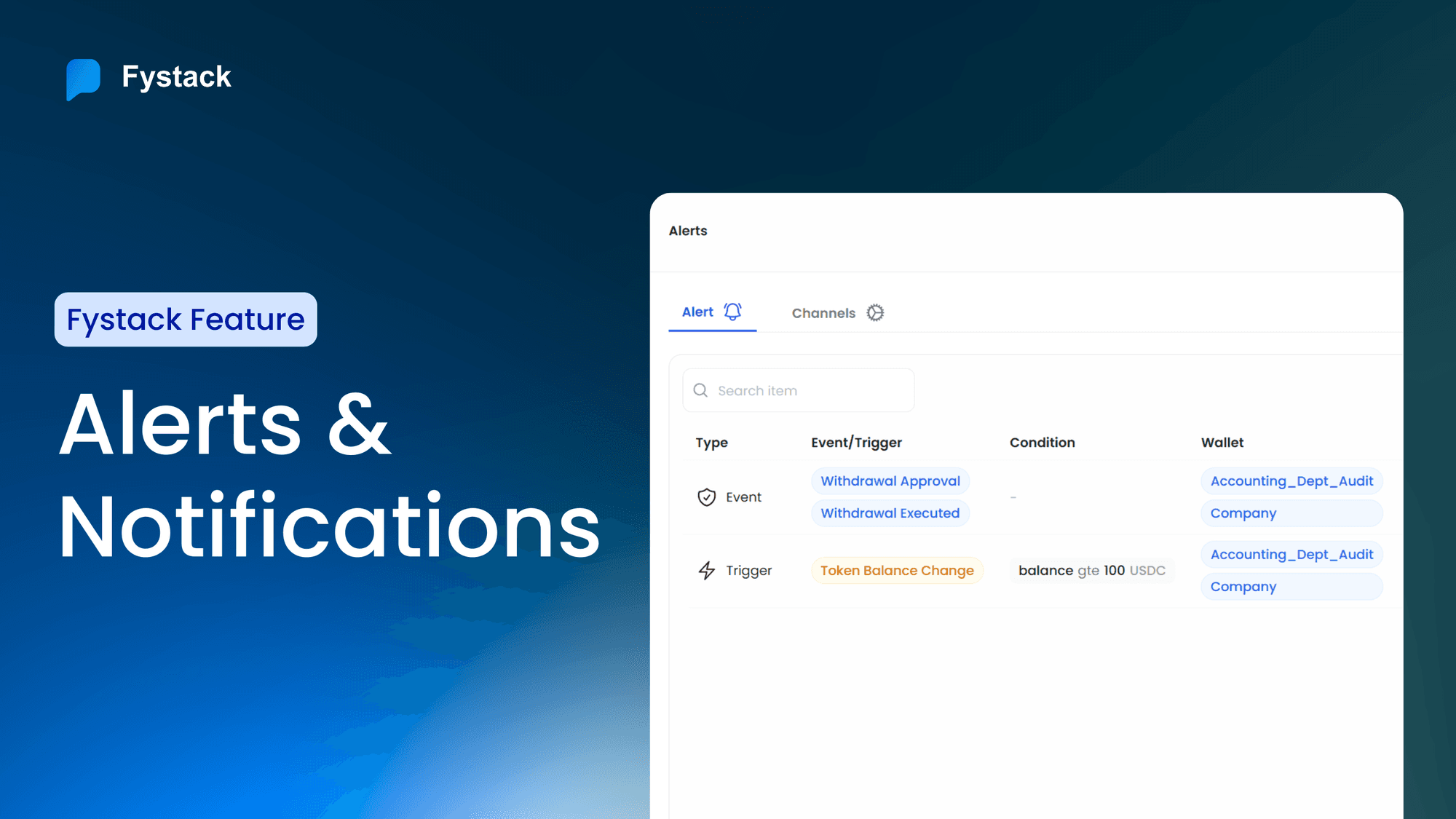
Event Alerts notify teams when predefined on-chain events occur.
Common finance use cases:
- Deposit received into a treasury or operational wallet
- Withdrawal executed from a controlled wallet
- Transaction approved or completed

Configuration flow:
- Select Event Alert
- Choose the event type (deposit, withdrawal, execution)
- Select the wallet(s) to monitor
- Assign one or more notification channels

Once created, alerts trigger automatically and notify the relevant team as soon as the transaction is confirmed on-chain.
This removes reliance on manual checking and ensures fund movements are visible in real time.
3. Trigger Alerts Balance Threshold and Low-Balance Monitoring
Trigger Alerts continuously monitor wallet states and balances.
They are designed to answer a critical treasury question:
“Will this wallet be able to support operations if nothing changes?”

Trigger Alerts allow teams to:
- Define minimum balance thresholds
- Receive low-balance warnings before transactions fail
- Monitor native token balances without unit conversion
- Track ERC20 token balances for specific assets

Typical trigger conditions include:
- Balance drops below a defined threshold
- Transaction volume exceeds expected limits
- Unusual activity detected
These alerts shift treasury operations from reactive troubleshooting to proactive risk prevention.
4. Team-Based Alert Routing at Scale
As organizations scale, the challenge is no longer receiving alertsit is ensuring alerts reach the right team.
Fystack enables:
- Multiple Telegram groups per workspace
- Custom alert routing per wallet and alert type
- Separation of signals across treasury, ops, and risk teams
Examples:
- Treasury team receives balance threshold and liquidity alerts
- Operations team receives execution and funding alerts
- Management receives escalations only when thresholds are breached
This prevents alert fatigue while preserving accountability and response speed.
Real-Time Alerts in Action
When a withdrawal is executed:
- The designated Telegram group is notified immediately after confirmation

When a deposit is received:
- Alerts include transaction value, network details, and transaction ID

Teams always know:
- When funds move
- Which wallet is affected
- Whether action is required
Enterprise-grade Benefits of System-Enforced Treasury Alerts
By implementing real-time alerts with Fystack, enterprises gain:
- Operational continuity Prevent failed transactions caused by insufficient balances
- Faster response times Detect issues immediately, not after disruption
- Reduced human dependency Eliminate manual balance checks and message forwarding
- Clear accountability Alerts align with role-based access and audit trails
- Scalable monitoring Manage multiple wallets and chains with consistent controls
From Notifications to Treasury Control
At scale, digital asset treasury management is not about watching walletsit is about designing systems that actively monitor, alert, and enforce operational discipline.
Fystack transforms alerts from simple notifications into an enterprise-grade treasury control layer, allowing finance teams to operate on-chain with clarity, confidence, and control.
Manage your digital asset treasury securely across multiple chains with Fystack.
Have questions about your custody setup?Share what you are building via the form and explore how Fystack’s MPC wallets, KYT integrations, and consolidation engine fit your architecture.
Not ready yet?Join our Telegram for product updates and architecture discussions: https://t.me/+9AtC0z8sS79iZjFl
FAQ
What are crypto treasury alerts?
Crypto treasury alerts are automated notifications that inform enterprise teams about wallet activity, balance changes, and predefined threshold conditions in real time. They help treasury and finance teams maintain liquidity, detect risks early, and avoid operational disruptions when managing funds on-chain.
Why are real-time balance alerts important for enterprise treasury management?
On-chain transactions are irreversible. Without real-time balance monitoring, enterprises risk failed payments, delayed settlements, or insufficient gas balances. Balance threshold alerts ensure teams are notified before balances drop below operationally safe levels.
What types of alerts does Fystack support?
Fystack supports two primary alert types:
- Event Alerts – notify teams when specific transactions occur, such as deposits or withdrawals.
- Trigger Alerts – monitor wallet or token balances and send alerts when predefined thresholds are met.
Can Fystack monitor both native tokens and ERC20 tokens?
Yes. Trigger Alerts in Fystack can track native token balance changes without unit configuration, as well as monitor balance changes for specific ERC20 tokens. This allows enterprises to manage both gas funds and operational token balances within a single monitoring system.
Who can create and manage alert notification channels?
Only users with Admin permissions are authorized to create and configure notification channels in Fystack. This ensures alerts are governed by role-based access controls and aligned with enterprise security policies.
Which notification channels are supported?
Fystack currently supports Telegram as a notification channel, enabling real-time delivery of treasury alerts to individual users or operational groups commonly used by finance and DevOps teams.
How do low balance alerts help prevent operational failures?
Low balance alerts notify teams before a wallet runs out of funds needed for payments, settlements, or gas fees. This proactive warning system allows enterprises to top up wallets in advance, avoiding failed transactions and service interruptions.
Are treasury alerts auditable?
Yes. Treasury alerts are part of Fystack’s broader custody and governance framework. Alert creation, configuration, and triggering events can be reviewed alongside transaction activity, supporting auditability and compliance requirements.
How does Fystack treasury alerting differ from standard wallet notifications?
Unlike retail wallet notifications, Fystack’s alert system is designed for enterprise treasury operations. Alerts are tied to workspaces, roles, multiple wallets, and threshold-based logic—providing structured, system-enforced monitoring rather than ad hoc notifications.