MPC Wallet as a Service: How It Works, Pricing and Self-Hosted Options

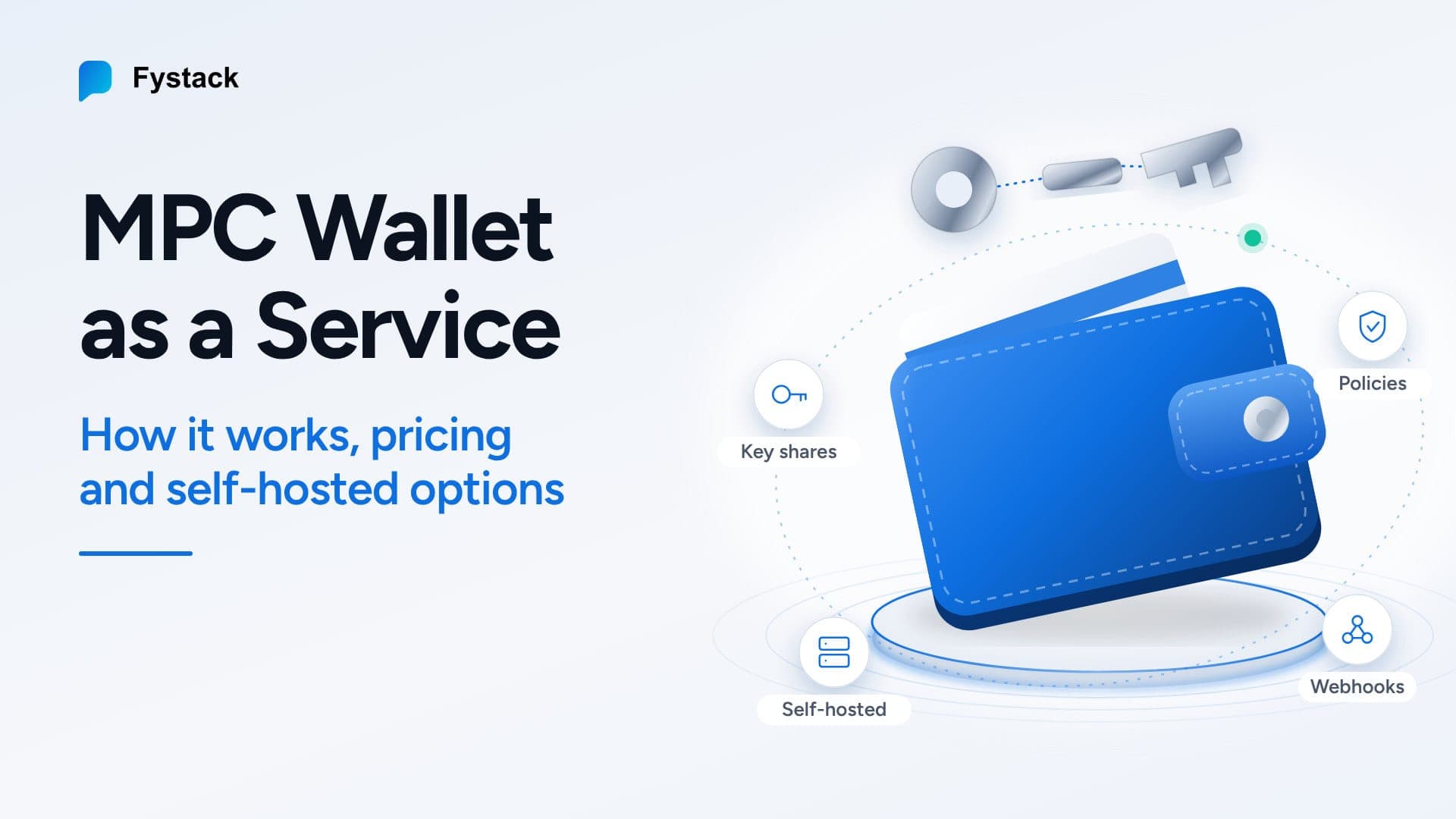
MPC wallet as a service lets you run crypto wallets through an API while a provider operates the signing infrastructure. For a payment business, it is the fastest way to launch. The harder question comes later: what does it cost you once the business works?
Picture a payment company in Southeast Asia. It needs stablecoin wallets live next quarter, has no blockchain team, and sends about $2M a month. An MPC wallet service gets it live in weeks. Two years later, volume is five times higher, a bank partner wants to know who can freeze funds, and the regulator asks where customer data is stored.
This guide follows that company: how the service works, what it costs as you grow, and when self-hosting makes more business sense.
Key takeaways
- MPC wallet as a service (MPC WaaS) is the fastest way to launch wallets without a blockchain team.
- Its price usually grows with your volume or your balances, so success raises the bill.
- Three business questions decide the fit: who can move funds, where data lives, and what growth costs.
- Self-hosting trades a fast start for control over keys, data and cost.
What Is MPC Wallet as a Service?
MPC wallet as a service is a cloud product that gives you crypto wallets through an API, while the provider runs the multi-party computation (MPC) signing nodes. MPC splits signing authority across several parties, so no single device or person ever holds the full private key.
In practice, your backend calls the API to create a wallet, gets a webhook when a deposit lands, and requests a transfer. A policy engine checks limits and approvals, then the MPC nodes sign together.
What matters for your business is who holds the key shares. Some services hold all of them. Others split them with you: Utila describes a two-party model with one share on the customer's device, and Cobo lets you run a server co-signer yourself. A white-label MPC wallet is the same idea packaged as a ready-made app with your brand on it. If you are still choosing a signing model, start with the MPC vs multisig trade-offs.
What MPC Wallet as a Service Costs a Growing Payment Business
MPC wallet providers charge in one of three ways. Think of a phone plan: you pay for how much you use, how many people use it, or how much you store.
- By money sent out. A monthly plan covers a set amount of money leaving your wallets, called outbound volume. Send more, and you move to a bigger plan.
- By active wallets. You pay for each wallet used in a month.
- By money held. You pay a yearly percentage of the balance in your wallets, called assets under custody (AUC).
Now back to our payment company. Today it sends about $6M a quarter and keeps about $5M in its wallets so it can pay customers quickly. That balance is called the float. In two years, both are five times bigger.
| How you pay | Today: $6M sent per quarter, $5M held | In two years: $30M sent per quarter, $25M held |
| By money sent out (Fireblocks example) | Too big for the $1M entry plan: custom contract, listed from $36,000 a year | A bigger custom contract, price negotiated |
| By money held (illustrative 0.25% a year) | $12,500 a year | $62,500 a year |
| Self-hosted | Your servers and your team's time | Grows with your servers, not with money sent or held |
The entry plan is too small from day one. Fireblocks' Essentials plan covers up to $1M sent out per quarter, and Utila's Starter plan up to $3M. Our company sends $6M, so it needs a custom contract. Fireblocks lists custom plans from $36,000 a year, and the final price is negotiated. See our Fireblocks alternative comparison.
A fee on money held grows even when profit does not. A payment company keeps a float to pay out fast, not to earn on it. At an illustrative 0.25% a year, a $5M float costs $12,500. When the float grows to $25M, the fee grows to $62,500, while the company still earns the same margin on each payment. We explain why in why AUC-based custody pricing breaks payment unit economics.
Per-wallet pricing fits a different business. Circle charges per active wallet, with the first 1,000 free each month. That suits consumer apps with many small users, not a few large treasury wallets.
Three Business Risks Beyond the Invoice
The invoice is the risk you can see. Three others show up later.
A partner asks who can stop your withdrawals. If the provider holds every key share, it can sign or block transactions without you. Banks and enterprise customers ask this in due diligence. "Our vendor" is a weak answer.
A regulator asks where your data lives. Wallet addresses, transaction history and customer records sit on the provider's servers. In markets with data residency rules, such as Vietnam and Indonesia, that can turn a licence review into a migration project.
Leaving costs more than joining. Your wallets, addresses and policies live inside the provider's system. Switching can mean new deposit addresses for every customer and a careful move of funds.
The Who-Where-How Test
Before you sign, ask the vendor three questions. We call this the Who-Where-How Test.
Who can move funds? List every key share and who holds it. You want at least one share that nothing can be signed without, plus a quorum of approvers, as in this enterprise MPC wallet setup.
Where does the data live? Get the hosting region in writing, and check it against your licence conditions.
How does the price scale? Send the vendor your volume and float for today and two years out, and ask for both quotes.
If all three answers work for you, use the service. It is still the fastest way to launch.
What Is a Self-Hosted Alternative to MPC Wallet as a Service?
A self-hosted alternative runs the same features (wallet creation, signing, policies and webhooks) on servers you control. For our payment company, it answers each of the three risks above.
| Question | MPC wallet as a service | Self-hosted MPC wallet |
| Who can move funds? | The provider, if it holds every key share | Only your team, because every key share sits in your environment |
| Where does data live? | In the provider's cloud and region | On your servers, in the country you choose |
| How does cost grow? | With money sent, wallets used or money held | With the servers you run |
| What if you leave? | New deposit addresses and a move of funds | Wallets and data already sit with you |
| What must you run? | Nothing; the provider runs it | Servers, updates and on-call support |
Put simply, a service rents you speed; self-hosting gives you control. The bank partner hears "only we can move funds," the regulator sees data in the country, and growth no longer raises a per-dollar fee.
The trade-off is real: your team runs the servers and stays on call. It fits best once you have steady volume, thin margins or a data residency review ahead. Before that, a service is often the smarter start. Our guide to self-hosted MPC wallet infrastructure covers the trade-offs in detail.
Fystack is self-hosted custody infrastructure built for this case. It runs in your cloud account or on your own servers with Docker Compose. Signing runs on mpcium, an open-source MPC engine your team can read and audit, and a policy engine checks every transfer before signing.
FAQ
What is MPC wallet as a service?
It is a cloud product that gives you MPC wallets through an API. The provider runs the signing infrastructure, and you create wallets and send transactions with API calls.
What is the difference between MPC wallet as a service and a white-label MPC wallet?
MPC wallet as a service gives you an API to build your own product. A white-label MPC wallet gives you a ready-made wallet interface with your brand on it.
Is MPC wallet as a service non-custodial?
It depends on who holds the key shares. If the provider holds all of them, it controls the funds. If you hold at least one share, no transaction can be signed without you.
Can I self-host an MPC wallet instead?
Yes. Self-hosted platforms such as Fystack run wallet creation, signing, policies and webhooks on your own servers, so you keep all key shares and data in your environment.
What Comes Next
More regulators in Asia are asking where keys and customer data live. That question used to come up during audits. Now it comes up during vendor selection.
The teams that choose well will run the Who-Where-How Test before they sign, not after their first big invoice.
If you want MPC wallets that run on your own servers, see how Fystack self-hosting works.
About Fystack: Fystack is a self-hosted custody platform for fintech teams. Its core signing infrastructure, mpcium, is open-source on GitHub. Fystack supports Ethereum, Base, Solana, Polygon, BNB Chain, Bitcoin, TRON, Stellar and more.