From Card Payments to On-Chain Settlement: What Actually Changes in Your Existing Stack?

Most payment companies that want to settle in stablecoins start with the same question:
"Do we need to rebuild our whole payment stack?"
No.
A mature card program already has most of what it needs. Card issuing. A processor. An authorization engine. Fraud controls. An internal ledger. Bank accounts. Treasury. Reconciliation.
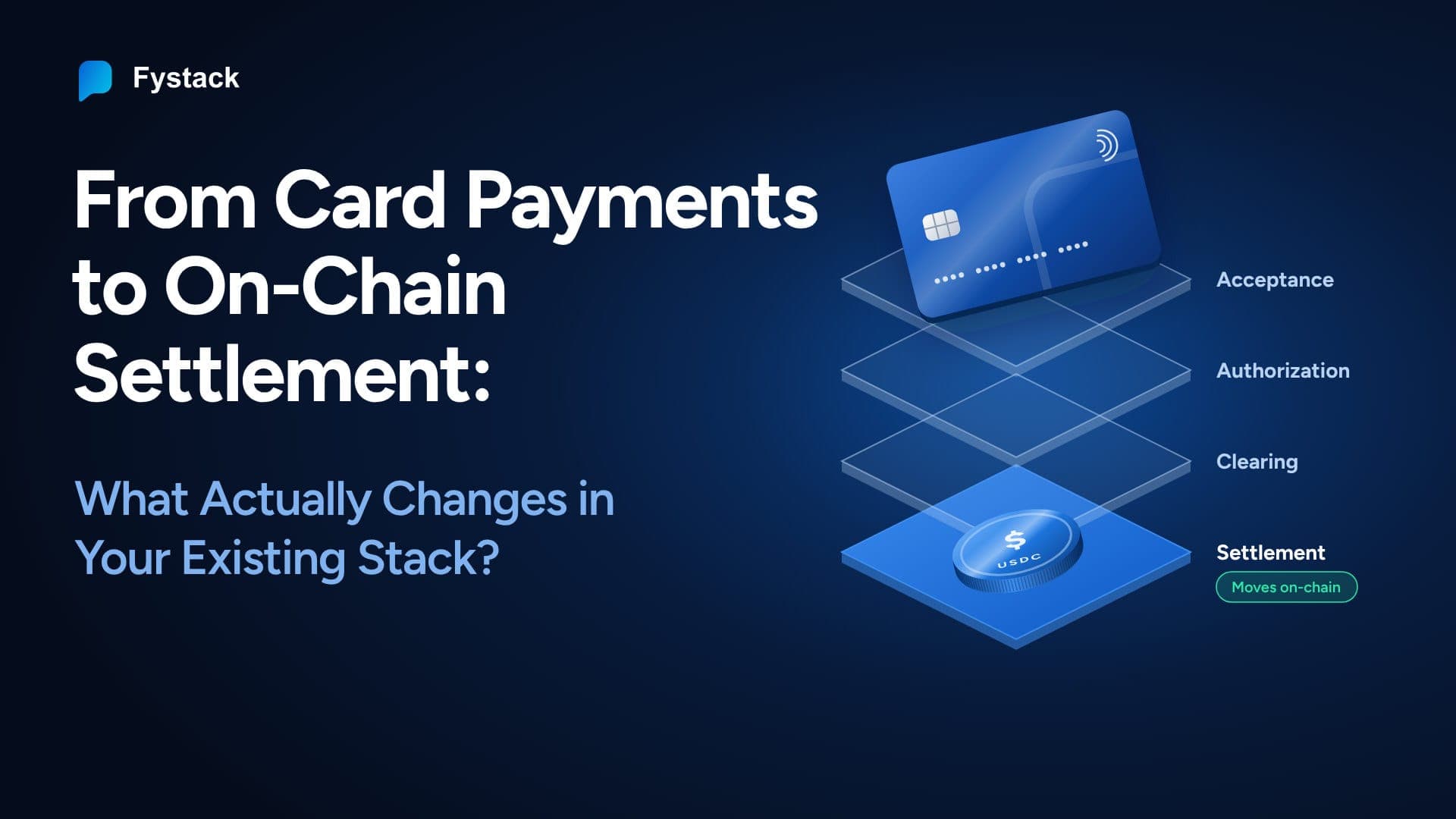
Very little of this has to go. What changes is the money movement layer: the part of the stack that holds, moves, controls, and reconciles money.

The tap, the checkout, and most of the processor logic can stay the same. On-chain settlement is a new path that runs next to bank settlement. It is not a pipe that replaces it.
This article walks through each part of the stack with one simple question in mind. What do you Keep, what do you Add, and what should you Automate?
Key takeaway
- On-chain settlement does not replace your card stack. It adds an on-chain money movement layer underneath it.
- What stays: the card experience, authorization, fraud engine, processor, and card network.
- What you add: settlement wallets, blockchain connectivity, wallet and signing policies, reconciliation between bank and on-chain records, and monitoring.
- What you automate: treasury rebalancing, sweeps, and liquidity across wallets and chains.
- The biggest shift is not a new payment rail. It is a new control plane: who can move money, how much, and where.
If you want the background on why institutions are moving to stablecoin settlement at all, start with what changes and what doesn't in stablecoin card settlement. This article picks up the next question: how do you connect it to the stack you already run?
Mapping Your Card Stack to an On-Chain Stack
The fastest way to see how much changes is to put each part of your current stack next to its on-chain version.
| Current card stack | On-chain equivalent | What changes (Keep / Add / Automate) |
| Bank settlement account | Bank account + stablecoin settlement wallet | Keep + Add. The wallet holds the share of liquidity that moves to stablecoins. It runs next to the bank account, not as a 1:1 replacement. |
| Treasury | On-chain treasury | Automate. Liquidity is managed by wallet, chain, and policy, not only by bank account. |
| Payment processor | Processor + blockchain connectivity | Keep + Add. The processor still handles authorization and clearing. Blockchain connectivity is a separate layer added next to it. The processor does not become blockchain infrastructure. |
| Clearing records and settlement reports | Same records, plus an on-chain transfer | Keep. The network still sends the same reports. Only the funds transfer (the wire) becomes an on-chain transaction. |
| Bank reconciliation | Bank + on-chain reconciliation | Add. A new type of record (transaction hash, wallet address) has to match your card records and settlement batches. |
| Transfer approval (maker-checker) | Wallet policy + signing policy | Add. Approval rules are written as policies and checked before a transaction is signed. |
| Banking cut-off times | Wider settlement windows | A new timing model. Weekend, holiday, and same-day settlement become possible, but still on the network's schedule. |
| Bank account permissions | Signing rights and key management | Add. Who holds the keys and who can sign becomes one of the most important controls in the on-chain layer. |
Not every row needs to be replaced.
Some parts stay exactly as they are. Some stay, but need a new layer connected to them. And some need a kind of control your old stack never had.
Knowing which is which sets the scope of the whole project: which teams are involved, what it costs, and where the risk sits.
What Stays the Same: Card Experience, Authorization, and Processor
This is worth saying first, because it is the biggest worry for traditional payment companies.
The card experience. Customers still tap, swipe, and pay online. They still get an approval or a decline. Merchants still get paid the way they always have. This is not just theory. When Visa launched USDC settlement in the US, it said issuers get faster fund movement and seven-day settlement with no change to the consumer card experience (Visa).
Authorization and risk. If your authorization engine works well, you don't need to rewrite it. It still answers one question: should this transaction be allowed? In institutional settlement, the blockchain layer plays no part in that decision. It only moves money after the transaction has been approved and cleared.
The processor and the card network. The processor still handles authorization, clearing, card events, and merchant data. On the network side, Mastercard says its expanded settlement lets partners use both traditional and digital asset settlement through the same global infrastructure, while keeping existing protections such as security standards, fraud safeguards, and dispute processes (Mastercard).
One exception to be clear about. Everything above applies to settlement between institutions. Crypto-funded cards are different. If users keep their balance in crypto until the moment they tap, authorization does have to check and debit a wallet within a few seconds. That is a different architecture, covered in our breakdown of crypto debit card authorization and settlement.
The card does not need to become blockchain-native just because settlement does.
What Needs to Change: The Four Layers of Money Movement
Money Storage: Adding a Settlement Wallet Next to the Bank Account
Today, settlement money sits in bank accounts. When part of it moves on-chain, that part sits in a stablecoin wallet. The rest stays at the bank.
But a settlement wallet is not simply "a bank account on a blockchain."
A bank account comes with a whole control system that the bank runs for you. A wallet comes with none of that. You decide how wallets are structured, which assets and chains they support, how balances are tracked, how transactions are controlled, and who can sign.
Once a wallet handles regular settlement flows, it stops being a place to store money. It becomes part of your payment infrastructure.
Treasury: From Bank Treasury to On-Chain Treasury
A bank treasury moves money between bank accounts based on expected settlement needs. An on-chain treasury moves stablecoins between wallets, chains, and settlement accounts.
The question changes too.
Take a simple example. A card program settles about $1 million a day. The old question was "which bank account holds the money?" The new question is "which wallet holds how much, on which chain, under which policy?"
That one change creates new jobs for treasury: deciding where liquidity sits, keeping a settlement buffer, rebalancing between wallets, sweeping funds from collection wallets into a main wallet, and setting transaction limits for each wallet.
Reconciliation: From Bank Records to Bank and Blockchain Records
This is the part CFOs and operations teams should care about most.
One card transaction can leave a trail of records across many systems:
Card authorization → Internal ledger entry → Settlement batch → Stablecoin debit → Blockchain transaction → Fiat settlement → Bank statement
Without a link between these records, one payment can look like several unrelated financial events. To match them, each record needs the right data: transaction ID, batch ID, wallet address, timestamp, amount, asset or currency, and settlement status.
How card transactions map to on-chain transactions depends on the settlement model. In network settlement, one on-chain transfer usually settles the net position of a whole cycle, which can cover thousands of card transactions. That means reconciliation happens in two steps. First, match each card transaction to its settlement batch. Then match that batch to its transaction hash. With crypto-funded cards, the link can be closer to one-to-one.
Either way, the goal is transaction-level reconciliation: being able to trace every card transaction to the on-chain settlement that included it. This is a design requirement. It does not come for free. We go deeper on this in our guide to reconciliation for B2B stablecoin flows.
Payment Approval: From Bank Controls to Wallet Policies
At a bank, the question is simple: who can approve a transfer?
On-chain, that question breaks into four. Who can start a transaction? Who can approve it? Who can sign it? And under what conditions can it be executed?
To answer them, you need separate proposer and signer roles, approval thresholds, spending limits, allowlists of destination addresses, and other policy rules. The difference from a bank portal is that these rules can be enforced automatically before a transaction is signed, instead of relying only on the person clicking "approve."
Moving money on-chain does not just add a new payment rail. It adds a new control plane.
Many teams underestimate this. It is where a large share of the new operational risk sits, alongside liquidity, compliance, and counterparty risk. We cover this in more detail in settlement risk for crypto cards.
The New Infrastructure You Actually Need
Once the stack is mapped, the list of what to build is short:
- Wallet infrastructure: custody, balances, addresses, and asset management.
- Blockchain connectivity: sending transactions to the chain and tracking their status.
- Transaction policy: limits, approval flows, destination controls, and operating rules.
- Reconciliation layer: linking card transaction IDs and settlement batches to your ledger and blockchain transactions.
- Monitoring: transaction status, wallet balances, and operational exceptions.
- Treasury automation: rebalancing, sweeps, and moving liquidity between wallets.
Using the Keep / Add / Automate lens, items 1 to 5 are Add. These are capabilities your old stack does not have. Item 6 is Automate. You already have a treasury, but now it needs to run on rules instead of manual work.
None of these items asks you to rewrite anything in the Keep group.
You are not replacing the card stack. You are building an on-chain money movement layer around it.
A Practical Migration Path in Three Phases
Architecture is only useful if it turns into a plan. The safest plan is to not move everything at once.
| Phase | What you add | Goal |
| 1. Stablecoin treasury | Settlement wallets, treasury, and monitoring. Cards, processor, authorization, and customer experience stay the same. | Learn to operate on-chain liquidity before real settlement flows go through it. |
| 2. Selected settlement flows | Reconciliation, wallet policies, and transaction monitoring for specific markets, corridors, or settlement flows. | Prove that on-chain settlement works at small scale and measure the real liquidity gains. |
| 3. On-chain settlement in the core stack | Multiple chains, stablecoins, and wallets, plus automated sweeps, treasury rules, and enterprise controls. | Scale with control, using policies and reconciliation already tested in phase 2. |
In phase 2, your partners often decide the scope as much as you do. On-chain settlement only works when your card network, BIN sponsor, and settlement partner support the market, stablecoin, and chain you need. For example, Mastercard's first stablecoin settlement partners are focused on the US and Latin America, with more expansion planned through 2026 (Mastercard). So the first step is to check what each partner supports before you plan a pilot.
The rule of thumb is simple. Move the settlement layer first. Leave the payment experience alone.
The Real Architecture Question
So how much of your stack actually needs to change?
Less than most teams expect.
The biggest shift is not the card. It is the layer underneath the card. The layer that holds liquidity, moves funds, controls transactions, reconciles settlement, and manages treasury.
Card companies have spent years building issuing, authorization, fraud controls, customer experience, and merchant acceptance. Going on-chain does not mean throwing that away. It means connecting it to a new financial infrastructure layer.
Keep what already works. Add a control plane for on-chain money. Automate treasury so the new layer doesn't turn into a new operational burden.
That is the layer Fystack builds: wallet, policy, signing, transaction, and treasury infrastructure that connects existing payment systems to on-chain settlement, delivered as self-hosted custody infrastructure.
FAQ
What is on-chain settlement for card payments?
It is when part of the settlement between issuers, acquirers, and card networks moves in stablecoins on a blockchain, in flows the network and partners support, instead of only through wires or ACH. Authorization and checkout work the same as before.
Do I need to replace my card processor to move to on-chain settlement?
No. Your processor still handles authorization, clearing, and card events. You add blockchain connectivity and settlement wallets next to it.
Does on-chain settlement change anything for cardholders?
No. Cardholders pay and get approved or declined the same way. What changes is how institutions move and manage money after the payment.
What is the minimum infrastructure needed to start?
Settlement wallets, treasury, and monitoring are enough for the first phase. Once real settlement flows go on-chain, you also need blockchain connectivity, transaction policies, and a reconciliation layer.