Stablecoin Card Settlement: What Changes (and What Doesn't) in 2026

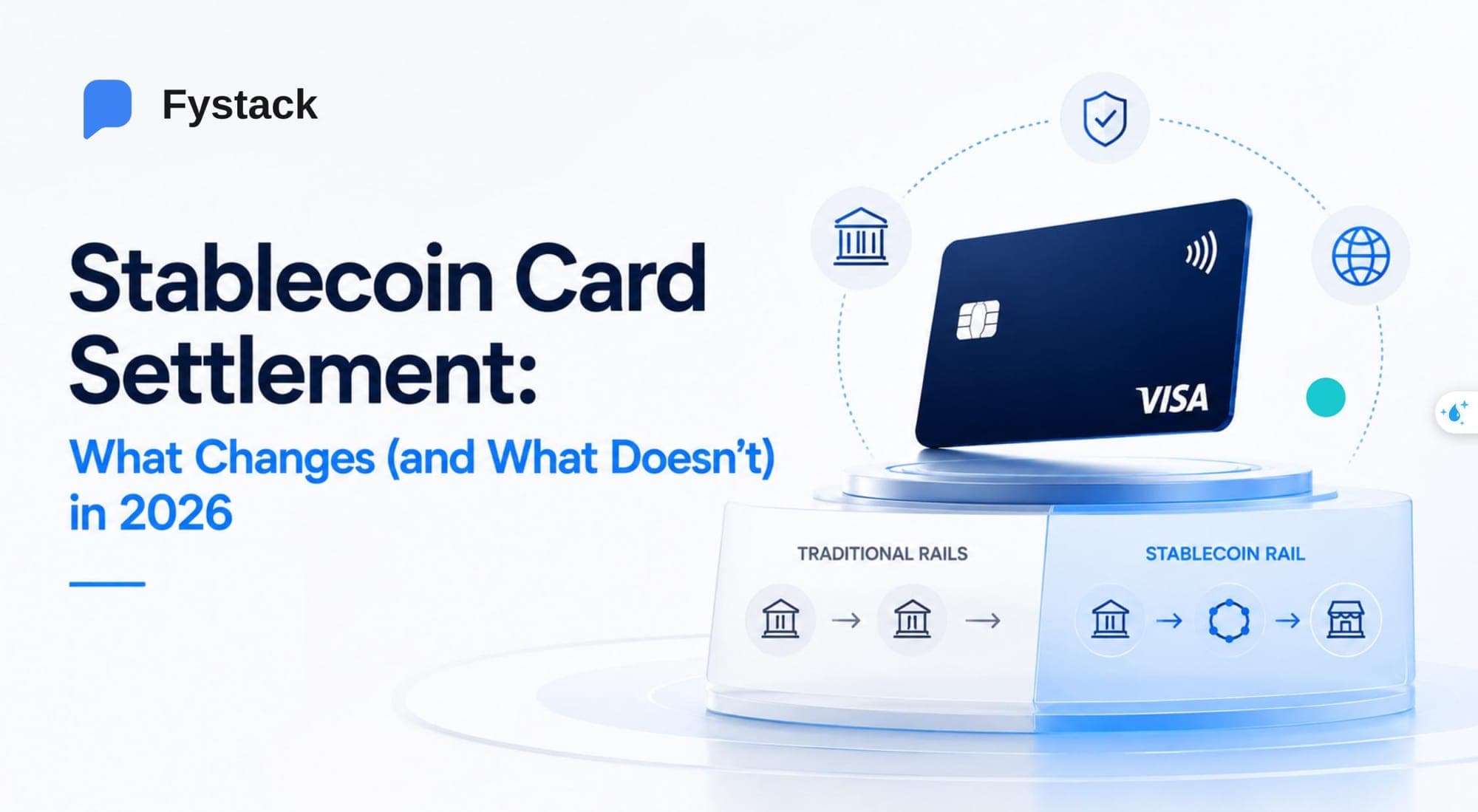
Stablecoin card settlement is when the transfer of money between the parties in the card system happens using stablecoins, instead of banking rails like ACH or Fedwire.
Card authorization and checkout work the same way as before, on Visa or Mastercard. What changes is the settlement layer behind the transaction, where money moves from the issuer to the acquirer, for example through programs like Visa's Stablecoin Platform (VSP).
This is not a card that lets someone spend stablecoins directly. That is a different product, built for consumers. Here, stablecoins are used behind the scenes to settle transactions between financial institutions, mainly banks and card issuers, fintechs and BaaS providers, issuer processors, and PSPs and acquirers.
Stablecoin settlement does not reinvent the card. It upgrades the financial infrastructure behind it.
Three things to remember
- Stablecoins do not make card payments faster. Authorization already happens almost instantly. What changes is how money moves between institutions after the transaction happens.
- The biggest value is not the "24/7" part. What matters is that treasury no longer needs to hold as much money just in case settlement falls on a weekend or holiday.
- Complexity doesn't disappear. It moves. Instead of depending entirely on banking rails, institutions now need to manage wallets, custody, compliance, blockchain infrastructure, and on-chain reconciliation.
1. What Is Stablecoin Card Settlement?
Card authorization does not change. Checkout does not change. The part that changes is what happens after the transaction: how money moves between the issuer and acquirer.
Today: Cardholder → Card Network → Issuer → Settlement Bank / ACH / Fedwire → Acquirer → Merchant
With stablecoin settlement: Cardholder → Card Network → Issuer → Stablecoin Settlement Rail → Acquirer / Settlement Partner → Merchant
Only one link in the chain changes: the funding layer between issuer and acquirer.

2. What Actually Changes?
The constraint on today's settlement isn't the card network, it's the banking rail underneath it. Fedwire, one of the two main settlement rails between US banks, runs about 22 hours a day, Monday through Friday, and is closed on weekends and Federal Reserve holidays. The Fed has approved a plan to extend Fedwire to Sundays and weekday holidays, but not before 2028, and Saturdays will still be closed even then. That gap is what stablecoin settlement fills.
The biggest change is not speed. It is control over when money moves.
With traditional settlement, treasury teams work around the banking system's schedule. If a payment needs to settle on Saturday, the institution may need to prepare liquidity before the weekend.
With stablecoin settlement, money can move whenever it is needed. Treasury teams can monitor balances and move funds continuously instead of planning around banking holidays and settlement windows.
In simple terms:
Traditional model: "When can the banking rail move the money?"
Stablecoin model: "When do we need to move the money?"
3. The Real Economic Benefit: Better Liquidity Management
Today, treasury teams often need to prepare liquidity in advance.
If weekend settlement is limited, they need to estimate how much money will be needed and keep enough funds available before the weekend starts.
The problem is that actual transaction volume is never perfectly predictable. The institution may end up holding more liquidity than it actually needs.
Stablecoin settlement changes this model. Instead of preparing a large buffer in advance, treasury can move and rebalance liquidity more continuously as settlement demand changes.
The benefit is not simply faster settlement. It is better use of capital. This does not mean stablecoins make settlement cheaper by default: the gain comes from holding less idle capital, not from the asset itself.
4. The Trade-off: Complexity Moves
Stablecoin settlement does not make payment infrastructure automatically simpler. It replaces some traditional banking constraints with a new set of operational requirements.
Traditional complexity: banking cut-off times, correspondent banks, prefunding, batch reconciliation.
New complexity: wallet and key management, blockchain and network dependency, stablecoin issuer risk, depeg and redemption risk, on-chain transaction monitoring, on-chain reconciliation, operational controls and recovery.
The complexity has not disappeared. It has moved. That means institutions need a different set of capabilities to manage it, starting with custody and reconciliation.

Custody. A settlement wallet is not just a place to store stablecoins. Once that wallet handles recurring settlement flows, it becomes part of the payment infrastructure. That means institutions need controls around who can initiate a transaction, who can approve it, how much can be transferred, when a transaction can be executed, how every transaction is recorded and audited, and what happens when a key or system fails. This is the same ground covered in more depth in what an MPC wallet actually does, now applied to card settlement.
Reconciliation. A card transaction and a blockchain transaction generate different records. The card system gives you a transaction ID, an authorization, a clearing record, and a settlement amount. The blockchain gives you a wallet address, a transaction hash, a token amount, and a timestamp. The challenge is connecting these two records reliably. At small volumes, this can be handled manually. At scale, it cannot. The settlement system needs to automatically match the card transaction with its corresponding on-chain movement of funds, which is the problem covered in the reconciliation approach for B2B stablecoin flows.
5. What Doesn't Change for Customers
For the cardholder, almost nothing changes. They still use the same card, pay through the same checkout flow, get the same authorization experience, and see the transaction in their usual currency. The merchant can also continue receiving fiat as usual. The stablecoin sits behind the payment, not in front of the customer.
Stablecoin does not have to replace the card. It can replace the settlement rail behind the card.
6. Should Banks and Fintechs Adopt It?
It makes more sense when:
- You have significant cross-border settlement volume.
- Weekend and holiday liquidity creates a real capital cost.
- Treasury efficiency is becoming a priority.
- Your settlement partners can already handle stablecoins.
- You have the custody and compliance infrastructure to operate them safely.
It may not be worth it yet when:
- Domestic fiat settlement already works efficiently.
- Your settlement volume is too small for liquidity savings to matter.
- Stablecoin liquidity or fiat off-ramps are limited in your market.
- Regulation is still unclear.
- Your organization is not ready to operate digital-asset custody and compliance.
| Area | What Changes | What to Evaluate |
| Treasury | From periodic funding to continuous liquidity management | Treasury needs the ability to rebalance based on actual demand, not a fixed schedule |
| Custody | From bank accounts to programmable wallets | Settlement wallets need a policy engine, role separation, and an audit trail, not a single private key held by one person |
| Reconciliation | From bank records to a mix of bank and blockchain records | You need an automated layer that maps transaction IDs and clearing records to transaction hashes and token amounts; this cannot be done manually at scale |
| Compliance | From banking controls to banking controls plus on-chain monitoring | You need visibility into wallet activity, not just bank account activity |
| Settlement | From batch, timing-dependent settlement to continuous settlement | You need to decide where stablecoin settlement sits in your existing payment stack, and whether to build or integrate |
Once settlement moves onto a stablecoin rail, it can extend beyond the issuer's back office. Merchants with cross-border flows or dollar-denominated treasuries may start asking to be paid in stablecoins directly, rather than having it settled behind the scenes. Further out, the same wallet and reconciliation infrastructure could support machine-initiated payments: Mastercard has launched Agent Pay for Machines for high-frequency, machine-initiated transactions, and Visa has completed hundreds of AI agent-initiated transactions through its agentic commerce initiative, both designed to clear over card rails, banks, or stablecoin rails depending on configuration.
The big change is not the card. It is the infrastructure behind it.
Stablecoin settlement does not change how a customer pays. It changes how financial institutions move and manage money after the payment happens. That shift can give treasury teams more flexibility and reduce the need to hold excess liquidity around banking cut-off times. But it also introduces new requirements around custody, compliance, transaction controls, and reconciliation.
So the real question for banks and fintechs is not "should we replace card payments with stablecoins?" It is "can stablecoin settlement improve our liquidity model enough to justify the new infrastructure required to operate it?" That is the decision institutions need to make in 2026.
FAQ
What is stablecoin card settlement?
It is when the funding transfer between the issuer, card network, and acquirer settles in a stablecoin instead of through ACH or Fedwire, while card authorization and checkout continue to run as normal on the existing network.
Does it replace Visa or Mastercard?
No. The card network still handles authorization and transaction routing as before. Stablecoins only change how the funding settles behind the scenes, not the network's role.
How is it different from settling through ACH or Fedwire?
The main difference is operating hours and how fast capital cycles. ACH and Fedwire run on banking hours and close on weekends and holidays. Stablecoin settlement can happen daily, independent of a traditional banking rail's schedule.
Do cardholders or merchants notice a difference?
Not today. Cardholders still swipe their card, get authorized instantly, and spend in their usual currency. Merchants still get paid in local currency.
What infrastructure does an issuer need to support this?
A connection to a stablecoin settlement rail, the ability to manage a stablecoin treasury, and, most importantly, custody infrastructure, meaning who holds the wallet and who has signing authority, plus compliance monitoring and a reconciliation process that matches on-chain records.
If your team is building the settlement or custody layer for stablecoin-funded cards, Fystack builds open-source, self-hosted custody infrastructure with a policy engine that enforces spend rules before signing.