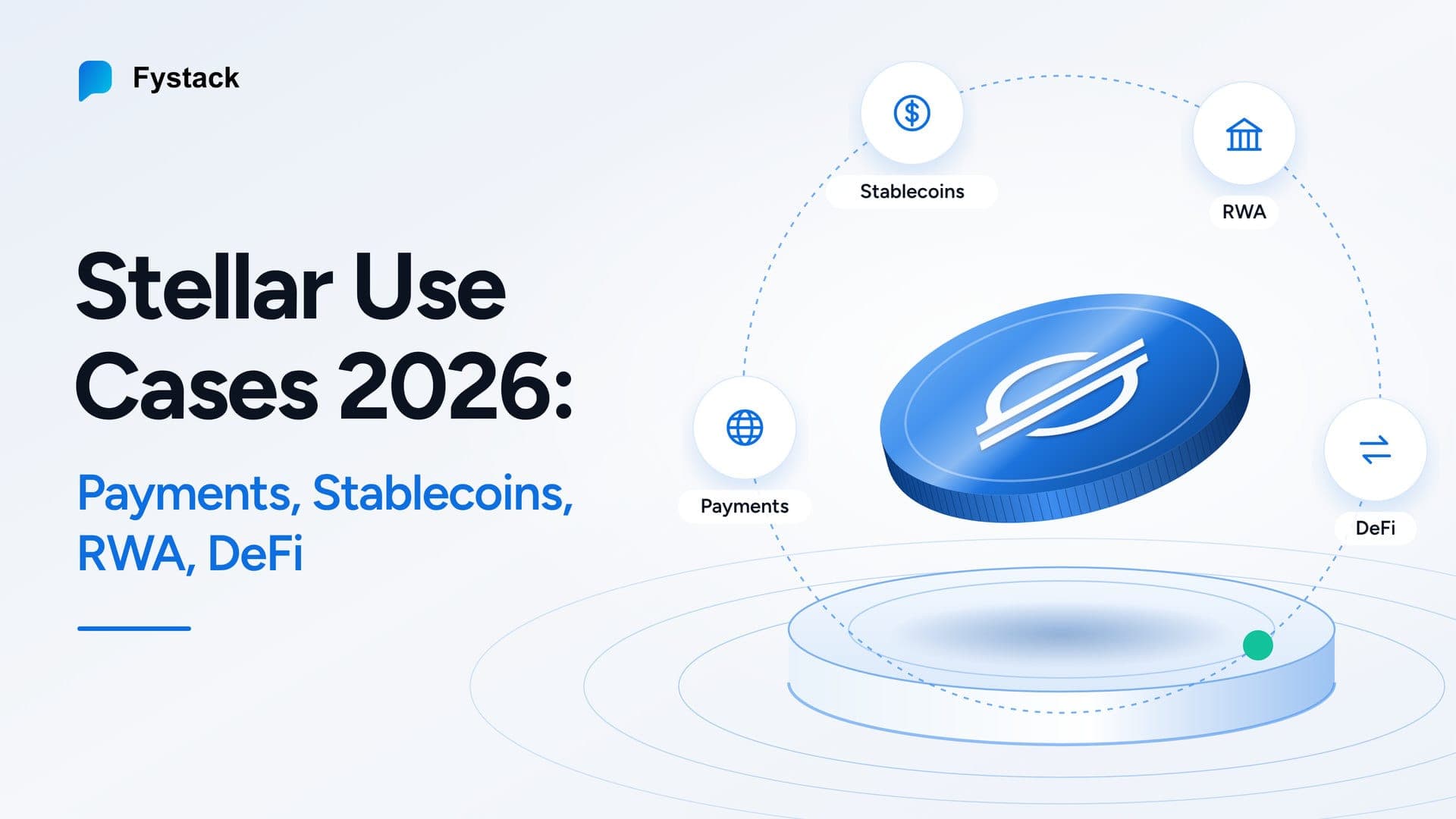
Stellar Use Cases 2026: Payments, Stablecoins, RWA, DeFi

Most blockchains try to do everything. Stellar was designed to do one job well: issue, move and settle money.
For years, that narrow focus looked like a limitation. In 2026, it looks like a head start. In the same quarter, DTCC, which oversees more than $114 trillion across U.S. capital markets, selected Stellar as one of the first public blockchains for tokenization, and MoneyGram launched its own regulated dollar stablecoin on the network, according to the Stellar Development Foundation (SDF).
So the useful question is no longer "Is Stellar fast?" It is "What can I build on it, and what will I need to run it in production?"
Key takeaways
- Stellar closes a ledger roughly every five seconds, and settlement is final once recorded.
- The minimum network fee is 0.00001 XLM per operation. Smart contract calls add a resource fee.
- Issuers get native controls (authorization, freeze, clawback), which is why regulated stablecoins and funds use it.
- All eight use cases fall into three jobs: issue, move or hold.
- Decide who holds the keys before writing code.
The Issue, Move, Hold Framework
Every product on Stellar does one of three jobs. It issues an asset: a stablecoin, a fund share, a bond. It moves that asset: a payment, a remittance, a payout. Or it holds the asset somewhere useful: a lending pool, a corporate treasury.
The split matters because each job fails in a different place. Issuance fails on compliance. Movement fails on liquidity and cash-out. Holding fails on key security and risk models. We call this the Issue, Move, Hold framework, and the eight use cases below map onto it.
Two network facts sit under all of them. Ledgers close roughly every five seconds, and records written to the ledger are irreversible. The minimum inclusion fee is 100 stroops (0.00001 XLM) per operation, about $0.000002 at an XLM price near $0.21 in early October 2026. The SDF reports average fees around one hundredth of a penny.
What Can You Build on Stellar? 8 Use Cases
| Use case | Job | Stellar building block | Live example |
| Payments | Move | ~5s finality, low base fee, x402/MPP | Agent payments on mainnet |
| Stablecoins | Issue | Asset flags, governed freeze, CCTP | USDC, EURC, MGUSD, YLDS |
| RWA | Issue | Native assets, Soroban | Centrifuge credit, Matrixdock gold |
| DeFi | Hold | Soroban smart contracts | Blend lending pools |
| Fintech | Move | Anchors and SEPs | MoneyGram Ramps |
| Remittance | Move | Anchors, stablecoins | MoneyGram, MGUSD |
| Treasury | Hold | Tokenized fund shares | Spiko T-bill funds |
| Tokenized securities | Issue | ISIN asset codes, issuer controls | DTCC, Franklin Templeton BENJI |
1. Payments
When a transfer costs a fraction of a cent, fees stop being a product decision. That opens flows card rails cannot price: micropayments, pay-per-call APIs and machine-to-machine billing. Agent payment protocols x402 and MPP are already live on Stellar mainnet. Low fees are not zero fees, though. Fees rise during surge pricing, and Soroban contract calls pay for the compute and storage they use.
2. Stablecoins
Stellar carries Circle's USDC and EURC, MoneyGram's MGUSD, and Figure's YLDS, which the SDF describes as the first SEC-registered yield-bearing dollar product on the network. Issuers choose Stellar for control. Asset flags let an issuer approve holders before they can receive a token, freeze a balance, or claw tokens back. The 2026 "Yardstick" upgrade added a governed freeze at the consensus level, and Circle's CCTP now connects Stellar USDC with 23 chains.
3. Real-World Assets (RWA)
Tokenized real-world assets on Stellar crossed $3 billion in June 2026, after $1 billion in January and $2 billion in April, per the SDF. The mix includes private credit through Centrifuge and gold through Matrixdock's XAUm. RWA is a representation problem. The token tracks something that lives off-chain, so the hard part is not minting. It is proving the asset exists and keeping both records in sync.
4. DeFi
Soroban, Stellar's smart contract platform, turns those assets into programmable collateral. Blend, the network's main lending protocol, lets anyone deploy isolated pools with their own collateral, oracle and risk settings. That flexibility cuts both ways. In February 2026, one Blend pool lost about $11 million in an attack that DefiLlama classifies as spot price manipulation. For DeFi on Stellar, oracle design is part of the product, not an afterthought.
5. Fintech Integrations
Most fintechs do not want to build a cash network. Stellar's answer is anchors: regulated businesses that convert between local money and on-chain assets through shared standards called Stellar Ecosystem Proposals (SEPs). Because the interface is standard, one integration can reach many providers. MoneyGram Ramps, for example, lets a wallet offer USDC cash-in and cash-out across more than 170 countries. For bulk payouts, the SDF maintains the open-source Stellar Disbursement Platform.
6. Remittance
Remittance is where Stellar's design meets the most demand. In Africa, sending money still costs 8.8% on average, according to the SDF. MoneyGram has used Stellar USDC for settlement since its 2021 partnership with the SDF, and MGUSD now reaches a network of more than 60 million customers. The pattern is simple: on-chain for the corridor, cash at both ends.
7. Treasury
Corporate cash often sits idle because moving it is slow. Tokenized money market funds change that. Spiko pitches its tokenized T-bill funds as a treasury tool for companies, and it was the largest single RWA issuer on Stellar as of late August 2026. A finance team can park surplus cash in a regulated fund and move shares in seconds instead of days. The new question is not yield. It is who signs, and under which approval rules.
8. Tokenized Securities and Funds
This differs from RWA in one way: the instrument has to fit existing securities infrastructure. DTCC plans to tokenize real-world assets on Stellar, and Franklin Templeton's BENJI fund runs on the network. Even naming follows market conventions: Stellar's docs recommend using the ISIN as the asset code for a stock or bond.
Why Regulated Finance Chooses Stellar
Three structural reasons explain the pattern.
Controls live in the protocol. Freeze, clawback and holder approval are native features, not custom code each issuer has to write and audit.
Costs and finality are predictable. A treasurer can plan around five-second, final settlement and fees that round to zero.
Distribution already exists. Anchors and MoneyGram connect on-chain balances to cash in the markets where access is the real problem.
In other words, Stellar does not win on raw speed. It wins because a compliance officer, a treasurer and a remittance agent can all use the same rail without asking for exceptions.
What Builders Should Decide Before Writing Code
Start with the job. An issuer, a payments app and a treasury product need different controls, so place your product in the Issue, Move, Hold framework first.
Then make three decisions early:
- Set asset flags before users open trustlines. Clawback applies only to trustlines created after the flag is set, so a late change will not cover existing holders.
- Split issuing and distribution accounts. Stellar's docs recommend this so a compromised hot key cannot mint unlimited supply.
- Decide who holds the keys. Issuer, distribution and treasury keys are each a single point of failure. Threshold signing (MPC) distributes signing authority so no single party holds the complete private key.
How Fystack Supports Building on Stellar
Stellar gives issuers the controls. It does not decide who signs, when a payment needs a second approver, or how your backend learns that money arrived. That custody layer is what every use case above needs, and it is the part we build.
1. An open-source Stellar MPC wallet
We built a Stellar MPC wallet and published the full code on GitHub. The private key is generated in shares across three nodes and is never assembled in one place. Every transaction is signed by 2 of the 3 nodes, so one compromised server cannot move funds.
The wallet already covers the operations most Stellar products start with:
- Payments and account creation, with fee estimates and memos
- Trustlines and custom assets, so it can hold a stablecoin or a tokenized fund share
- Swaps on the Stellar DEX, with a quote and a slippage guard
- Live balances and incoming payment tracking
One command starts the whole stack (three signing nodes, backend and UI) in Docker. A team can read the code, run it and test the signing flow before committing to anything.
2. Custody infrastructure you do not have to build
The wallet shows the signing works on Stellar. Running a product needs more than signing: approval rules, alerts and a deployment your compliance team accepts. Building that layer in-house usually takes longer than building the product itself.
Fystack already runs this layer in production. mpcium, our MPC signing engine, supports Ed25519, the signature scheme Stellar accounts use. Around it sit a policy engine (USD limits, address whitelists, roles, time windows, 1h/6h/24h velocity checks), webhooks for deposits and withdrawals, and self-hosted deployment on your own infrastructure. Stellar is not yet one of the networks on the platform, but the custody layer is already built, so a Stellar team starts from a working foundation instead of a blank repo.
| Use case | What custody has to handle | What Fystack provides |
| Stablecoins | An issuing key that can mint supply | Issuing and distribution accounts as separate MPC wallets, so no single key can mint |
| RWA | Trustlines and custom assets for every holder | Trustline and custom asset payments, already in the Stellar wallet |
| DeFi | Interacting with protocols safely | MPC signing core plus contract rules in the policy engine (Soroban signing is not in the wallet yet) |
| Fintech | Knowing when funds arrive and leave | Deposit and withdrawal webhooks with idempotency keys |
| Remittance | Converting between assets on the way out | DEX path payments with a slippage guard, plus velocity limits |
| Treasury | Approvals, roles and whitelisted destinations | Policy engine with limits, address book, roles and approval rules |
| Tokenized securities | Keys that stay inside a regulated entity | Self-hosted signing cluster on your own infrastructure |
The pattern is the same across all eight. Stellar decides what an asset is allowed to do. Custody decides who is allowed to move it. We build that second part as open source, so you can read it before you trust it.
For a deeper look at the trade-offs, see our Stellar custody guide and what an MPC wallet is.
What Comes Next
The next phase on Stellar is less about new features and more about reach. The SDF's roadmap points to confidential tokens and payments made by AI agents, while issuers keep adding funds and stablecoins.
For builders, the opportunity sits in the layer that connects them: the wallets, ramps and treasury systems people will use without ever thinking about the chain underneath.
If you are building on Stellar, start with our open-source Stellar MPC wallet, then talk to us about the custody layer around it.
FAQ
What can you build on Stellar?
Payments, stablecoins, RWA, DeFi, fintech ramps, remittance, treasury tools and tokenized securities. Most products do one of three jobs: issue, move or hold assets.
How much does a Stellar transaction cost?
The minimum fee is 100 stroops (0.00001 XLM) per operation, a tiny fraction of a cent. Smart contract calls add a resource fee, and fees rise during surge pricing.
How fast is settlement on Stellar?
Ledgers close about every five seconds, and transactions are final once recorded.
Can I issue a regulated stablecoin on Stellar?
Stellar offers native issuer controls such as holder authorization, freezing and clawback. Whether you can issue one legally depends on licensing in your jurisdiction.
Does Fystack support Stellar?
Fystack has an open-source Stellar MPC wallet that signs payments, trustlines and DEX swaps with 2-of-3 threshold signatures. Its custody infrastructure (policy engine, webhooks, self-hosting) is ready for teams building on Stellar; Stellar is not yet a listed network on the platform.