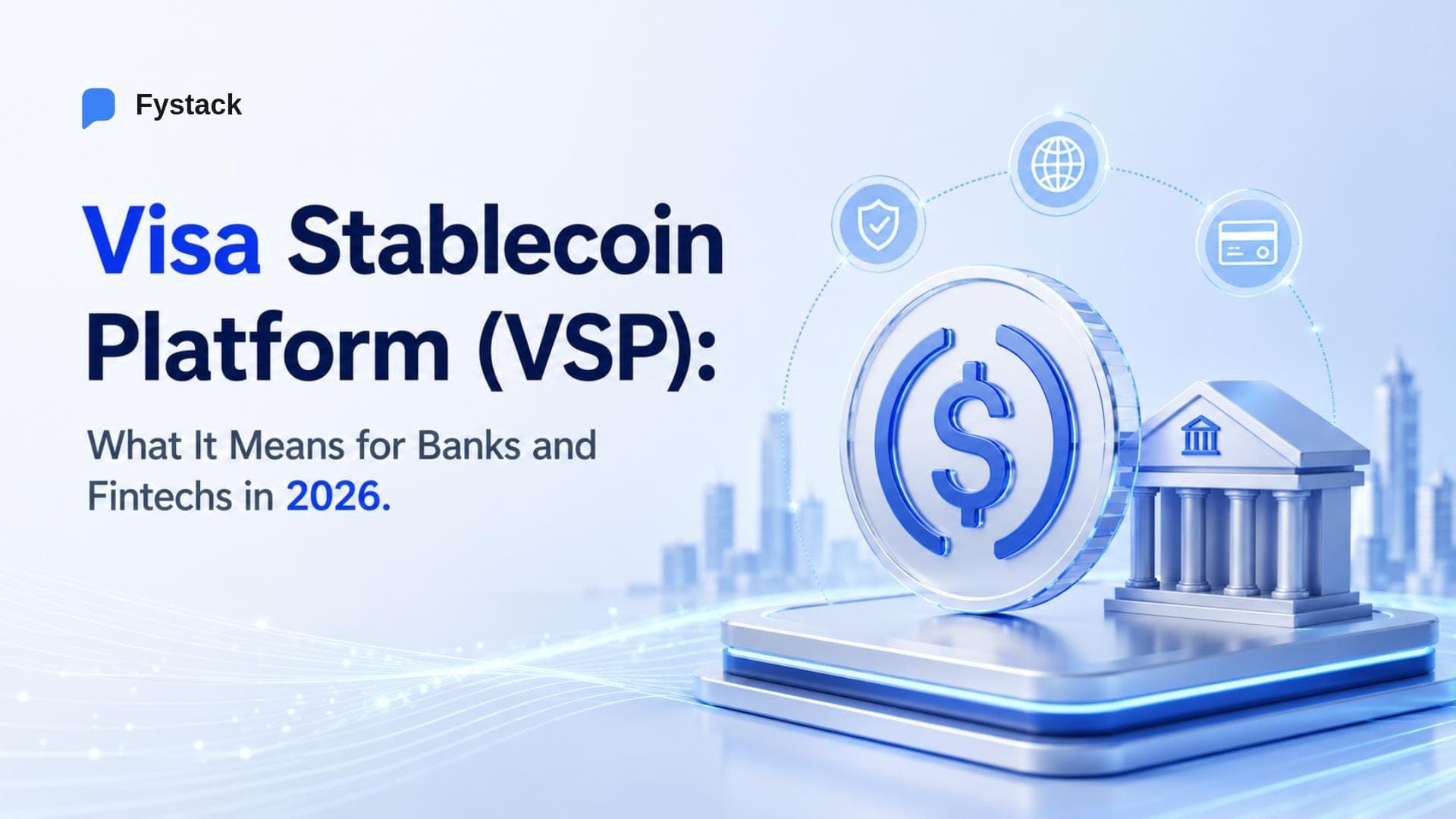
Visa Stablecoin Platform (VSP): What It Means for Banks and Fintechs in 2026

TL;DR
The Visa Stablecoin Platform (VSP) is Visa's enterprise infrastructure for minting, moving, and managing Open USD, launched in limited beta on July 16, 2026. Access requires an existing Visa Access ID and Business Identification (BID) number, so VSP is not open to any business today, only Visa's existing client base. VSP offers two paths: Wallet-as-a-Service, where Visa provides key-management technology but the client remains the custodian, or Bring Your Own Wallet, where VSP only handles on-ramp and off-ramp while an existing custody provider handles minting, burning, and transfers. It supports Ethereum, Solana, and Tempo today, and Open USD only.
Visa Stablecoin Platform: Key Facts
| Field | Detail |
| Launch date | July 16, 2026 |
| Current status | Limited beta, with volume and geographic limits; no public GA date |
| Access requirement | Existing Visa Access ID and Business Identification (BID) number required |
| Supported stablecoin | Open USD (OUSD) only; not USDC, USDT, PYUSD, RLUSD, or EURC |
| Supported chains | Ethereum, Solana, and Tempo |
| Custody model | Two options: Wallet-as-a-Service (Visa provides key-management tech, client is custodian) or Bring Your Own Wallet (client's existing provider handles custody, VSP handles ramps only) |
| API | Not yet available; portal and documentation are live, API access is "coming soon" |
| Pricing | Not publicly disclosed; available through Visa sales contact only |
| Official source | Visa Stablecoin Platform product page |
Who Should Use the Visa Stablecoin Platform? Who Probably Shouldn't?
You can likely evaluate VSP if:
- You already hold a Visa Access ID and Business Identification (BID) number, meaning you have an existing commercial relationship with Visa as an issuer, acquirer, or program partner.
- You specifically need Open USD, not another stablecoin, for treasury, settlement, or liquidity operations.
- Ethereum, Solana, or Tempo cover the chains your product needs.
- You can operate within Visa's current volume and geographic limits during the beta.
You probably cannot use VSP yet if:
- You have no existing Visa relationship. Access requires a Visa Account Executive to issue you a BID; there is no public sign-up.
- You need a stablecoin other than Open USD. USDC, USDT, PYUSD, RLUSD, and EURC are not supported.
- You need chains beyond Ethereum, Solana, and Tempo.
- You need an API today. Integration currently runs through the portal; programmatic access is not yet live.
- You are a pure crypto exchange, remittance operator, or stablecoin issuer without a card network relationship. Nothing in Visa's materials suggests VSP is open to this segment during the beta.
What Does VSP Replace? VSP vs. Fireblocks, BitGo, Copper, and Fystack
VSP is actually two different products wearing one name, and which one you're comparing changes the answer completely.
Path 1, Wallet-as-a-Service, is a custody product. Think of it like signing up for Fireblocks or BitGo: Visa runs the wallet technology, you log into a dashboard, and you manage Open USD through it. This path genuinely competes with custody vendors, but only for Open USD specifically. It does not touch any other asset you hold.
Path 2, Bring Your Own Wallet, is not a custody product at all. It's a payment rail. Picture it like adding a new payment gateway on top of a bank account you already have: VSP just moves fiat in and out (on-ramp and off-ramp) to fund Open USD. Your actual custody, meaning who holds the keys and signs transactions, stays exactly where it already is, whether that's Fireblocks, BitGo, Copper, or a self-hosted setup like Fystack. VSP never touches that part in this path.
So the honest one-line answer: if you pick WaaS, VSP replaces a custody vendor for Open USD. If you pick BYOW, VSP replaces nothing, it just adds a funding pipe on top of the custody you already run.
Where Fystack specifically differs from Fireblocks, BitGo, and Copper: those three are SaaS-only. You never run the infrastructure yourself, you always operate inside their hosted environment. Fystack works either way: you can self-host the MPC engine on your own servers, so no third party ever touches your keys, or use Fystack's hosted version if you want a managed option without giving up an open-source stack you can audit or move off later. That flexibility, self-hosted or hosted, on your terms, is what "self-hosted custody infrastructure" means in the rest of this article, and it's the piece VSP's Wallet-as-a-Service does not offer today: with WaaS, you're inside Visa's environment, full stop.
| Dimension | VSP Wallet-as-a-Service | Fireblocks, BitGo, Copper (SaaS-only) | Fystack (self-hosted or hosted) |
| Assets supported | Open USD only | Broad, dozens of assets typically | Any supported stablecoin or token |
| Chains supported | Ethereum, Solana, Tempo | Broad, most major chains | Any supported chain |
| Where infrastructure runs | Inside Visa's environment only | Inside the vendor's environment only | Your choice: your servers or Fystack-hosted |
| Access requirement | Existing Visa Access ID and BID number | Commercial sign-up, publicly available | No third-party access requirement |
| API today | Not yet, "coming soon" | Mature, production APIs and SDKs | Available now, self-managed |
Where Does Custody Actually Sit in VSP?
This is the question buyers should ask before anything else, and the answer differs by path.
With Wallet-as-a-Service: per Visa's own product documentation, Visa provides the key-management technology and the client remains its own custodian, with maker/checker dual approval on sensitive operations, device-bound passkey signing instead of shared credentials, and destination-wallet allowlisting. Visa has not disclosed whether the underlying architecture is MPC, HSM-backed, or another model, so treat "you remain your own custodian" as a legal and operational framing until Visa publishes the technical architecture.
With Bring Your Own Wallet: custody stays exactly where it already is, with your existing MPC or custody provider running its own withdrawal and approval workflow. VSP never touches signing or key material in this path; it only moves fiat in and out through the on-ramp and off-ramp.
This means the practical answers to "who signs" and "who's liable" depend on which path you pick: with WaaS, your organization signs (via passkey) and Visa's terms govern what "custodian" means in the beta agreement, details not yet public. With BYOW, your existing provider's terms and architecture apply unchanged, whether that is a vendor like Fireblocks or self-hosted MPC infrastructure you operate yourself. AML and transaction monitoring responsibility, and which KYT vendor screens transactions, are not detailed in Visa's public materials for either path.
Which Stablecoins and Chains Does VSP Support?
Open USD only, on Ethereum, Solana, and Tempo, as of the beta. Visa has not published a timeline for adding USDC, USDT, PYUSD, RLUSD, EURC, or tokenized deposits to VSP, and has not confirmed additional chains beyond the three above. If your roadmap depends on multi-stablecoin or multi-chain support, that is not available in VSP today regardless of implementation path.
Does VSP Have an API for Developers?
Not yet. Visa's product page states the front-end portal and documentation are available now so teams can review specs and plan integration, but API access is "coming soon." No SDKs, language bindings, sandbox environment, or rate limits have been published. Teams evaluating VSP today are evaluating a portal-driven beta, not an API-first integration.
How Much Does VSP Cost?
Not disclosed. Visa has not published licensing fees, per-transaction fees, custody fees, minting fees, or settlement fees for VSP. Access and pricing go through a Visa Account Executive on a contract basis. Any cost comparison against Fireblocks, BitGo, Copper, or self-hosted infrastructure cannot be made responsibly until Visa publishes pricing, and any figure you see elsewhere online should be treated as speculation.
What Compliance and Security Standards Does VSP Meet?
Confirmed from Visa's materials: maker/checker dual approval on sensitive operations, device-bound passkey signing, and destination-wallet allowlisting. Not confirmed in Visa's public materials: SOC 2, ISO 27001, or PCI DSS certification specific to VSP, which KYT or transaction-screening vendor is used, Travel Rule and GENIUS Act compliance mapping specific to VSP, or GDPR-specific data handling terms. Visa as a company carries extensive compliance infrastructure, but none of that has been mapped explicitly onto VSP in public documentation. Institutions with strict vendor-compliance checklists should request this directly from their Visa representative rather than assume standard terms apply.
Is VSP Live in Production, or Still in Beta?
Still beta, with volume and geographic limits, and no public general-availability date. Visa has not named beta clients, published a case study, or disclosed transaction volume, TPS, or the number of institutions participating. For a bank evaluating whether to build a roadmap around VSP, the honest current state is: a beta program with a small number of unnamed participants, not a production-proven platform with a public track record yet.
How Do You Migrate to VSP From an Existing Custody Provider?
Visa has not published a migration guide, and no public detail exists on seed import, wallet address portability, or transition timelines. The Bring Your Own Wallet path is the lower-friction option for teams already on another provider, since it adds Open USD ramps without requiring a custody migration at all. Wallet-as-a-Service would require a genuine migration if you want to move existing custody workflows onto Visa's key-management stack, and that process is not documented publicly as of this beta.
What's the ROI of Using VSP?
Not quantifiable from public information, because pricing is not published. The general pitch behind managed platforms like VSP is fewer engineers needed to build custody and compliance tooling in-house, faster time to a working stablecoin product, and lower ongoing compliance overhead from relying on an established, regulated partner. Whether that pitch beats the cost of an existing custody vendor or a self-hosted build depends entirely on pricing Visa has not disclosed, so treat any ROI claim, including this one, as directional until you have a quote.
If You're Not Eligible for VSP Yet, What Should You Do?
| If you are... | Reasonable next step |
| A bank or PSP with an existing Visa relationship | Contact your Visa Account Executive to scope eligibility and beta timing for WaaS or BYOW. |
| A fintech needing to launch in 1-2 months | Use a custody vendor or [self-hosted MPC infrastructure](https://fystack.io/blog/self-hosted-mpc-wallet-infrastructure-2025) available today, independent of VSP's beta timeline. |
| A multi-chain exchange | VSP's three chains and single asset will not cover your needs today; use multi-chain custody infrastructure. |
| A PSP wanting broad stablecoin settlement, not just Open USD | Build or buy custody that supports today's stablecoins now; revisit VSP once Visa confirms multi-asset support. |
| Already on Fireblocks, BitGo, Copper, or similar | If eligible, VSP's Bring Your Own Wallet path adds Open USD ramps without requiring a custody switch. |
Visa's Broader Stablecoin Strategy
VSP is one step in a build-out Visa started in 2021: live USDC settlement (December 2025), settlement expanded to nine blockchains reaching a $7 billion annualized run rate (April 2026), a privacy-focused settlement pilot with Brale on Canton Network (June 4, 2026), a tokenized-deposits initiative announced at Visa's Payments Forum (June 10, 2026), co-founding the 140-plus partner Open USD consortium with Stripe, Mastercard, American Express, BlackRock, Coinbase, Google, Ripple, BNY, Standard Chartered, and early adopters like DBS Bank (June 30, 2026), and now VSP itself (July 16, 2026). Read as a sequence, this is Visa building settlement, deposit, and onboarding infrastructure across every layer a bank might need, so it stays in the middle of stablecoin flows regardless of which token or chain wins.
Conclusion
VSP is real infrastructure, not vaporware, but it is early: beta only, one asset, three chains, no public API, no published pricing, and access limited to Visa's existing client base. If you already have a Visa relationship and only need Open USD, Bring Your Own Wallet is likely the lowest-friction way to try it without touching your existing custody stack. If you don't have that relationship, or need multi-chain, multi-asset custody today, that gap is exactly what self-hosted custody infrastructure like Fystack is built to close, on your own timeline, not Visa's beta list.
FAQ
What is the Visa Stablecoin Platform (VSP)?
VSP is Visa's enterprise platform for minting, moving, and managing Open USD, launched in limited beta on July 16, 2026, with access restricted to institutions that already hold a Visa Access ID and BID number.
Who can use the Visa Stablecoin Platform?
Only institutions with an existing Visa commercial relationship, since access requires a Visa Access ID and Business Identification number issued through a Visa Account Executive. There is no public sign-up.
Does VSP replace custody providers like Fireblocks or BitGo?
Only if you choose the Wallet-as-a-Service path, and only for Open USD. The Bring Your Own Wallet path keeps your existing custody provider in place and only adds Open USD on-ramp and off-ramp through VSP.
Who holds the keys in VSP?
With Wallet-as-a-Service, Visa provides the key-management technology but the client remains the custodian, per Visa's own documentation. With Bring Your Own Wallet, your existing custody provider holds the keys exactly as it does today.
Which stablecoins and chains does VSP support?
Open USD only, on Ethereum, Solana, and Tempo. USDC, USDT, PYUSD, RLUSD, EURC, and other chains are not currently supported.
Does VSP have an API?
Not yet. The portal and documentation are live, but API access is described as "coming soon" with no confirmed date.
Is VSP available in production today?
It is in limited beta with volume and geographic caps. Visa has not named beta clients or published production volume or case studies.