GENIUS Act vs. MiCA vs. Asia Sandboxes: Mapping the 2026 Stablecoin Regulatory Triad

Traditional Finance is no longer standing on the sidelines. In 2026, institutions are transforming blockchain into Financial Rails to upgrade their core systems. The emergence of PYUSD (PayPal), EURCV (Société Générale), and BUIDL (BlackRock) illustrates a new model of capital circulation: Institutional Stablecoins are no longer just supporting tools, they have become the Transaction Layer operating global cash flows.
Once the “rules of the game” become fragmented across jurisdictions, the key question of 2026 is no longer about selecting the fastest chain or the cheapest network.
Instead, it becomes a deeper architectural challenge: how to design infrastructure that allows capital to move efficiently across borders while remaining fully compliant within each regulatory domain.
Regulatory Shift 2026: Stablecoins Transitioning from Crypto Assets to Payment Infrastructure
2026 marks the definitive moment stablecoins exit the legal "gray area" to assume their role as a widely recognized payment infrastructure layer. Major markets are no longer debating whether to regulate stablecoins; instead, they have shifted toward standardizing how they are managed.
According to the EY-Parthenon Stablecoin Survey, 13% of financial institutions have already operationalized stablecoins in production environments, while 54% plan to integrate them within the next 6-12 months.

Simultaneously, the market scale has reached a critical mass necessary for infrastructure. Based on a CEX.IO report aggregated via Yahoo Finance, the total stablecoin supply hit approximately $310-315 billion by the end of Q1/2026.
- The US: Entering the formal rulemaking phase following the GENIUS Act.
- Europe: Officially enforcing MiCA on a broad scale.
- Asia: Continuing to refine regulatory sandboxes and accelerating production deployment.
This represents a fundamental shift: stablecoins are no longer viewed as peripheral crypto assets but as core components of global payment infrastructure. Once categorized as infrastructure, the narrative shifts from pure technology to how capital flows are routed across different legal frameworks.
For a deeper dive into designing compliance systems in this context, refer to: Crypto Regulatory Compliance for Web3 & Fintech 2026.
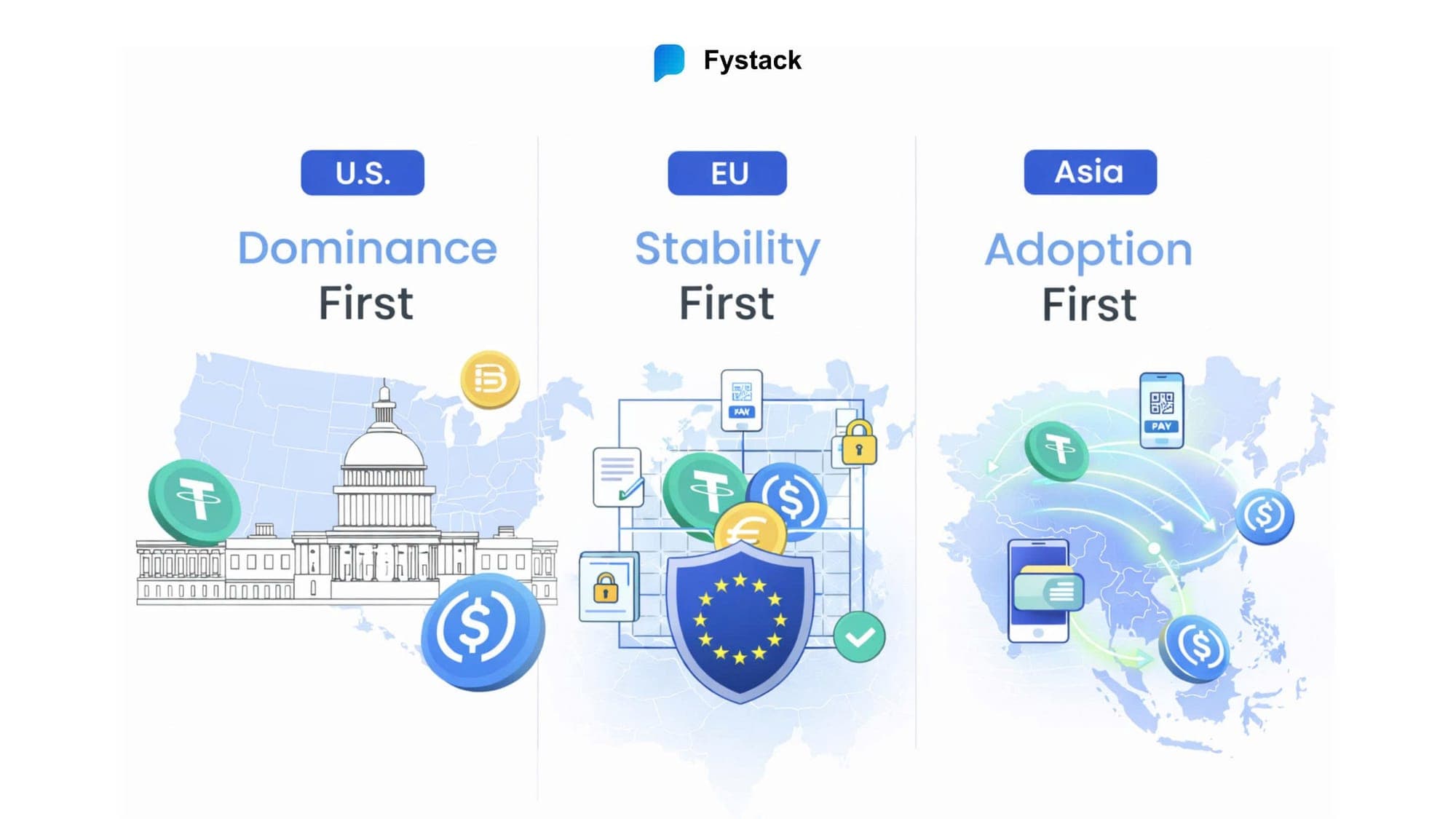
Three Global Power Poles: US – Europe – Asia
The US: When Stablecoins Become an Extension of the USD System

The US is in no rush to launch a CBDC (Central Bank Digital Currency). Instead, they are transforming private stablecoins into an extension of the US Dollar. With the GENIUS Act, every stage from issuance and reserves to operations - falls under the supervision of federal financial institutions.
Specifically by 2026, the concept of "Qualifying Stablecoin" was born, clearly distinguishing stablecoins backed by the Fed with the highest liquidity priority. This approach creates a high-trust environment, nearly equivalent to bank deposits, especially for enterprises needing USD liquidity and wanting to operate at scale.
However, this level of control significantly increases infrastructure requirements. Systems must not only process transactions but also integrate Real-time Auditing (API) so regulators can monitor reserves 24/7. Compliance is no longer a final check but a part of execution.
This brings two major benefits:
- Creating maximum trust and Bank-grade stability for stablecoins.
- Directly connecting to capital markets and the Fed's reserve system.
The flip side is the intense level of supervision. For businesses, this means:
- It is impossible to operate stablecoins without KYT (Know Your Transaction) and AML systems deeply integrated at the protocol level.
- Every transaction must have the capability for instant auditing, tracing, and tax reporting.
- Therefore, the US is suitable for enterprises with large capital structures needing to leverage USD liquidity, but it requires infrastructure designed with "Compliance as Core," not an add-on.
Europe: When Stability Is Prioritized Over Performance

In contrast to the US, Europe approaches stablecoins from a systemic risk control perspective. MiCA is not merely a set of regulations; it is a framework aimed at ensuring stablecoins do not create any contagion risk for the traditional financial system.
According to 2026 updates from KuCoin Research, MiCA in 2026 has become a strictly enforced framework, forcing businesses to choose between absolute compliance or being eliminated from the market.
A key point in 2026 is the application of Volume Caps:
- Stablecoins not pegged to the Euro (such as USDT, USDC) are limited to a threshold of €200 million/day for payment purposes.
- Additionally, the ban on direct interest payments on stablecoins is strictly enforced to prevent them from becoming speculative tools.
This approach creates an environment with very high legal certainty, close to the standards of the EU's traditional banking system. From an operational perspective, Europe is not the place to optimize profits from idle capital, but the place to ensure absolute safety and transparency.
Therefore, common strategies include:
- Using the EU as a Custody and Legal Hub.
- Accepting the shift toward Euro-stablecoins (such as EURCV) to avoid the transaction volume trap.
- Optimizing auditing and Asset Segregation according to MiCA standards to protect investor interests.
Asia: When Adoption Is Placed Before Legal Perfection

While the US and Europe focus on building legal frameworks before expansion, many Asian nations choose a different path: practical deployment in parallel with finalizing laws.
2026 marks the explosion of infrastructure connection projects like mBridge, where institutional stablecoins are put into production to directly solve cross-border payment problems. Instead of waiting for a complete set of laws for every situation, countries like Singapore (MAS) and Hong Kong prioritize standards for Redemption and Interoperability.
This makes Asia a suitable environment for businesses needing fast and flexible deployment. The difference in this region lies in:
- Prioritizing practical and urgent use cases (remittances, B2B payments for SMEs).
- Leveraging Sandboxes to scale quickly before full standardization.
- Directly connecting stablecoins with CBDC systems and regional banks.
However, this flexibility comes with a challenge: businesses must be more proactive in designing systems with the ability to "retro-adapt" as legal regulations gradually tighten over time.
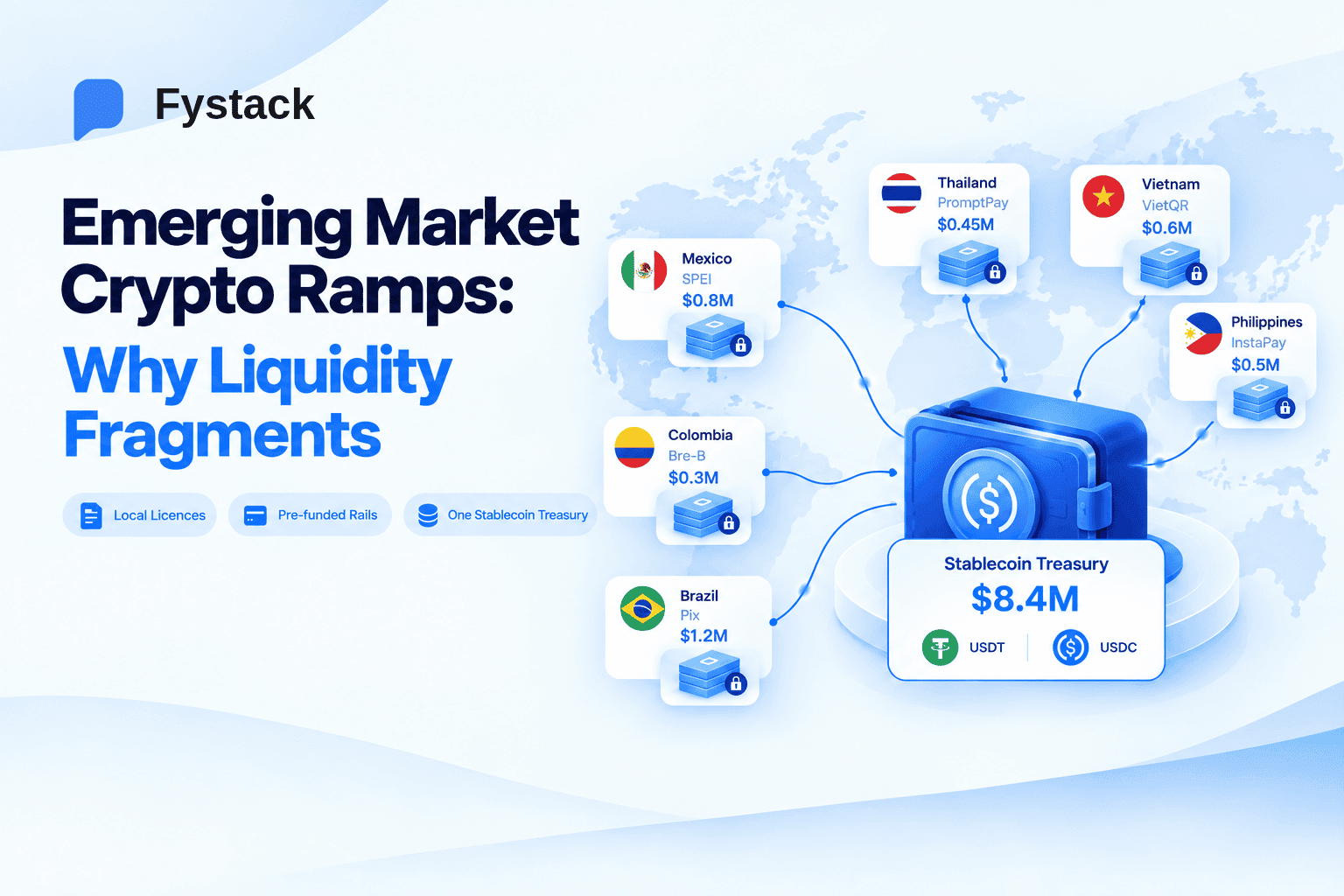
Liquidity Fragmentation
Despite the massive potential, a critical issue has emerged: Liquidity Fragmentation. When each region operates under its own set of laws, capital becomes trapped in "islands":
- Assets on Ethereum cannot easily flow to Solana in a compliant manner.
- Assets compliant with US laws cannot automatically match orders with assets compliant with EU laws.
This complexity creates a significant operational barrier. Businesses face the challenge of tracking asset statuses across multiple chains, wallets, and legal environments. Without a unified solution, Capital Efficiency will be severely hindered.
MPC & Institutional Grade Infrastructure: The Solution for 2026
To solve the aforementioned puzzle, MPC (Multi-Party Computation) technology has emerged as an architectural revolution, helping to harmonize security with operational flexibility.
1. The Principle of "Threshold Signatures"
MPC eliminates the "Single Point of Failure" by splitting the private key into multiple Key Shards stored independently. Signatures are generated at the cryptographic layer without ever needing to reconstruct the original private key.
2. Turning Compliance into "Code" (Programmable Policy)
This is the strategic weapon for Web3 CEOs. MPC systems allow for the setup of complex filtering layers:
- Automated Travel Rule: Per 2026 FATF regulations, the MPC system automatically exchanges identity information (VASP-to-VASP) and screens Sanction lists before the final key shard is activated.
- Multi-layer Approval: Small transactions are auto-signed, while large transactions require mandatory confirmation from the CFO/CEO via an isolated device.
3. Solving the "Chain-Agnostic" Problem
Since MPC operates at the cryptographic level (off-chain), businesses can manage assets on Ethereum, Solana, or Layer 2s through a single unified interface. This facilitates the coordination of cross-border liquidity without having to rewrite compliance rulebooks for every individual chain.
Conclusion
A new financial architecture is taking shape, where stablecoins act as the liquidity circulation layer, RWA (Real World Assets) optimize capital efficiency, MPC ensures security and compliance, and aggregation allows businesses to control the entire system.
The difference lies not in the individual components, but in how they are designed to work together within a fragmented legal environment. At this level, building financial infrastructure is no longer a pure technology problem.
It is an architectural challenge, where businesses must balance speed, efficiency, and compliance on a global scale.
At Fystack, we are building the infrastructure to help enterprises answer that question with confidence.
Not ready yet?
Join our Telegram to follow architecture updates and product discussions. https://t.me/+9AtC0z8sS79iZjFl
FAQ
What are institutional stablecoins and how are they different from traditional stablecoins?
Institutional stablecoins are fiat-backed digital assets designed specifically for regulated financial environments, where compliance, auditability, and integration with traditional finance are critical. Unlike retail-focused stablecoins used primarily for trading, institutional stablecoins are built to support treasury operations, cross-border settlements, and large-scale capital flows under regulatory oversight.
Why are stablecoins becoming a core part of enterprise treasury management?
Stablecoins significantly reduce the cost and latency of cross-border payments, enabling near real-time settlement at a fraction of traditional fees. This allows companies to improve cash flow efficiency, optimize working capital, and operate with greater financial agility. As adoption grows, stablecoins are increasingly used as the transaction layer for global treasury operations.
How do regulatory differences between the US, Europe, and Asia impact stablecoin usage?
Each region follows a distinct regulatory philosophy. The US integrates stablecoins into the existing financial system with strict federal oversight, Europe prioritizes systemic stability through frameworks like MiCA, and Asia focuses on rapid adoption via sandbox models. These differences require businesses to design infrastructure that can route transactions and enforce compliance rules dynamically across jurisdictions.
What is liquidity fragmentation and why is it a problem for businesses?
Liquidity fragmentation occurs when capital is distributed across multiple blockchains, wallets, and regulatory environments, making it difficult to manage and reconcile. Even if sufficient liquidity exists, businesses may struggle to coordinate it efficiently, leading to operational complexity, delayed settlements, and reduced capital efficiency.
Why is compliance becoming the main bottleneck in stablecoin infrastructure?
As stablecoins transition into regulated financial infrastructure, compliance requirements such as AML, KYT, and reporting are no longer optional. Businesses must ensure that every transaction meets jurisdiction-specific rules, which increases the complexity of system design. Without integrated compliance capabilities, scaling stablecoin operations becomes difficult and risky.
How does the GENIUS Act affect stablecoin adoption in the US?
The GENIUS Act establishes a federal framework for stablecoins, requiring full reserve backing, transparency, and regulatory supervision. This increases trust and enables institutional adoption, but also raises the bar for infrastructure, as companies must support real-time auditing, transaction monitoring, and strict compliance integration.
What role does MiCA play in shaping the European stablecoin market?
MiCA provides a comprehensive regulatory framework for stablecoins in the EU, focusing on transparency, reserve management, and consumer protection. While it creates high legal certainty, it also imposes constraints such as limits on non-euro stablecoins and restrictions on yield generation, making Europe more suitable for custody and compliance hubs rather than capital optimization.
Why is Asia considered a fast-moving region for stablecoin adoption?
Many Asian markets prioritize real-world implementation through regulatory sandboxes and close collaboration with banks. This allows stablecoins to be deployed quickly in use cases like remittances and B2B payments, even as legal frameworks continue to evolve. However, businesses must design systems that can adapt to future regulatory changes.
What is MPC and why is it critical for institutional stablecoin infrastructure?
MPC (Multi-Party Computation) is a cryptographic technology that allows private keys to be distributed across multiple parties, eliminating single points of failure. More importantly, it enables businesses to embed compliance policies directly into transaction execution, ensuring that approvals, risk checks, and regulatory requirements are enforced automatically.
How can businesses design infrastructure to operate across fragmented regulations?
Companies need modular infrastructure that combines multi-chain asset management, policy-based transaction controls, and integrated compliance monitoring. By using solutions such as MPC-based wallets and liquidity aggregation layers, businesses can unify operations across jurisdictions while maintaining both efficiency and regulatory alignment.