Top 3 Agentic Payment Protocols in 2026: What Fintechs Need to Know

Ted Nguyen
Author
BD & Growth @Fystack
TL;DR
- Three protocols launched in the past year solve different parts of autonomous agent payments: x402 for on-demand, AP2 for pre-authorized, and MPP for session-based.
- x402 (Coinbase/Cloudflare, May 2025): per-request stablecoin payments at the HTTP layer, no account setup, 154 million transactions since launch.
- AP2 (Google, September 2025): user signs a spending mandate upfront; agent draws from it autonomously, backed by 60-plus organizations including Amex, PayPal, and Mastercard.
- MPP (Stripe/Tempo, March 2026): session-based billing where the agent consumes and settles at close; IETF draft submitted March 30, 2026.
Every AI agent building on stablecoins eventually hits the same wall: it needs to pay for external services, and the payment stack was built for humans. Account creation, subscription tiers, billing cycles: each step requires a human action that breaks autonomous operation.
Three protocols launched in the past year make this solvable. x402 (Coinbase/Cloudflare), AP2 (Google), and MPP (Stripe/Tempo) are now live, each handling a different part of how agents pay on their own. In this post, we cover how each one works, which payment pattern it is designed for, and how fintech teams should choose.
Why AI Agents Need Payment Protocols
A payment protocol is a machine-readable agreement on how value transfers happen between two systems without requiring real-time human approval.
For human payments, trust comes from accounts, contracts, and relationship history. AI agents have none of those. The guarantees have to be built into the protocol itself. Four properties determine whether a payment protocol is fit for autonomous operation:
Table 1. Four Properties of an Agent-Ready Payment Protocol
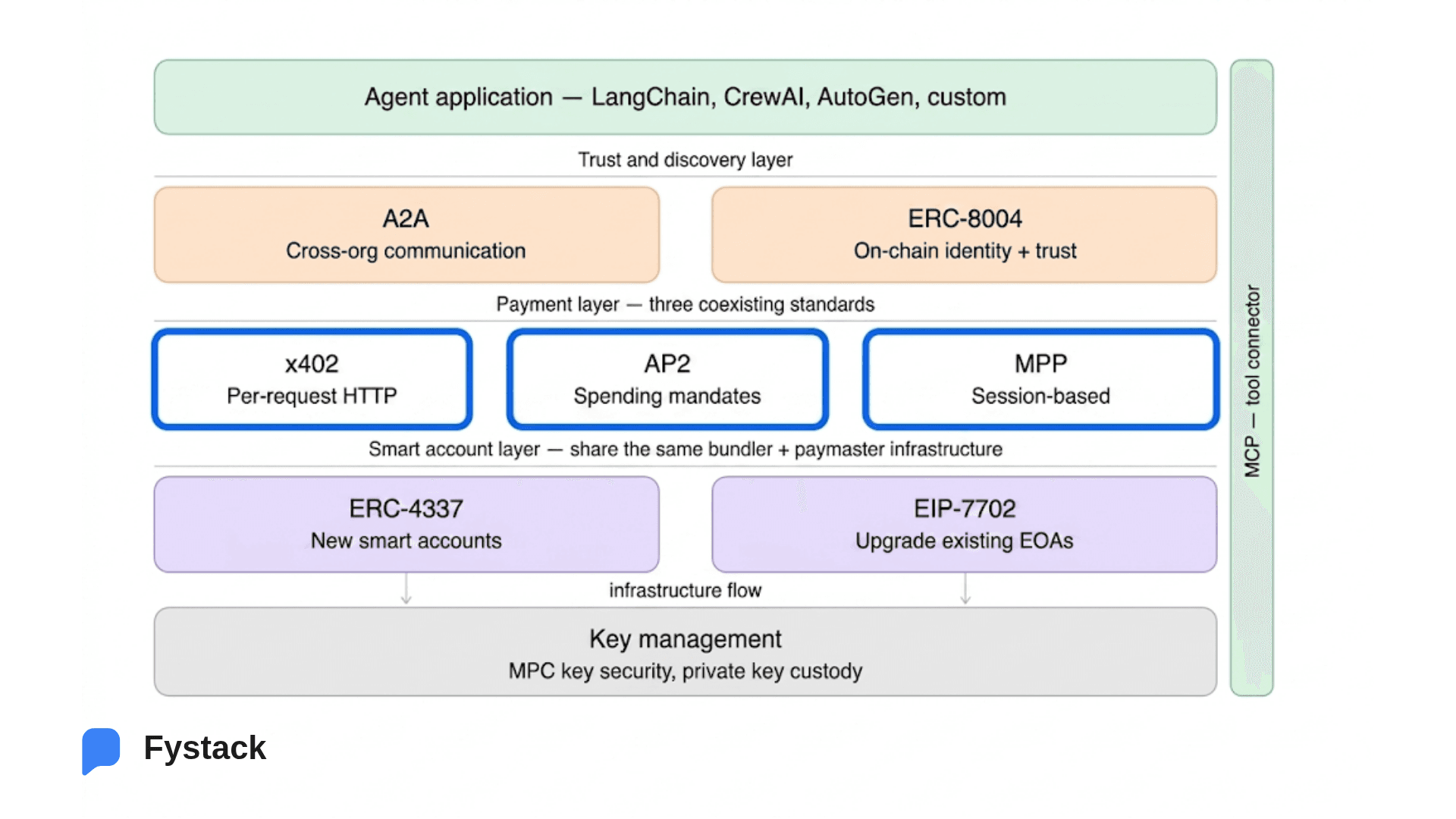
How x402, AP2, and MPP Fit Into the Agentic Payment Stack
These three standards operate at different layers, which means a production agentic payment system can use more than one at the same time without conflict.
Agents need infrastructure at four distinct levels: identity (ERC-8004 - Ethereum agent identity and reputation proposal), coordination (A2A), authorization (AP2), and execution (x402 and MPP). Each protocol occupies its own layer, which is what makes them complementary rather than competing alternatives.
Table 2. Where x402, AP2, and MPP Sit in the Agentic Payment Stack
x402: Per-Request Stablecoin Payments at the HTTP Layer
x402 turns the HTTP 402 status code into a live payment mechanism. An agent sends a request, the server responds with a 402 if no payment is attached, the agent pays with stablecoins, and the resource is delivered: no account setup, no API key management. Coinbase and Cloudflare launched it in May 2025, and the live network now processes 75.41 million transactions per month, with Stripe, AWS, Vercel, Cloudflare, and Alchemy as integrators.
x402 is free for both the customer and the merchant; you only pay nominal payment network fees. It currently supports USDC payments on Base and Solana.
// Server: require payment with one middleware call
app.use(paymentMiddleware({
  "GET /weather": {
    accepts: [{ network: "base", currency: "USDC", maxAmountRequired: "0.01" }],
    description: "Real-time weather data"
  }
}));

// Client: agent handles the 402 cycle automatically
const response = await x402Client.fetch("https://api.example.com/weather", {
  maxPayment: { amount: "0.01", currency: "USDC", chain: "base" }
});
Server-side payment requirement and client-side 402 handling with x402.
"x402 and AP2 show that agent-to-agent payments aren't just an experiment anymore, they're becoming part of how developers actually build." - Erik Reppel, Head of Engineering at Coinbase Developer Platform
x402 suits services where each API call is a standalone billable unit; for usage-based or session-priced services, MPP is the appropriate layer.
AP2: Pre-Authorized Spending Mandates for Delegated Tasks
AP2 solves the authorization problem that sits upstream of payment execution: how does an agent prove it was permitted to spend when no human is present. Google announced AP2 in September 2025 alongside 60-plus organizations including Adyen, American Express, Mastercard, PayPal, and Coinbase. The core mechanism is the mandate: a cryptographically-signed contract the user signs upfront specifying price limits, allowed merchants, and timing constraints.
When the agent finds a matching purchase, it generates a Cart Mandate referencing the original Intent Mandate, creating an auditable chain from user intent to completed transaction.

AP2 supports cards, stablecoins, and real-time bank transfers in a single framework. The A2A x402 extension, co-developed with Coinbase and MetaMask, lets AP2-authorized agents execute stablecoin payments via x402 at the execution layer.
As of May 2026, AP2 is at the partner integration stage: specification and reference implementations are public on GitHub. Confirmed live consumer deployments have not been publicly documented, which is worth stating plainly for teams evaluating it today.
MPP: Session-Based Billing for Ongoing Agent Services
MPP handles services where consumption accumulates over time and charging per request creates friction. Stripe and Tempo launched MPP on March 18, 2026, with an IETF draft (draft-httpauth-payment-00) submitted twelve days later: the first of the three protocols to reach an international standards body. The agent opens a session, consumes resources, and the payment settles at close, matching the billing model to actual consumption.
// Stripe server: accept MPP payments via PaymentIntents
const paymentIntent = await stripe.paymentIntents.create({
  amount: 1,
  currency: "usd",
  payment_method_types: ["crypto"],
  payment_method_data: { type: "crypto" },
  payment_method_options: {
    crypto: {
      mode: "deposit",
      deposit_options: { networks: ["tempo"] }
    }
  },
  confirm: true
});
Opening an MPP session via Stripe PaymentIntents with Tempo settlement.
MPP launched with live deployments: Browserbase (headless browser sessions), PostalForm (physical mail), and Prospect Butcher Co. (agent-initiated food orders).
"Agents can autonomously pay per API call for web access. This allows us to reach any agent developer in the world on the same Stripe stack we already run on." - Parag Agrawal, founder of Parallel Web Systems
Tax calculation, fraud protection, and reporting apply to agent transactions automatically through Stripe's existing PaymentIntents infrastructure.
How the Three Protocols Work Together
In a production agentic workflow, all three can operate within the same task. An automated procurement agent uses A2A to find vendor agents, cites an AP2 Intent Mandate as its authorization, pays one-time data enrichment calls via x402, and settles ongoing market intelligence access via MPP.
Teams do not need to implement all layers at once: x402 is the lowest-friction entry point, AP2 becomes relevant when delegated tasks require a verifiable authorization chain, and MPP fits when services are priced by consumption rather than per call.
Which Protocol Should You Build On?
The choice comes down to payment patterns.
Table 3. Protocol Selection by Payment Pattern
x402 is the practical starting point for most fintech teams today: the largest live network, the lowest integration overhead, and broad support from Stripe, AWS, and Vercel.
AP2 is the right investment when verifiable authorization matters: regulated workflows, procurement, or high-value delegated tasks.
MPP fits when the service model is session-based rather than per-request.
Below all three sits the same question: where does the signing key live, and who controls it. For teams evaluating self-hosted signing infrastructure, Fystack's mpcium library is an open-source MPC implementation compatible with any of the three protocols.
Get Started
If you are building agent-driven payment infrastructure and want to map your signing layer to the right protocol, tell us where your setup stands and our technical team will follow up.
Frequently Asked Questions (FAQs)
Can an agent use x402 and AP2 at the same time?
Yes. AP2 handles authorization: it proves the agent was permitted to act within a defined budget. x402 handles execution: it moves the stablecoins. The A2A x402 extension was built explicitly to connect both in production.
Is AP2 production-ready today?
AP2 has a public specification, reference implementations on GitHub, and 60-plus organizations building on the standard as of May 2026. Confirmed live end-user deployments have not been publicly documented; teams building on AP2 now are working toward a standard with strong institutional backing but consumer-facing production maturity is still rolling out.
What is the difference between x402 and MPP?
x402 fires a payment per individual request. MPP opens a session, lets the agent consume resources across it, and settles at the close. The choice is the billing model: per-request versus usage-based. Stripe supports both on the same settlement infrastructure.
Do I need A2A and ERC-8004 to use these payment protocols?
No. You can integrate x402 or MPP independently without either. A2A and ERC-8004 become relevant when your workflow requires verifiable agent-to-agent coordination or on-chain counterparty identity verification as part of the same payment flow.
What are the fees, and what happens when a payment fails?
x402 charges no protocol fees; network fees are fractions of a cent on Base or Solana. MPP applies Stripe's standard processing fees per session close. AP2 specifies no fees at the protocol layer. On failure: x402 clients retry automatically on HTTP 402; MPP and AP2 failure handling depends on the service's settlement policy and the original mandate terms.