How to Implement a Crypto Debit Card: The Authorization and Settlement Architecture

Part 3 of the Crypto Payment Rails series. Read Part 1: How Crypto On-Ramps Work and Part 2: How Crypto Off-Ramps Work for the inbound and outbound sides.
TL;DR - A crypto payment debit card is not a wallet with a card skin on top. It is a real-time system that has to answer a card network authorization in under two seconds, debit a user's crypto balance atomically, and back the payment with a pre-funded fiat float that you settle days later. Five systems run behind every tap: card acceptance (Visa/Mastercard rails and a BIN sponsor), an issuer processor, a just-in-time authorization engine, an MPC-backed spend wallet, and a settlement treasury. The two systems that decide whether your program lives or dies are the spend wallet and the float. Get either wrong and the card network suspends you. This post walks through the full authorization and settlement path, the four ways a crypto card program dies, and why the signing architecture is the part most teams underestimate.
Building a crypto card program? Talk to Fystack - we provide the MPC spend-wallet and custody layer so you can ship in weeks, not quarters. Star mpcium on GitHub to see the engine.
What a crypto debit card actually is
A crypto payment debit card lets a user spend an on-chain balance - USDC, ETH, a basket of stablecoins - at any of the ~150 million merchants that accept Visa or Mastercard. The user taps a card, the merchant sees a normal fiat payment, and somewhere in your backend a crypto balance shrinks.
The magic word most marketing pages skip is conversion timing. The merchant is paid in fiat. Your user holds crypto. Something has to bridge those two, in real time, before the terminal times out. That something is your entire business, and almost none of it is visible to the user.

There are two ways to think about a crypto card, and the difference dictates your whole architecture:
- Funding card. The user pre-converts crypto to a fiat balance, then spends the fiat. Simple, but it defeats the point - the user is holding your IOU, not their crypto, and you have taken on custody of fiat you now have to safeguard and reconcile.
- Real-time debit card. The user's balance stays in crypto until the moment of the tap. The card network authorization triggers a crypto debit and an FX lock in the same 2-second window. This is what people mean by "crypto card" in 2026, and it is dramatically harder to build.
This post is about the second kind, because the first kind is just an off-ramp with a plastic front end, and we already covered off-ramps in Part 2.
Who actually issues the card: the BIN sponsor stack
You cannot walk up to Visa and ask for a card program. Visa and Mastercard only deal with member banks. So the real question when you implement a crypto card is not "how do I integrate Visa" - it is "whose banking license am I renting."
The stack looks like this, from the network down to you:
- Card network - Visa or Mastercard. Owns the rails and the rules.
- Issuing bank / BIN sponsor - a licensed member bank that owns a Bank Identification Number range and lets you issue cards under it. This is your regulatory umbrella.
- Issuer processor - the technical platform that receives authorization messages from the network and asks your backend what to do. Marqeta, Stripe Issuing, Lithic, Highnote, Galileo.
- Program manager - you. You own the user relationship, the crypto custody, the float, and the product.
The BIN sponsor relationship is the single hardest thing to acquire and the easiest thing to lose. Sponsors run due diligence on your custody, your AML program, and your financial controls before they let a single card go live, and they will offboard you the moment your program looks like a liability. Every architectural decision in the rest of this post is, downstream, a decision about whether you keep your BIN sponsor.
What happens in the two seconds after a tap
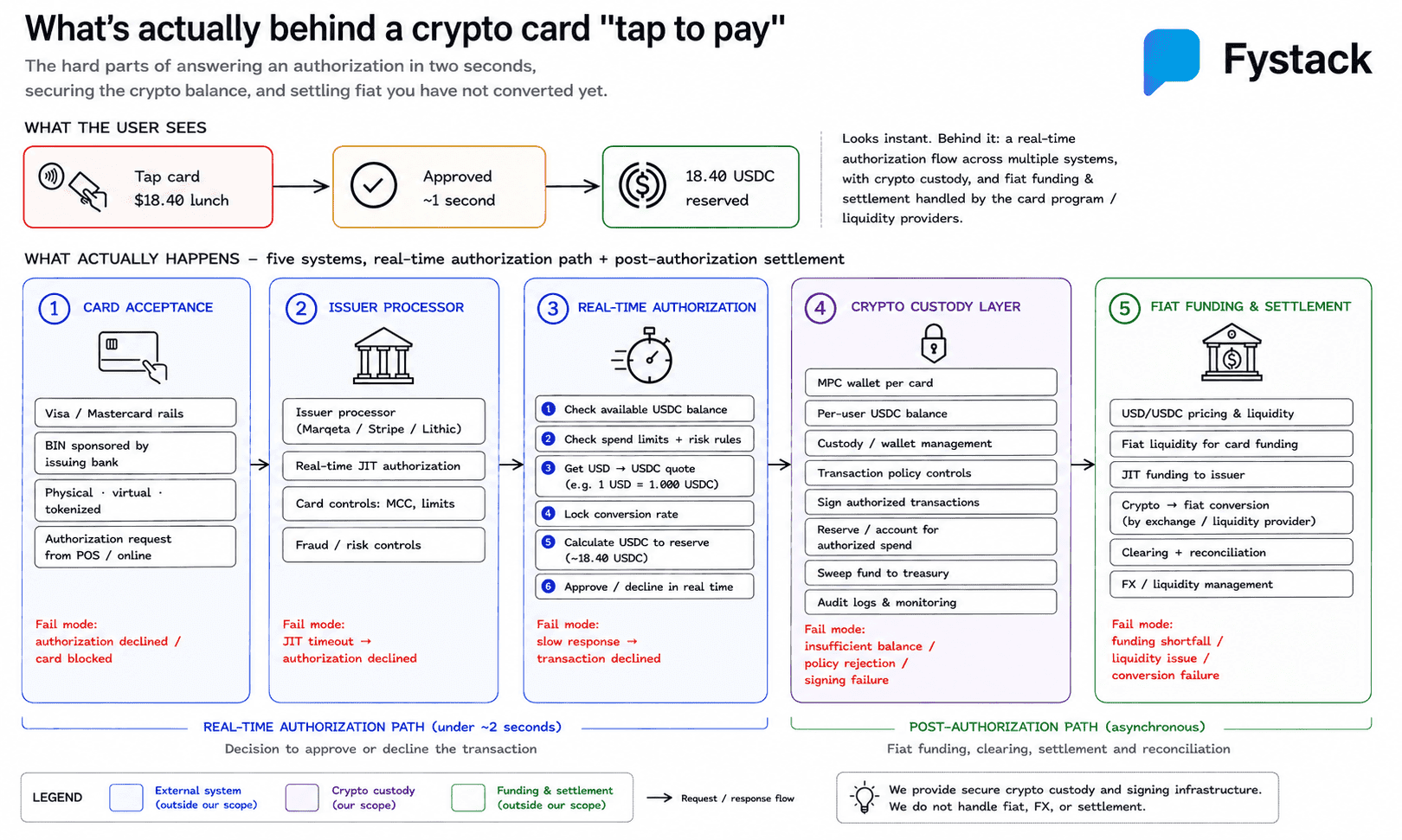
From the user's perspective, a crypto card tap is instant - a green light and a receipt. Behind it, five systems run a race against a hard deadline. Card networks expect an authorization response in roughly 2 seconds; miss it and the processor issues a stand-in decline on your behalf. A crypto card that declines at lunch is a crypto card that gets left in a drawer.

The critical design insight is the split between the hot path and the settlement path. The hot path is synchronous and blocks the terminal, so everything in it has to complete in well under two seconds. The settlement path - selling crypto, MPC-signing the on-chain movement, replenishing the float - runs afterward, because on-chain settlement takes seconds to minutes and cannot fit inside the network's window.
The hot path: just-in-time authorization
Just-in-time (JIT) funding is the mechanism that makes real-time crypto debit possible. When the network sends an authorization request, your issuer processor fires a webhook to your backend - a JIT funding call - and waits for a yes or no. Inside that webhook handler, in parallel, you:
- Check the user's crypto balance is enough to cover the purchase at the current rate.
- Validate spend controls: per-transaction cap, daily limit, merchant category (MCC) rules, geography.
- Run a real-time fraud and velocity screen.
- Lock an FX quote (for example, ETH to USD) so you know exactly how much crypto to debit.
- Reserve the fiat amount against your pre-funded float and return an approval.
Every one of these has a strict latency budget. A naive implementation that calls a price oracle over HTTP, then queries a database, then calls a fraud API in sequence will blow the 2-second budget on a bad network day. Production JIT handlers run these checks concurrently and keep hot data (balances, price quotes, limits) in memory or a low-latency cache.
Notice what is not in the hot path: signing an on-chain transaction. You do not have time to wait for a blockchain, and you do not need to. At authorization time you debit an internal ledger balance and reserve fiat. The actual on-chain settlement is deferred.
The settlement path: where MPC signing lives
After the terminal shows green, the real money movement begins asynchronously:
- The MPC spend wallet co-signs the on-chain movement of the user's crypto (or a batched sweep of many users' crypto) into your treasury.
- You sell that crypto for fiat on an exchange or through an OTC desk, at or near the rate you locked at authorization.
- You replenish the fiat float that fronted the payment.
- At T+1, the card network settlement file lands and you reconcile every authorization against actual settled fiat.
This is the part teams underestimate. The card was approved in one second, but your treasury does not actually rebalance for a day or more - and in that window you are carrying both a float obligation and FX risk. Which brings us to the gap.
The auth-settlement gap: float and FX risk
Here is the uncomfortable truth about a crypto card's unit economics: you pay the merchant before you have sold the user's crypto. You front fiat from a pre-funded float at the instant of authorization, and you only recover it once the crypto sale settles and the network pays you. That gap is measured in days.

Two costs live in that gap:
- Float / working capital. At 80,000 taps a day and a $35 average ticket, roughly $2.8M flows daily, and a rolling $2-5M of float sits locked in settlement at any moment. That is capital you have to fund and cannot deploy elsewhere. It is the single largest balance-sheet line item of a card program, and it scales linearly with volume.
- FX exposure. You approved the transaction at a crypto price locked at T+0, but you sell the crypto at T+1. If the market moves against you in between, the margin evaporates. A card program that does not hedge this window is running an unintentional prop-trading book on top of a payments business.
The teams that survive treat the float and the FX window as first-class problems from day one: they hedge the exposure, they keep the float sized to peak daily flow, and they minimize the gap by settling crypto sales as fast as the venues allow. The teams that fail discover the gap the first time a volatile week turns a month of card revenue into an FX loss.
Why custody is the part you cannot outsource carelessly
Every crypto card program holds one dangerous thing: a wallet that can move user funds programmatically, thousands of times a day, with no human in the loop. That wallet is the beating heart of the system and the single most attractive target an attacker will ever find.

There are four ways a crypto card program dies. Two route through the spend wallet, two through the settlement float:
| Failure | Trigger | Where it lives | Consequence |
|---|---|---|---|
| Auth timeout | Spend wallet or JIT handler too slow to answer in 2s | Spend wallet / hot path | Declines at the terminal, users churn |
| Hot wallet drain | Single signing key compromised on the spend wallet | Spend wallet / custody | Total loss of the spend float |
| FX gap loss | Approved at a locked quote, market moves before you sell | Settlement treasury | Margin bled away, program unprofitable |
| Float shortfall | Settlement file lands, no pre-funded fiat to cover it | Settlement treasury | Network suspends the program |
The pattern is the same one from the off-ramp post: your custody and treasury architecture decides whether you survive each failure. A hot wallet drain only happens if the signing key exists in one place. A float shortfall only happens if you did not size and monitor the float. An auth timeout only happens if your signing and balance-check path is not built for latency.
Most card teams ship version one with a single-key hot wallet holding the spend float, a JIT handler that calls services in sequence, and a float sized to last week's volume. Then they spend the next year rebuilding all three in production while their BIN sponsor's risk team gets steadily more nervous.
How MPC custody fits a card program
The custody pattern that works for a high-frequency spend wallet in 2026 is multi-party computation (MPC) threshold signing. The private key never exists in one place. It is split into shares held by independent signing nodes, and a transaction is signed only when a threshold of nodes approves it against a policy.

For a crypto card, MPC matters in three specific ways:
No single point of compromise on the spend wallet. The spend wallet signs constantly and automatically, which makes it the highest-value target in your system. With MPC, a leaked operator credential or a compromised server does not drain the float - an attacker has to compromise a threshold of independent nodes at once, across different clouds and regions.
Programmatic policy, not human approval. A card payment cannot wait for a human to approve a transaction in Slack. The signing decision has to be code: balance sufficient, under caps, destination is the canonical treasury, FX quote fresh. MPC nodes co-sign only when the policy passes, and every signature is bound to the policy that authorized it.
One key, unlimited user balances. A single MPC key can derive and manage per-user deposit and spend addresses without provisioning a key per user and without exposing a master key. You get per-user accounting without per-user key management.
The important architectural nuance for a card program: MPC signing is not in the 2-second hot path. At authorization you debit an internal ledger; the MPC co-signing happens on the async settlement path where a few hundred milliseconds of signing latency is irrelevant. This is exactly what the Fystack MPC engine, mpcium, is built for - fast, policy-bound, automated signing on the settlement side, with the hot path reading balances your ledger already tracks.
If you are building a crypto card, the spend-wallet and settlement custody is the part you should not hand-roll. Book a 30-minute architecture review and we will walk through where MPC fits your hot path and your settlement path.
Build vs buy: the real economics of card custody
A meaningful share of card founders we talk to are quietly building their own spend-wallet custody. Six months in, they have an MVP. Twelve months in, they realize it does not pass a BIN sponsor's security review. Eighteen months in, they have rebuilt twice and lost their first sponsor over a hot wallet scare.

| Dimension | Build in-house | Buy managed (Fystack Cloud) | Self-hosted (mpcium) |
|---|---|---|---|
| Time to first spend wallet | 4-6 months | 1 day | 10 minutes |
| Time to production custody | 12-18 months | 1-2 weeks | 2-4 weeks |
| Engineering team required | 3-5 senior, full-time | 0 dedicated | 1 part-time |
| First-year cost | $400K-$800K | $50K-$60K | $0 (infra only) |
| Security review ready | Eventually | Day one | After your own audit |
| BIN sponsor due diligence | Months of friction | Vendor docs ready | Self-attestation |
| Multi-chain support | What you build | 12+ chains shipped | 12+ chains shipped |
The honest version: your moat as a crypto card program is in the card experience, the rewards, the FX margin, and your BIN-sponsor and processor relationships - not in MPC cryptography. Building your own threshold signing scheme is a way to spend a year and a senior team reinventing infrastructure that already exists, while a competitor with the same idea ships in weeks and spends that year signing merchants and users.
The only defensible reason to build custody in-house is a regulatory or data-sovereignty constraint that no vendor can satisfy - and even then, self-hosting an open-source engine gets you sovereignty without the cryptography R&D.
What to look for in card custody infrastructure
If you are evaluating custody for a card program, this is the questionnaire to run a vendor through:
- Threshold MPC signing, not just multisig. Multisig is on-chain and chain-specific and adds latency and gas. MPC threshold signatures are off-chain, chain-agnostic, and look like a normal single-signer transaction to the network.
- Low-latency signing on the settlement path. You need automated co-signing that clears in hundreds of milliseconds, not a workflow that waits on human approvals.
- Ledger-first balance model. The hot path should read balances from your ledger, not from a chain query. Custody has to integrate with, not replace, your internal accounting.
- Programmatic policy engine. Per-transaction caps, daily limits, destination whitelists, velocity rules - all enforced at signing time, all versioned, all auditable.
- Per-user address derivation without per-user keys. Cheap, deterministic, and no master-key exposure.
- Open-source option. Closed-source custody is a non-starter for any team that wants to self-host or have the code audited during a BIN sponsor review.
- Sponsor-review readiness. Key ceremony documentation, SOC 2, incident response playbook. This is what your BIN sponsor's risk team reads before they sign.
You should expect to ship the card custody layer in weeks. If a vendor's onboarding timeline is longer than that, they are selling you a Fireblocks-class enterprise product, not builder infrastructure.
SaaS vs self-hosted custody for a card program
The same tradeoff from the on-ramp and off-ramp posts applies here, with one card-specific wrinkle: the spend wallet is latency-sensitive and high-frequency, so where you run the signing nodes matters for your authorization budget.
| Dimension | SaaS (Fystack Cloud) | Self-hosted (mpcium) |
|---|---|---|
| Operational overhead | Vendor runs nodes, key ceremony, upgrades | Your team operates nodes |
| Signing latency control | Vendor SLA | You tune node placement |
| Data residency | Vendor region | Your region, your cloud |
| Sponsor review evidence | Vendor docs reusable | Your own attestations |
| Cost at scale | Per-wallet pricing | Infra cost only |
| Risk of vendor offboarding | Real | None |
The pragmatic split we see: teams launch on Fystack Cloud to hit the market fast, then migrate to self-hosted mpcium once volume and sovereignty requirements justify running their own nodes. Both use the same protocol, so the migration is a configuration change, not a rewrite.
The window is open
Crypto cards in 2026 are where stablecoin payments were two years ago: a handful of well-funded incumbents, a maturing set of BIN sponsors willing to work with crypto programs, and a long tail of builders starting to ship. Visa, Mastercard, and the major issuer processors have all shipped crypto and stablecoin settlement products in the last 18 months, which means the rails are finally builder-accessible.
The teams that win the next two years will be the ones that treat the boring parts - the spend-wallet custody, the JIT latency budget, the float and FX hedging - as first-class engineering from day one, and spend their remaining time on the parts users actually see. The teams that lose will be the ones that ship a single-key hot wallet behind a beautiful card and find out, the hard way, why the card network cares so much about custody.
Talk to Fystack
If you are building a crypto payment card, spend product, or stablecoin card program, we provide the custody and settlement-signing layer so you can focus on the rest:
- Fystack Cloud - managed MPC custody SaaS, ready in days
- mpcium - open source MPC wallet engine you can self-host in 10 minutes
- multichain-indexer - production indexer for 12+ chains, balance and deposit detection ready
- Fystack Self-Hosted - supported on-premise deployment for teams with sovereignty requirements
Book an architecture review - 30 minutes, technical, no slides. We will walk through your card stack and tell you honestly which parts you should build and which parts you should not.
Not ready yet? Join our Telegram for product updates and architecture discussions, or star mpcium on GitHub.
Frequently asked questions
How does a crypto debit card work?
A crypto debit card lets a user spend an on-chain balance at any Visa or Mastercard merchant. When the card is tapped, the card network sends an authorization request to your issuer processor, which fires a just-in-time funding webhook to your backend. In under two seconds you check the user's crypto balance, lock an FX quote, reserve fiat from a pre-funded float, and approve. The actual crypto sale and on-chain settlement happen asynchronously afterward.
What is just-in-time (JIT) funding for a card?
JIT funding is the mechanism where your backend decides, in real time, whether to approve a card authorization and how to fund it. Instead of pre-loading a fiat balance, the issuer processor asks your system at the moment of the tap. This is what lets a user keep their balance in crypto until the instant they spend it.
Do I need a bank to issue a crypto card?
Yes. Card networks only deal with member banks, so you issue cards under a licensed issuing bank's BIN through a BIN sponsor arrangement, usually via an issuer processor like Marqeta, Lithic, Stripe Issuing, or Galileo. Acquiring and keeping that sponsor relationship is the hardest part of launching a program, and it depends heavily on your custody and AML controls.
What is the settlement float on a crypto card?
The float is the pre-funded fiat you use to pay merchants at authorization time, before you have sold the user's crypto and received network settlement. Because settlement takes one to two days, a rolling balance - often $2-5M at moderate volume - stays locked in the gap at any moment. Sizing, funding, and hedging that float is a core part of a card program's economics.
Why does a crypto card need MPC custody?
The spend wallet on a crypto card signs automatically thousands of times a day, which makes it the highest-value attack target in the system. MPC threshold signing removes the single point of compromise: the key is split across independent nodes and a transaction is signed only when a threshold approves it against a policy. It also enables programmatic, human-free signing that a real-time card requires.
Does MPC signing slow down card authorization?
No, if the architecture is correct. On-chain signing is not in the 2-second authorization hot path. At authorization you debit an internal ledger and reserve fiat; the MPC co-signing of the actual on-chain movement happens on the asynchronous settlement path, where signing latency is irrelevant.
How long does it take to build a crypto card program?
The custody and settlement layer alone takes 12-18 months to build to production grade in-house. The full program - processor integration, BIN sponsor, JIT handler, custody, float management, compliance - is typically 18-24 months from a standing start. Teams using managed or self-hosted MPC custody cut the custody engineering to 1-4 weeks and spend the rest of the time on the card product and sponsor relationship.
What is the best custody for a crypto card program?
The right custody for a card has threshold MPC signing across the chains you support, low-latency automated co-signing on the settlement path, a ledger-first balance model for the hot path, and a programmatic policy engine. Fystack provides all of it in either SaaS (Fystack Cloud) or open-source self-hosted form (mpcium).