Why AUC-based custody pricing breaks Crypto Payment Processor unit economics

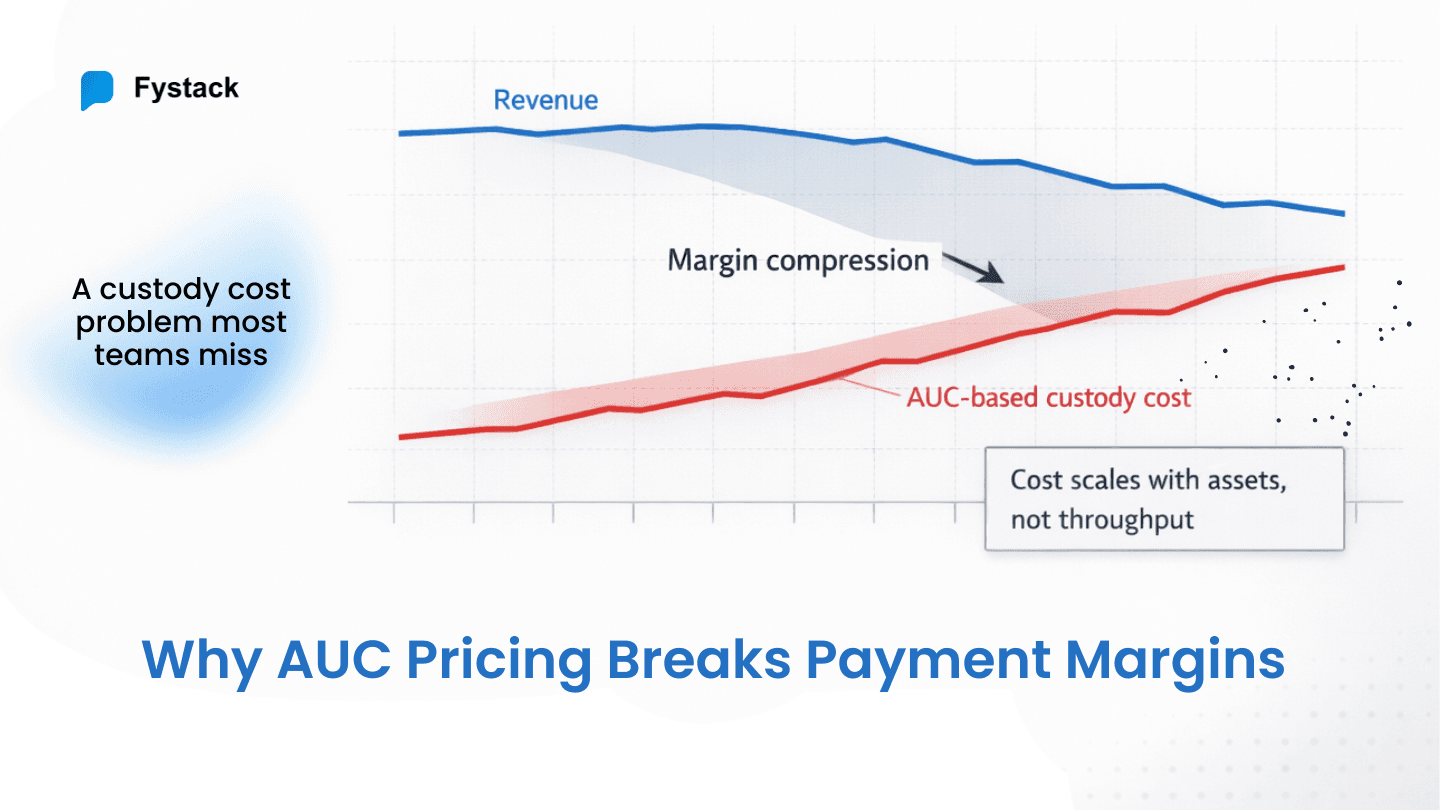
There is a pricing model that quietly eats into the margins of many crypto payment processors. Most teams do not notice it until they are already locked in.
It is called AUC-based pricing, where custody fees are charged as a percentage of Assets Under Custody. This model is widely used by providers like BitGo.
The problem is not that the model is wrong. It works well for hedge funds that hold large balances over time. The issue is not the price level. It is that AUC-based custody pricing is built around assets held, while a crypto payment processor is driven by transaction throughput.
If you are running or evaluating a crypto payment processor, this mismatch directly impacts your unit economics and long-term cost structure.
This post walks through why, using real numbers.
How payment processors actually work
A custodial crypto payment processor holds user funds in hot and warm wallets to support checkouts, top-ups, and settlements.
The business model is simple: it is volume-driven. You make money by processing as many transactions as possible, while earning a small margin on each one.
Most crypto payment processors charge merchants around 0.5% to 1% per transaction, according to Elliptic. In some stablecoin corridors, fees can be even lower. That is your gross revenue. From there, you still need to cover infrastructure, compliance, staffing, and custody.
Some operators in high-volume or stablecoin corridors negotiate fees well below the standard range, with certain market segments seeing rates under 0.5% per transaction.
The math looks like this:
| Metric | Example |
|---|---|
| Monthly volume processed | $10,000,000 |
| Average transaction fee | 0.8% |
| Gross revenue | $80,000 |
| Gross margin (after ops, staffing) | ~$20,000–$30,000 |
What AUC pricing actually costs at payment processor scale
AUC-based pricing charges based on the assets sitting in custody, not the revenue those assets generate.

On paper, the rates look reasonable. Industry custody fees typically range from 10 to 60 basis points per year, depending on scale. Self-service tiers from providers like BitGo can reach 60 basis points annually, while enterprise contracts may negotiate lower rates. Providers like BitGo also layer on platform fees on top of AUC charges. Enterprise pricing is typically negotiated directly and varies by contract, with additional transaction-based fees applied on top.
Now apply this to the earlier example.
A payment processor handling $10M per month does not hold that full amount as a static balance. Funds are continuously moving between collection and settlement.
At any given time, a portion of funds remains in wallets as operational float. Assume a conservative average of $2M.
This float is not fixed. It can expand during peak volume, delayed settlements, or liquidity buffering.
At typical AUC rates, the custody cost looks like this:
| Custody model | Annual cost |
|---|---|
| 10 bps on $2M | $2,000 |
| 25 bps on $2M | $5,000 |
| 50 bps on $2M | $10,000 |
At first glance, this looks manageable.
But this is only the base layer.
The fixed platform fee changes the picture. Custody providers typically layer base platform fees on top of AUC charges, before adding costs for feature upgrades like auto-sweep and AML screening. These platform fees vary significantly by provider and tier, and are often only disclosed during contract negotiation.
Over a 3-year period, that is $25,000+ in base fees alone. At enterprise tiers, pricing for custody platforms can reach tens of thousands per year for mid-sized operators. Over the same period, this adds up to $130,000+ before overages or add-ons.
Now compare that to your margin:
| Monthly gross margin | Custody cost | Custody as % of margin |
|---|---|---|
| $20,000 | $699 | 3.5% |
| $15,000 | $699 | 4.7% |
| $10,000 | $699 | 7.0% |
This is under normal conditions.
In practice, custody cost is not always stable.
During peak periods, float can increase due to delayed settlements, liquidity buffering, or sudden spikes in transaction volume. A processor expecting a $2M float may temporarily carry $4M to $6M.
Under AUC pricing, cost scales with that exposure.
| Scenario | Float | Annual cost (25 bps) |
|---|---|---|
| Normal | $2M | $5,000 |
| Peak liquidity | $4M | $10,000 |
| Stress / delays | $6M | $15,000 |
This makes custody cost not just proportional, but also harder to predict.
Custody pricing model comparison
The difference becomes clearer when you compare models directly:
| Model | Scales with | Predictability | Margin impact |
|---|---|---|---|
| AUC-based | Assets (float) | Medium | Unclear, can spike |
| Volume-based | Transactions | Medium | Scales with usage |
| Flat-fee | Fixed | High | Improves with scale |
AUC pricing is not accidental. It is optimized for custody providers, not payment processors.
For providers, charging on assets under custody creates a stable and scalable revenue base. It aligns with clients who hold large balances over time.
For payment processors, the primary driver is transaction throughput, not assets held. That is where the mismatch comes from.
The hidden costs of AUC pricing

The primary cost of AUC pricing is visible. The secondary effects only appear at scale.
Most teams model a simple structure: a percentage on assets under custody, plus a base platform fee. On paper, this looks predictable.
In practice, additional costs appear once the system is in production.
1. Feature gating adds cost layers
Core features such as auto-sweep, AML screening, policy controls, or multi-chain support are often not included in base plans.
For a payment processor, these are not optional. They are part of the minimum required setup.
What starts as a single custody fee becomes a stack of incremental costs tied to how the system actually operates.
2. Costs scale with operational complexity
As volume grows, the system becomes more complex:
- More wallets
- More signing policies
- More chains and tokens
- More compliance checks
These are not reflected cleanly in AUC pricing. Instead, they show up indirectly through wallet limits, API limits, tier upgrades, or custom pricing.
You are not just paying for custody. You are paying to operate at your required level of complexity.
3. Vendor lock-in changes pricing dynamics
Once your wallet architecture, signing flows, and compliance processes are built around a provider, switching becomes expensive.
This is not just a technical migration. It involves reworking integrations, re-auditing flows, and moving assets safely in production.
At that point, pricing is no longer benchmarked against the market. It is constrained by switching cost.
4. Incentives are misaligned around float
Under AUC pricing, higher balances increase provider revenue.
For a payment processor, the goal is the opposite. Efficient systems reduce idle balances through faster settlement and tighter treasury management.
This creates a structural mismatch.
You are incentivized to reduce float. Your provider is incentivized to monetize it.
Why AUC pricing breaks at the model level

AUC pricing was designed for a different operating model.
For custody providers, charging on assets under custody creates stable, scalable revenue. It works well when balances are large and held over time.
A payment processor operates differently.
Revenue is driven by transaction throughput. Float exists, but it is a byproduct of operations, not the source of value.
This creates a mismatch at the pricing level.
You are charged based on a variable that does not drive your revenue, and that can change independently of it.
As volume scales, this disconnect becomes more visible:
- Cost does not track usage cleanly
- Cost can increase due to operational conditions, not growth
Flat-fee custody for payment processors
Flat-fee custody pricing charges a fixed monthly or annual cost, regardless of assets held or transaction volume.
This is the model used by platforms like Fystack, designed specifically for payment processors.
For a crypto payment processor, this changes the economics in a meaningful way.
| Monthly volume | Gross revenue (0.8%) | Custody cost | Custody as % of revenue |
|---|---|---|---|
| $5M | $40,000 | Fixed | Higher |
| $10M | $80,000 | Fixed | Decreasing |
| $20M | $160,000 | Fixed | Further decreasing |
As volume grows, your custody cost ratio improves.
Under AUC-based pricing or volume-based pricing, costs tend to scale with your business. Under a flat-fee model, they stay predictable.
This is one of the key reasons teams start to re-evaluate their setup as they scale.
Only at a much higher level would they start considering alternatives like BitGo.
That range matters.
Below a certain threshold, building in-house is not worth it. Above another threshold, enterprise custody providers become viable. In between, a flat-fee model creates a more balanced cost structure for operators at this stage.
What changes when you self-host
Self-hosted custody changes more than just pricing. It changes how your cost structure behaves as you scale.
With a SaaS custody provider, your costs typically include:
- Platform subscription, often tiered
- Volume-based fees or overages
- Feature unlocks such as auto-sweep, AML, or multi-chain support
- Compliance and reporting add-ons
- Higher support tiers as you grow
These costs tend to increase as your volume increases.
With a self-hosted setup, the structure is simpler:
- A flat platform cost
- Infrastructure costs such as servers or cloud, which you control
This is the approach taken by Fystack, where custody infrastructure is deployed and controlled by the operator.
At lower volumes, the difference may not be significant. But as volume grows, the behavior of these costs diverges.
At $10M per month, infrastructure costs are still relatively modest. At $50M per month, the same setup can often handle the load without a proportional increase in cost. In contrast, a SaaS provider typically moves you into a higher pricing tier.
There is also a structural difference in control.
With a SaaS custody provider, your wallet infrastructure, signing flows, and compliance setup are tightly coupled to their platform. That creates switching costs, which affects how much leverage you have in pricing or contract negotiations.
With a self-hosted approach, the underlying infrastructure is under your control. That reduces dependency on a single vendor and changes the dynamics of future decisions.
A common hesitation when considering a self-hosted model is the perceived tradeoff: “If I own the infra, do I need a massive DevOps team to keep it alive?” or “Is it less secure than a giant SaaS provider?”
In the modern Web3 stack, that tradeoff is a myth:
- Self-hosting # Building from scratch: Platforms like Fystack optimize deployment down to a single command. You aren't building the engine from zero; you are simply "parking" a pre-packaged, production-ready infrastructure in your own cloud environment. It’s designed to be managed without a dedicated fleet of engineers.
- Ownership without the cryptographic headache: By utilizing industry-standard MPC (Multi-Party Computation), you eliminate single points of failure. You maintain 100% control of your keys and data, while the complex security architecture is already baked into the code. You get the security of a top-tier custodian with the autonomy of a private setup.
Ultimately, self-hosting is about ownership, not adding more tickets to your engineering backlog.
The question to ask before signing a custody contract
Before committing to any custody provider, there is one number that matters more than the headline fee:
At your projected 12-month volume, what does custody cost as a percentage of gross margin, not gross revenue?
Most custody pricing is framed around AUC or transaction volume. Neither maps cleanly to how a crypto payment processor actually operates. What matters is the impact on operating margin.
If custody takes more than 5% of your gross margin at your current volume, and that percentage increases as you scale, it is worth modeling alternative pricing structures before signing.
This is not a cost that naturally improves over time. Under AUC-based pricing, it often moves in the opposite direction.
Flat-fee, self-hosted models such as Fystack are one approach designed to keep this cost predictable as volume grows.

About Us
Fystack is a self-hosted MPC custody platform built for custodial payment processors, on/off-ramp operators, and fintech companies. Flat-fee pricing, open-source code, single-command deployment.