Stripe vs PayPal: What It Reveals About Stablecoin Payment Infrastructure

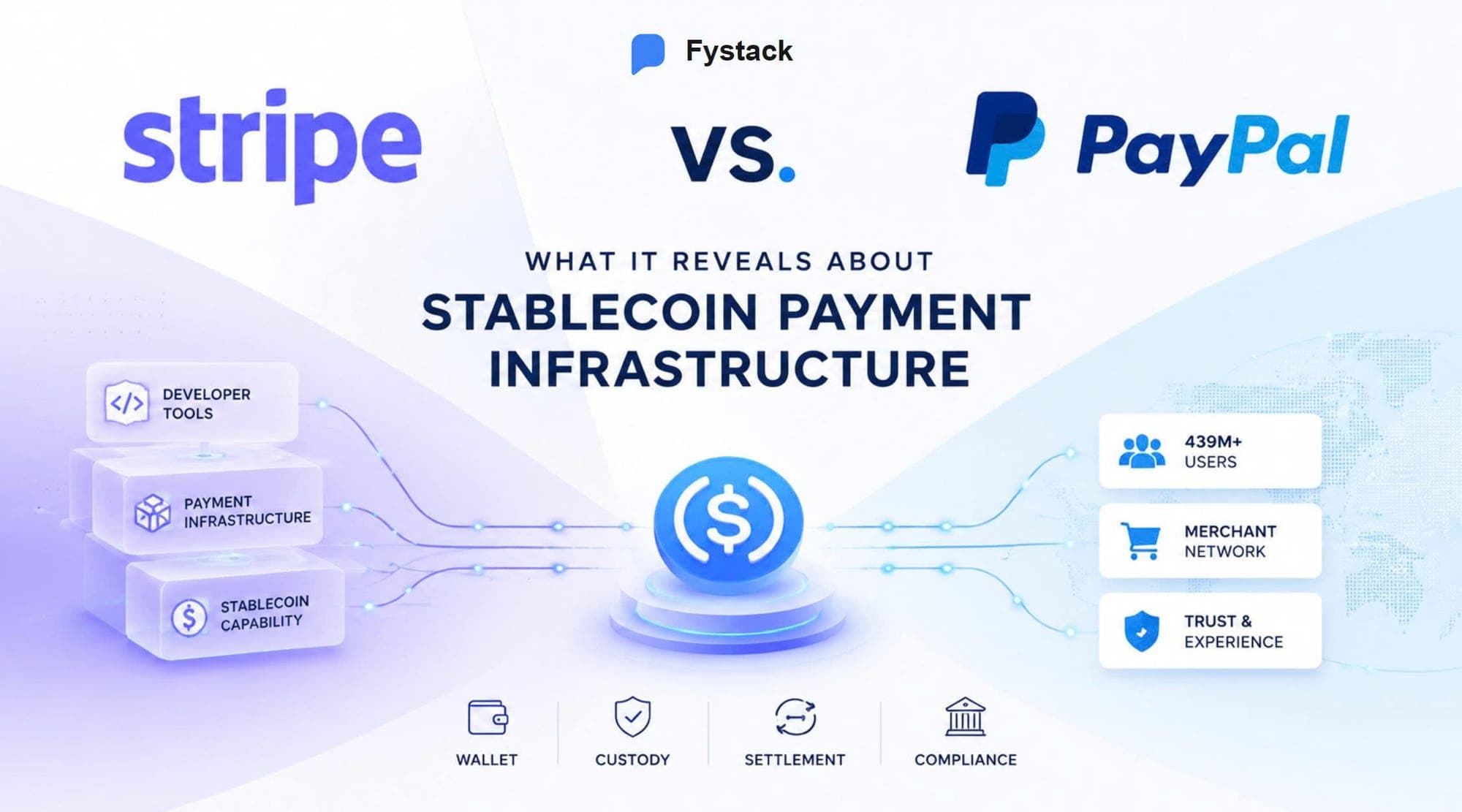
TL;DR: In stablecoin payments, the real edge is not the stablecoin, it's distribution: the ability to reach merchants and consumers through payment experiences people already trust.
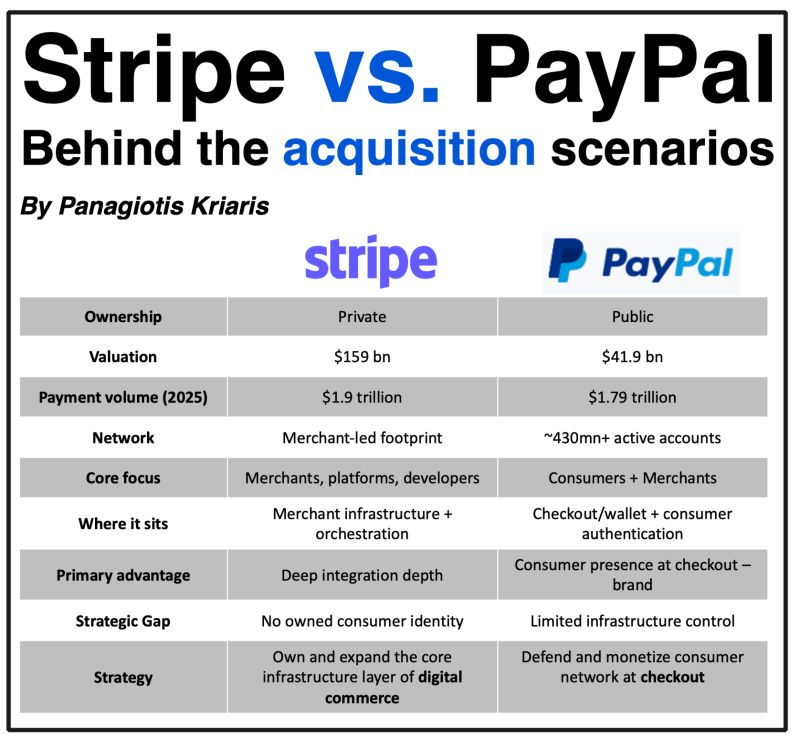
Stripe's $53 billion bid for PayPal makes the point clearly. Stripe already has the technical pieces to issue its own stablecoin. What it can't easily build is PayPal's 439 million accounts and two decades of checkout habits. As stablecoin infrastructure becomes a commodity, long-term advantage belongs to whoever controls distribution and payment infrastructure, no matter how this deal ends.
What Is a Stablecoin Payment Stack?
A stablecoin payment stack is the full set of infrastructure needed to issue, hold, move, settle, and accept stablecoin payments at scale. It usually includes wallet infrastructure, custody, payment orchestration, compliance, merchant acceptance, and the consumer-facing interface where someone actually taps "pay."
No single company naturally owns all six pieces. That is why so many recent payments deals, from Mastercard buying BVNK to Stripe buying Bridge, are really about filling one missing piece of the stack rather than expanding into something unrelated.
Why This Framework Matters
Most discussions about stablecoin payments focus on tokens, regulation, or settlement speed. In practice, successful payment systems compete across several layers at once. A stablecoin is only one component of a much larger operating stack that also includes custody, payment orchestration, compliance, merchant acceptance, and user experience.
Looking at payments through this stack makes it much easier to understand why acquisitions, partnerships, and infrastructure investments are accelerating across the industry, as stablecoins increasingly become core payment infrastructure rather than a niche crypto product. A company can be strong in one layer, such as issuing a well-collateralized token, and still be structurally weak in the market if it has no way to get that token in front of real merchants and consumers. The Stripe-PayPal story below is one example of a company trying to close that gap fast, through acquisition rather than years of organic growth.
Why Customer Reach Matters More Than Technology
In payments, distribution means the ability to reach merchants and end users through trusted, already-adopted payment experiences, rather than simply owning the technology behind the scenes. Some people call this commercial distribution, others call it an installed payment base or a go-to-market advantage. The label matters less than the underlying idea: who already has customer reach, and who has to build it from zero.
This distinction matters because two companies can build almost identical technology, yet the one with stronger merchant access usually wins where it counts most: the moment a customer decides which payment method to use. Technology enables participation. Distribution determines market adoption.
This is also why stablecoins themselves are becoming less of a differentiator in payment applications specifically. More well-capitalized and regulated companies are increasingly able to launch fiat-backed stablecoins and connect them to a settlement network. What is much harder to copy quickly is a trusted relationship with hundreds of millions of end users.
Can Companies Build Payment Reach Instead of Buying It?
Building distribution from scratch is possible, but it is slow, and it depends on a few things that cannot be rushed:
- Network effects. The more merchants accept a payment method, the more useful it becomes to consumers, and the more consumers use it, the more merchants want to accept it. This loop takes years to spin up.
- Merchant acquisition. Every new merchant relationship requires sales effort, integration work, and proof that the payment method actually converts.
- Switching costs. Once a merchant has payment logic, reconciliation, and reporting built around one provider, moving to another is expensive and risky, so they tend to stay.
- Trust. Consumers need to believe their money is safe and their data is handled responsibly before they will adopt a new way to pay. This is earned slowly, often over many years of consistent, incident-free service.
- Integrations. Deep plug-ins into e-commerce platforms, payment gateways, accounting software, and point-of-sale systems make a payment method sticky in ways that are hard to see from the outside, since they affect transaction routing decisions that most users never think about.
Buying customer reach, as Stripe attempted with PayPal, is simply a faster path to the same outcome. It trades cash and deal risk for years of organic growth. That tradeoff is exactly why large, well-capitalized companies keep reaching for M&A instead of waiting.
The Four Layers of a Modern Stablecoin Payment Stack
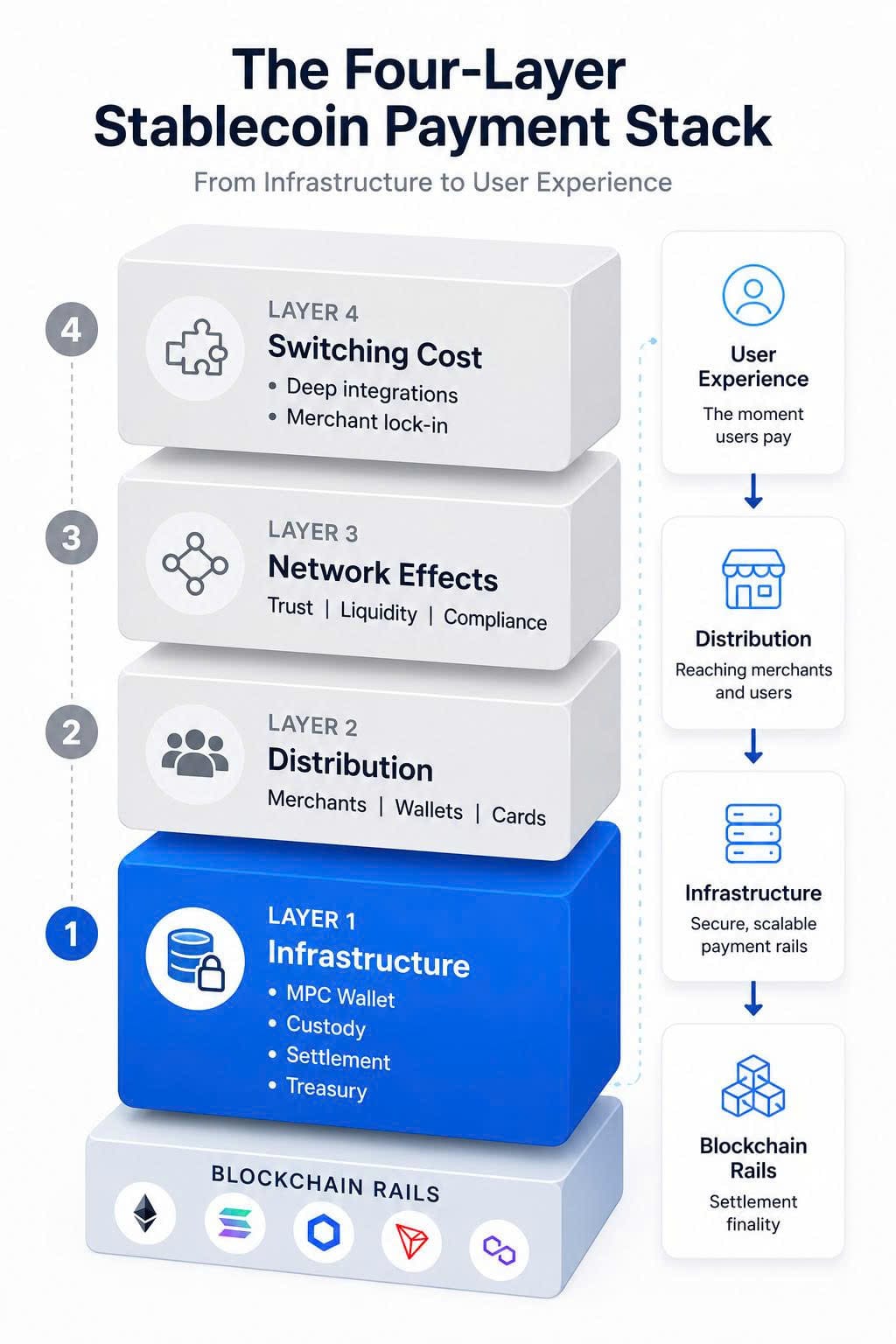
Putting the stack above into competitive terms, there are four layers, and each one builds on the one below it:
Layer 1: Infrastructure This includes payment orchestration (for example, Bridge), which coordinates money movement and typically runs on top of a lower, more foundational part of the same layer: wallet infrastructure (for example, MPC wallets), key management, treasury management, and settlement engines, often run in coordination with an issuer bank for fiat conversion. This is the plumbing: issuing, holding, and moving stablecoins safely, with programmable payment logic built in. It is also where custody architecture behind the "Buy Crypto" button lives, and where operational risks like the sequencer outages that have raised transaction liveness and settlement-delay concerns on Base actually get managed.
Layer 2: Distribution Merchants, consumers, cards, wallets, and apps. This is where the infrastructure in Layer 1 actually reaches a real user, through embedded finance and payment acceptance at the experience layer.
Layer 3: Network Effects Merchant acquiring, consumer trust, liquidity, and compliance. This layer only forms after Layers 1 and 2 have been running long enough and at enough scale to build momentum.
Layer 4: Switching Cost Once a merchant has deeply integrated a provider's payment rails, and consumers are used to paying through a specific wallet or app, competitors find it very hard to insert themselves between the two sides of that transaction. This is the real moat.
Seen through this framework, a Stripe-PayPal combination is not really about "buying more users." It is an attempt to lock in all four layers of digital asset infrastructure at once, before a competitor does the same.
What Happens to Banks When One Company Owns the Whole Stack?
This is the part of the story that gets the least attention, but it may matter most for traditional banks.
If one company, whether Stripe or anyone else, ends up owning all four layers of the stablecoin payment stack, some parts of the banking value chain may shift toward:
- Holding fiat reserves
- Compliance (KYC, AML, and regulatory reporting)
- Providing liquidity for converting between stablecoins and fiat
This does not eliminate banks, and it does not touch everything banks do, such as credit, lending, and deposit-taking. Instead, it shifts the customer-facing part of payments toward infrastructure roles such as reserve management, compliance, liquidity provision, and regulated settlement, rather than owning the customer-facing payment experience.
In that scenario, the bank increasingly sits behind the scenes rather than at the center of the payment experience, with less of its brand visible to the end customer at checkout. This is close to the position banks are already navigating with initiatives like the Visa Stablecoin Platform, which lets banks and fintechs mint and move stablecoins while Visa's network handles much of the underlying rail. Seen this way, what a company like Stripe may really be after is not a specific competitor, but a stronger position in the distribution layer that sits between stablecoins and end users. Owning both the payment rails and a large-scale consumer wallet can reduce reliance on traditional payment networks in some use cases, especially cross-border payments and programmable payments.
Case Study: Stripe's Attempted Acquisition of PayPal
The Proposed Acquisition
At a specially convened board meeting on July 20, 2026, PayPal's board reportedly declined to accept the initial acquisition proposal from Stripe and private equity firm Advent International, according to Tech Times. Reporting describes this as the board pushing back on the offer as insufficient rather than a formal, final refusal, particularly given cost-cutting and restructuring underway under CEO Enrique Lores.
| Detail | Figure |
|---|---|
| Offer price | $60.50 per share, valuing PayPal at $53.4 billion, a 28% premium over the prior closing price, according to CoinDesk |
| Board response date | July 20, 2026 |
| Reported valuation expectations | Around $70 per share |
| PayPal user accounts | 439 million |
| Combined annual payment volume if merged | Potentially multi-trillion-dollar scale (exact figures depend on how each company reports volume) |
| Main obstacles | Valuation gap and potential regulatory scrutiny |
PayPal brought in Goldman Sachs and Evercore to weigh its options, a sign that this is an opening move in a negotiation rather than a closed door. Some reporting, including from Reuters, has floated a combined volume estimate near $3.7 trillion a year, though the two companies calculate payment volume differently, so that figure should be read as a rough indication of scale rather than a precise number.
What Happened Next
Coverage since the board's response points to Stripe having the technical building blocks (through its acquisition of Bridge) but not the consumer reach PayPal has spent two decades building. Separately, Stripe has also explored expansion into AI infrastructure through reported acquisition talks, a sign that Stripe's ambitions extend beyond consumer payments as well.
What This Means for Banks, Fintechs, and Infrastructure Teams
If the two strongest players in payments still need to combine infrastructure and distribution to lock in all four layers of the stack, most other stablecoin companies are almost certainly strong in only one or two layers, not all four.
For most businesses, building PayPal-level distribution from scratch is not realistic, since the network effects in Layer 3 take years to build. But distribution is not the only thing that determines who survives this shift.
Organizations building stablecoin products increasingly differentiate at the infrastructure layer instead: wallet architecture, key management, treasury automation, and cross-border reconciliation, transaction orchestration, and compliance. Distribution can be rented or partnered for. Infrastructure, once deployed and wired into daily operations, is far harder to rip out and replace.
Why Infrastructure Layer Matters for Stablecoin Builders
For teams building stablecoin payment products, the infrastructure layer is where operational complexity becomes a real competitive challenge. Supporting institutional-grade payments requires more than simply holding stablecoins. Businesses need secure wallet architecture, programmable transaction flows, treasury automation, multi-chain support, and controls that satisfy enterprise security requirements.
This is why infrastructure providers such as Fystack focus on the operational layer behind stablecoin payments, helping fintechs, payment companies, and digital asset businesses deploy MPC wallet infrastructure for stablecoin payment operations without building every component from scratch.
As the market moves from experimentation to real-world payment adoption, the winners will not only be companies with access to stablecoins, but those that can operate reliable payment infrastructure at scale.
This is also why institutional custody and wallet infrastructure are increasingly treated as a separate competitive layer, distinct from the distribution race happening among the largest players.
Long-Term Implications
Whether or not Stripe ultimately acquires PayPal is only one chapter of a much larger story. The broader shift is already underway: as stablecoin infrastructure becomes increasingly commoditized, long-term competitive advantage will belong to companies that control distribution, orchestrate payment flows, and integrate deeply into enterprise operations. For infrastructure providers, this means becoming the security and transaction layer that enables those payment experiences behind the scenes.
Companies entering stablecoin payments should therefore think beyond issuing another token. The harder challenge, and the one worth solving first, is building or partnering for the infrastructure and distribution needed to make that token useful in real-world commerce.
Frequently Asked Questions
What is a stablecoin payment stack?
A stablecoin payment stack is the full infrastructure needed to issue, hold, move, settle, and accept stablecoin payments at scale. It spans four layers: infrastructure (custody, wallets, settlement), distribution (merchants and consumer apps), network effects (trust and liquidity), and switching cost (deep integrations that lock in usage).
Did Stripe buy PayPal?
No. As of late July 2026, Stripe and private equity firm Advent International submitted a $53.4 billion joint bid for PayPal, but PayPal's board pushed back on the offer as insufficient rather than accepting it. No deal has closed, and talks are reportedly ongoing.
Will banks lose control of payments if one company owns the whole stack?
Not entirely. Banks are more likely to shift toward reserve holding, compliance, and liquidity provision rather than disappearing from payments. Core banking functions like lending and deposit-taking are largely unaffected; what changes is how visible the bank's brand is at the point of checkout.