Crypto On Ramp Fees: Why More Volume Does Not Fix Your Margins

Ted Nguyen
Author
BD & Growth @Fystack
TL;DR
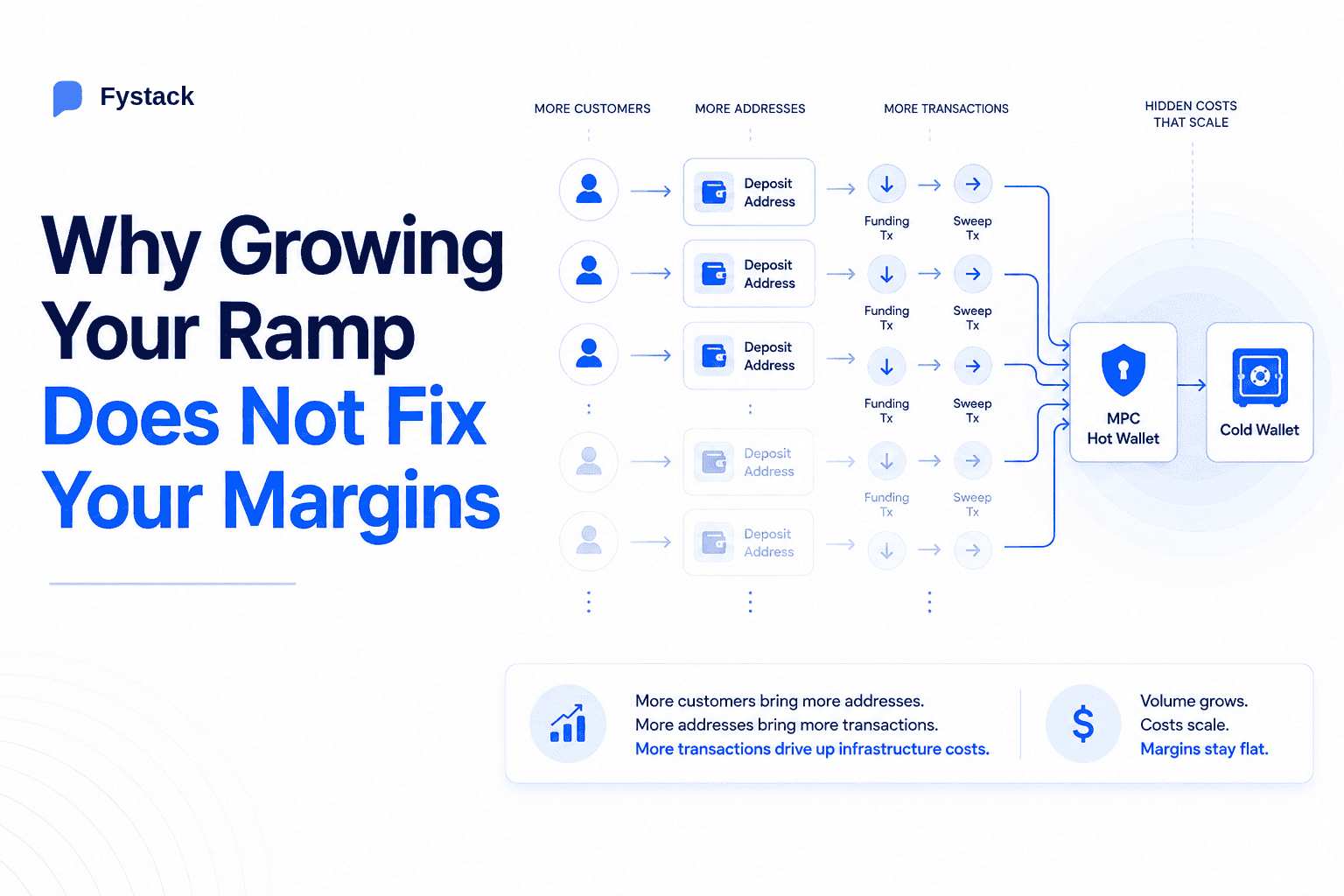
In the deposit address model most ramps run, each new address takes two on-chain transactions before it returns anything. Here is what a ramp transaction costs end to end, and which part an operator can still change.
Add a thousand customers and you add a thousand deposit addresses. In the standard model, each one takes two transactions before a cent of it reaches your hot wallet.
An engineer at a crypto exchange added his up. The answer came to roughly 270 million gas a month, at 50 deposits a day.
- 50 deposits/day times 2 transactions/deposit = 100 transactions/day
- 100 transactions/day times 30 days/month = 3,000 transactions/month
- 3,000 transactions/month times ~90,000 gas/transaction ~270M gas/month
Why Deposit Wallets Cost Two Transactions Each
A fresh deposit address arrives empty. It holds the customer's USDT but none of the native token needed to move it, so the platform funds the address first and sweeps it second. Both transactions are paid by the platform, on every deposit.
This is why volume does not rescue the number. Every extra customer brings an extra funding transaction with them, so the cost climbs at the same rate as the customer count while revenue per customer stays flat. That is one line on a longer bill.
What Every Ramp Transaction Costs
A $100 card purchase through Paybis delivers $91.82 in crypto. Three of the five lines belong to a counterparty.
Why Banking Costs Cannot Be Negotiated
Frax CEO Sam Kazemian quoted his JPMorgan banker word for word in 2024: "we have to close anyone's account that we know their primary source of income/wealth is crypto. This is directly from the top from Jamie."
Kept quiet about this for almost a year out of fear but since I'm in good company with @tyler @cameron @brian_armstrong @elonmusk now..Last December, I got a call from JPM saying "we have to close anyone's account that we know their primary source of income/wealth is crypto. This… https://t.co/xvJrO5eots
— sam.frax (@samkazemian) November 28, 2024
In December 2025 JPMorgan froze accounts belonging to Blindpay and Kontigo over disputed transactions.
Licensing has not changed the pattern. 338 firms now hold full MiCA authorisation across 30 EEA markets, up from around 60 at the start of the year, and banks still decline them.
MiCA carries no provision requiring a bank to serve a licensed CASP, while the European Banking Authority continues to treat the sector as enhanced due diligence whatever an individual firm has cleared. Around 86 percent of European crypto companies report repeated account closures.
An operator carrying a 10 percent reserve has no lever to pull on any of this, which sends them back to the last row of the table.
How TRON Prices New Deposit Addresses
TRON holds more than 51 percent of all USDT in circulation, so a ramp settling in USDT is almost certainly running there.
TRON charges by the address. One published comparison put a transfer to a brand new address at 27.25 TRX, against 13.4 TRX to one that had been received before, which puts every customer's first transfer on the expensive path.
Justin Sun's Proposal #104 post confirms the energy unit price was halved in August 2025, the largest cut in TRON's history. The same post commits super representatives to quarterly fee reviews, so an operator's per transaction cost gets decided at a governance vote they do not attend.
On August 26, 2025, the Tron Super Representative community proposed to reduce Tron network fees by 60%. This is the largest fee reduction since the founding of the Tron network. The proposal has already passed and will take effect at 20:00 (GMT+8) this Friday!
— H.E. Justin Sun 👨🚀 🌞 (@justinsuntron) August 29, 2025
Here’s my view on…
Three Ways Ramps Reduce Sweeping Costs
Deterministic addresses with proxy contracts
The engineer from the opening rebuilt his sweeping on CREATE2 with ERC-1167 minimal proxies and, in that one implementation, cut gas consumption by 84 percent
Threshold sweeping
Small balances stay put until the amount clears the cost of moving it.

Fystack runs this as sweep tasks set on a USD value, with one task attached across many deposit wallets so a threshold change lands everywhere at once, and a gas tank keeping those wallets funded for the transfer.
// Create wallet with new sweep task
await sdk.createWallet({
  name: 'User Payment Wallet',
  walletType: WalletType.Standard,
  sweepTaskParams: {
    minTriggerValueUsd: '100.00',
    destinationWalletId: '123e4567-e89b-12d3-a456-426614174001',
    destinationType: 'internal_wallet'
  }
})
Energy acquired instead of burned
Staking TRX or renting from an energy pool both avoid the burn. Guarda published a comparison of 11 USDT transfers costing $76.79 burned against $17.96 rented.
A TRON DAO ambassador puts the unit economics near 5.5 TRX per 100,000 energy, enough for two USDT transfers, with the deposit returned when the rental ends.
USDT Transfers on TRON Are Evolving—and Energy Renting Is Why
— KC GMI 🐝/EARN FEES BACK ON HTX TraDefi (@KC_GMI) February 7, 2026
After switching USDT transfers to Energy Renting via JustLend, the difference is clear: burning TRX for transfers feels outdated. Energy renting turns TRON’s resource model into a practical advantage, and once you try… pic.twitter.com/jlyQ18YhVL
Rental turns the per transfer cost into a working capital decision:

A TRON withdrawal in Fystack with energy renting active: 2.97 TRX rented against 24.03 TRX burned, roughly $6.96 saved on one transfer.
Where to Start Cutting Sweeping Costs
Sweeping is the one cost line still open to a decision, and the spread between a naive build and a considered one runs wide enough to matter at ramp margins.
If deposit wallets are multiplying faster than revenue and nobody owns the sweeping bill, that number is worth pulling before the next volume step.
Fystack can help there: stablecoin custody and payment infra, self hosted, with threshold sweeping and TRON energy renting built in. The signing core, mpcium, is open source.
Frequently Asked Questions
What margin do crypto on off ramps operate at?
Institutional and OTC desks run spreads of 0.1 to 0.5 percent. Retail card ramps quote higher headline fees, though acquiring and reserves consume most of that, and the real profit comes from the exchange rate spread.
Why do banks close crypto payment company accounts?
Compliance monitoring costs banks more than these accounts return, so many decline the category outright. The pattern holds even for licensed firms, as the MiCA numbers show.
Is TRON cheaper than Ethereum for USDT settlement?
For USDT transfers TRON is usually cheaper, which is part of why it carries more than half of USDT supply. The cost depends on whether an operator burns TRX, stakes for energy, or rents it, and those three paths differ by roughly an order of magnitude.