Multi-Chain Wallet Infrastructure: 12 Things That Change When You Add a New Chain

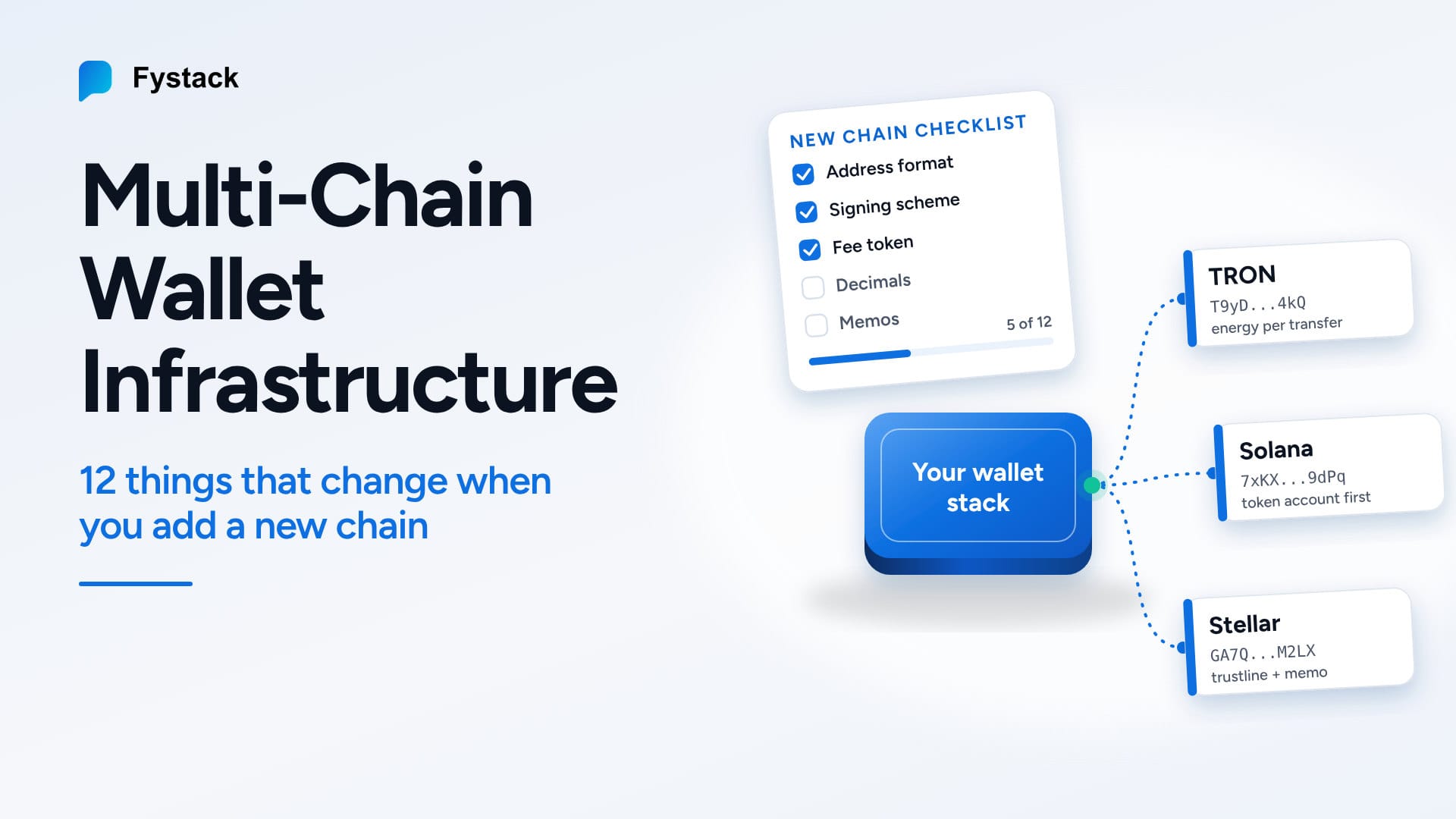
Adding a new chain looks like one line on the roadmap. In production, it is closer to twelve. Multi-chain wallet infrastructure has to handle a new address format, a new signing scheme, new nodes, new fee rules and new edge cases in your ledger, even when the stablecoin is the same USDC you already support.
Take a payment company that has run USDC on Ethereum for a year. A partner in the Philippines wants to settle on Stellar, and a large merchant asks for Solana. The product team pencils in two weeks per chain. The question this post answers is what those two weeks actually contain, so the team can set a launch date it will keep.
Key takeaways
- The same stablecoin behaves differently on each chain: address formats, signing schemes, fees, decimals and account setup all change.
- Most problems after launch come from money mechanics (fee tokens, decimals, memos) and from controls that were never extended to the new chain.
- We group the work into a 12-point New Chain Checklist across four areas: keys, connectivity, money mechanics and controls.
- Run one small real transfer through every step, from deposit to payout, before go-live.
Why Adding a Chain Is More Than One Line on the Roadmap
Adding a chain is more than one line because a wallet stack encodes many chain-specific assumptions, and each one has to be learned again. Your validation rules, address books, signer, deposit detection, fee handling and ledger were all written for the chains you already run.
This is why running a multi-chain stablecoin wallet is an operations problem as much as an integration problem. The New Chain Checklist below breaks the work into 12 items, grouped by where they bite.
Keys and Signing
The first two items decide whether you can hold and move funds on the new chain at all.
1. Address format
Ethereum and other EVM chains use addresses that start with 0x. TRON addresses start with T. Stellar addresses start with G. Every place that validates or stores an address has to change: input validation, address books, allowlists and screening lists.
2. Signing scheme
EVM chains and TRON use ECDSA on the secp256k1 curve. Solana and Stellar use EdDSA on Ed25519. If your signer only supports one, the new chain needs a second signing path, and with MPC wallet signing that means a second protocol, not just a new library. Fystack's open-source MPC engine, mpcium, supports both schemes for this reason.
Connecting and Detecting Deposits
The next three items decide whether you see money arrive, and when you trust it.
3. Nodes and RPC
You need your own node or a provider for each chain, plus a fallback. A single provider outage on one chain stops deposits and payouts there, even when every other chain is healthy.
4. Deposit detection
Each chain reports token transfers differently. EVM chains emit transfer events from the token contract. Solana records changes to token accounts. Stellar records payment operations. Your indexer needs chain-specific logic to turn these into one "deposit received" event.
5. Finality
Decide what counts as "done" before you credit a customer. On most chains that means a number of confirmations. On Stellar, a transaction is final once its ledger closes, so there are no extra confirmations to wait for. Crediting too early risks reversals on chains with reorganisations. Crediting too late slows every payout.
Money Mechanics: Fees, Accounts, Decimals and Memos
These four items cause most of the surprises after launch, because they look like small details until real money moves.
6. Fee token
Every chain charges network fees in its own token: ETH, SOL, TRX or XLM. A wallet with USDC but no fee token cannot send the USDC. Someone, or something, has to keep fee balances topped up across every address.
7. Account setup
Some chains need setup before an address can hold a token. On Stellar, an account needs a trustline to hold USDC, and each trustline locks a small XLM reserve. On Solana, each wallet needs a token account for USDC, funded with a small amount of SOL. On TRON, sending USDT to an address that has never held USDT uses about twice the energy of a normal transfer: around 130,000 energy instead of around 65,000, according to CatFee's measurements. Renting energy instead of burning TRX can cut TRON network fees by up to 60%.
8. Decimals
The same coin can have different decimals on different chains. USDC uses 6 decimals on Ethereum. Binance-Peg USDC on BNB Chain uses 18. Hard-code the wrong one and an amount is off by a factor of a trillion (10 to the power of 12).
9. Memos
Many exchanges use one shared deposit address on Stellar and tell customers apart by a memo. If a customer sends without the memo, the funds arrive but nobody knows whose they are. Your payout flow has to collect and send memos, and your deposit flow has to handle missing ones. Our Stellar custody guide covers the chain's other operational quirks.
| Chain | Address starts with | Signing | Fee token | Before an address holds USDC or USDT | Watch out for |
| Ethereum and EVM L2s | 0x | ECDSA (secp256k1) | ETH | Nothing extra | A low-fee transaction blocks later ones (nonce) |
| BNB Chain | 0x | ECDSA (secp256k1) | BNB | Nothing extra | Binance-Peg USDC uses 18 decimals, not 6 |
| TRON | T | ECDSA (secp256k1) | TRX or energy | Nothing extra, but the first USDT to a new address uses about 2x energy | Energy cost per transfer |
| Solana | No fixed prefix | EdDSA (Ed25519) | SOL | A token account funded with a little SOL | A transaction is dropped when its blockhash expires |
| Stellar | G | EdDSA (Ed25519) | XLM | A trustline plus a small XLM reserve | Memos on shared addresses; final when the ledger closes |
Controls and Operations
The last three items decide whether the new chain is as safe and as auditable as the old ones.
10. Policies and screening
Withdrawal limits, approval rules, address allowlists and sanctions screening all need coverage on the new chain. A common gap is a new chain that goes live with transfers working and policies still configured only for the old chains.
11. Stuck transactions
Failures look different on each chain. On EVM chains, a transaction with too low a fee blocks every later one from the same address, because transactions must run in order (by nonce). On Solana, a transaction that waits too long is dropped once its recent blockhash expires. Your retry logic needs a playbook per chain.
12. Reconciliation
New fee tokens, decimals and memos all land in your ledger. Each transfer now has a fee paid in a different asset, an amount that needs the right decimal conversion, and sometimes a memo that maps it to a customer. Our guide to stablecoin treasury automation shows how sweeps and ledger events fit together.
How to Test a New Chain Before Go-Live
The most reliable test is one small real transfer through every step on mainnet: deposit, detection, crediting, sweep, approval, payout and reconciliation. Test networks miss real fee markets, real RPC limits and real exchange behaviour.
For our payment company, that means sending a few dollars of USDC from a real exchange account to a Stellar deposit address with a memo, sweeping it, paying it out to the Philippine partner and checking that the ledger shows the right amount, fee and customer. Then the same on Solana, from a wallet that has never held USDC. Each item on the New Chain Checklist either passes or shows up as a broken step.
Teams that support TRON should run the same test from a brand-new address, since the first USDT transfer there behaves differently from later ones. Our guide to TRON USDT custody covers freeze risk and energy in more depth.
What to Look for in a Unified Multi-Chain Wallet API
A unified multi-chain wallet API should absorb the 12 items above, so adding a chain changes a configuration rather than your codebase. Before you choose one, check which items it handles for you and which it leaves to your team.
| Checklist area | Question to ask | What a good answer looks like |
| Keys and signing | Does the signer support both ECDSA and EdDSA? | Both, behind the same approval flow |
| Nodes and detection | Who runs the nodes, and what happens when one fails? | Managed nodes with a fallback, plus the option to use your own |
| Finality | Can we set crediting rules per chain? | Per-chain rules that are documented |
| Fees and account setup | Who keeps fee balances and token accounts funded? | Automatic gas top-ups and account setup |
| Decimals and memos | How are amounts and memos returned by the API? | One amount format across chains, memos supported where the chain uses them |
| Controls | Do policies, allowlists and screening apply on every chain? | The same policy engine on every supported chain |
| Reconciliation | What does a deposit or withdrawal event contain? | Transaction hash, amount, fee and fee asset, memo and your reference |
Building in-house gives full control and makes sense when chains are core to your product and you have a blockchain team. Using a provider is usually faster when chains are a means to an end, as for most payment companies. The trade-off is dependence on the provider's chain roadmap, so check which chains it supports today, not which it plans to add.
Fystack is self-hosted custody infrastructure built around this problem. It offers one API across its supported chains, gas sponsorship that tops up fee balances automatically, threshold-based sweeps, approval policies and address allowlists, so each new chain does not mean rebuilding these layers. Supported networks are listed in the Fystack docs. The trade-off: self-hosting means your team runs the servers.
If you are planning your next chain, see the networks Fystack supports.
FAQ
What changes when you add a new blockchain to a wallet stack?
Address formats, signing schemes, node connections, deposit detection, finality rules, fee tokens, account setup, token decimals, memos, policies, stuck-transaction handling and reconciliation. Even the same stablecoin behaves differently on each chain.
Why does the same USDC need different handling on each chain?
USDC is issued separately on each chain, with chain-specific contracts, decimals and account rules. Bridged versions can differ further, such as Binance-Peg USDC on BNB Chain using 18 decimals instead of 6.
What is multi-chain wallet infrastructure?
It is the layer that lets a business create addresses, detect deposits, sign and send transactions, and apply policies across several blockchains through one interface.
How do I test a new chain before launch?
Send one small real transfer through every step on mainnet, from deposit to payout and reconciliation, including from a brand-new address and with a memo where the chain uses them.