
Control USDT and USDC on TRON, ETH, and Solana - What Is the Gap of Managing Your Multi-Chain Stablecoin Treasury?

Your treasury holds $4.2M in stablecoins across three chains. Ask your finance team for the current balance right now. Watch how long it takes.
The treasury lead opens three browser tabs: Tronscan for the USDT balance on TRON, Etherscan for the USDC on Ethereum, and Solscan for whatever is sitting on Solana. They will write three numbers into a spreadsheet, note the timestamps, and try to produce one figure. By the time that figure exists, it is already wrong.
This is not a tooling problem. It is a structural one. Multi-chain treasury creates blind spots that no spreadsheet is designed to close, and the bigger your stablecoin volume grows, the wider those blind spots get.
What this guide covers:
- Why stablecoin treasury gets structurally harder as you add more chains
- How TRON, Ethereum, and Solana differ in ways that matter to finance teams
- The five operational blind spots that create invisible risk in multi-chain treasury
- Why USDT and USDC are not interchangeable from a CFO's perspective
- What control actually means at the infrastructure level - signing policy, segregation, and audit trail
- What good custody architecture looks like, and how to close the gap
Why Multi-Chain Treasury Is Structurally Different
When your stablecoin operations span a single chain, treasury management is relatively contained. One explorer. One confirmation model. One fee structure. One settlement finality. Your risk surface is bounded.
The moment you add a second or third chain, that containment breaks. Not because stablecoins are unreliable, but because each chain operates under a completely different set of assumptions, and those assumptions have real operational consequences for finance teams.
The table below summarises how the three most widely used stablecoin chains compare on the dimensions that matter most to treasury operations.
| Dimension | TRON | Ethereum | Solana |
| Typical finality | ~3 seconds (19 block confirmations recommended for high value) | ~12–15 minutes (2 epoch finalisation) | ~0.4s slot; ~13s soft finality (32 slots) |
| Fee structure | Energy + Bandwidth model; low cost with staked or rented Energy; variable when resources are unavailable | Variable gas pricing under EIP-1559; fees fluctuate with network demand | Low transaction fees; priority fee market during congestion |
| Primary stablecoin | USDT dominant; >$80B supply, ~97–98% of TRON stablecoin volume | USDC and USDT both liquid; USDC preferred for compliance | USDC dominant; USDT available but lower volume |
| Audit trail quality | Good; TRC-20 logs readable but less developer tooling than ETH | Richest on-chain data; ERC-20 event logs highly structured; best for compliance | SPL token model; account-based; requires specialist tooling to parse |
| Typical use in APAC | OTC settlement, remittance corridors, on/off ramp for retail volume | B2B settlement, cross-border treasury, institutional flows | Payments, consumer apps, growing neobank integrations |
The implication is straightforward: a stablecoin treasury that spans all three chains is managing three different operational realities simultaneously. A balance that is "confirmed" on Solana in under a second may take 15 minutes on Ethereum. Transaction costs vary significantly across chains and can change over time based on network conditions. And the data format you get from Tronscan is not the same format you get from Etherscan.
None of this is a reason to avoid multi-chain operations. The opposite, in fact - TRON's low fees make it ideal for high-frequency settlement, Ethereum's rich data makes it ideal for compliance reporting, and Solana's throughput is increasingly attractive for payment applications. But the operational model has to catch up with the technical reality.
USDT and USDC Are Not the Same Asset
This is the point that gets papered over most often in treasury discussions, and it deserves direct treatment.
USDT and USDC both peg to the US dollar. Both are liquid. Both appear on a balance sheet as "stablecoins." But from a CFO's perspective, they carry materially different risk profiles. Lumping them together into a single treasury line item is a compliance and governance weakness.
| Factor | USDT (Tether) | USDC (Circle) |
| Issuer | Tether Limited (British Virgin Islands) | Circle Internet Financial (US-regulated) |
| Reserve transparency | Quarterly attestations; claims T-bills and cash equivalents | Monthly attestations by Grant Thornton; US banks and US Treasuries |
| Regulatory posture | Ongoing scrutiny; $41M CFTC settlement (2021); not on some regulated platforms | Licensed in multiple jurisdictions; actively pursuing EU MiCA and US federal licensing |
| Blacklisting | Yes — Tether can freeze individual addresses on law enforcement request | Yes — Circle has freeze capability with more transparent process documentation |
| Best fit for | High-volume settlement, APAC OTC, remittance where USDT liquidity dominates | Compliance-sensitive flows, institutional settlement, regulated entity requirements |
| Market cap (2025–2026) | ~$150–187B (largest stablecoin globally) | ~$60–75B (second largest; rapid growth 2024–2025) |
CFO takeaway: If your treasury holds both USDT and USDC, your reporting layer needs to tag them separately, not just by chain, but by issuer. Counterparty exposure to Tether and counterparty exposure to Circle are different risks. They should appear as separate line items in any serious treasury management framework.
Understand how seedless MPC wallet architecture eliminates single points of failure while enabling clean USDT/USDC segregation at the infrastructure level. Read the Fystack guide to MPC wallets
The Five Operational Blind Spots
Here is where the structural differences above translate into day-to-day risk. These are not theoretical edge cases. Each of the following blind spots is a failure mode that finance teams at scaling fintechs have encountered in practice.
1. No Unified Balance Snapshot
When your treasury spans TRON, Ethereum, and Solana, there is no single query that returns your total position. You are pulling data from three different explorers, three different APIs, with three different confirmation times. If you need a real-time snapshot, for a board report, a risk review, or a regulatory filing, you are manually reconciling numbers that were never generated at the same moment.
The problem compounds when you hold the same asset type (say, USDT) across multiple chains simultaneously. Your spreadsheet says $4.2M USDT, but that figure is the sum of a TRON balance checked three minutes ago, an Ethereum balance that reflects a pending transaction, and a Solana balance that updated in real time. These are not equivalent data points.
2. Confirmation Time Mismatch Creates Phantom Liquidity
Different chains reach finality at different speeds, and the gap between "broadcasted" and "final" is meaningful for treasury operations. According to Ethereum's documentation, transaction finality under Proof of Stake takes approximately two epochs, around 12 to 15 minutes. TRON reaches practical finality in seconds. Solana achieves slot confirmation in under a second, though 32-slot soft finality takes around 13 seconds.
If your internal dashboard marks a transaction as "available" at broadcast rather than at finality, you are operating with phantom liquidity. This is a balance sheet accuracy problem, and in regulated environments, it is also a compliance problem.
3. USDT and USDC Are Collapsed Into One Line Item
As covered above, treating USDT and USDC as a single "stablecoin" category in treasury reporting understates counterparty risk. But the problem runs deeper than reporting. If your custody infrastructure does not tag and segregate by issuer, you cannot enforce issuer-specific policies at the transaction level, for example, routing compliance-sensitive B2B settlements exclusively through USDC, or restricting USDT exposure above a certain threshold.
4. Wallet Segregation Breaks Down at Scale
Sound treasury practice requires clear separation between hot wallets (operational float), warm wallets (short-term reserve), and cold wallets (long-term custody). In a multi-chain environment, this segregation has to be enforced at the infrastructure level, not just documented in a policy.
Many fintechs begin with clean segregation on a single chain and then gradually expand multi-chain operations without updating their wallet architecture. The result: a TRON hot wallet that also holds reserve balances, an Ethereum address used for both operational payments and custody, and no reliable way to enforce spending limits consistently across chains.
5. Audit Trail Is Fragmented Across Three Data Formats
When your external auditors or a regulatory examiner asks for a complete transaction history of your stablecoin treasury, what do you produce? On Ethereum, ERC-20 event logs are structured and machine-readable. On TRON, TRC-20 data is accessible but formatted differently. On Solana, the account-based model requires specialist tooling to parse correctly.
Rebuilding a unified audit trail post-hoc from three different explorers is time-consuming, error-prone, and, in some jurisdictions, may not meet regulator expectations for contemporaneous record-keeping. The audit trail needs to be generated at the infrastructure level, not reconstructed after the fact.
The Gas Token Management Problem Nobody Talks About
Managing a multi-chain stablecoin treasury is not just about tracking USDT and USDC balances. There is a second operational layer that creates constant friction: the native gas tokens required to move those stablecoins in the first place.
On Ethereum, every USDC transfer requires ETH for gas. On Solana, every transaction requires SOL. On TRON, the mechanism is more complex: USDT transfers require Energy and Bandwidth, two separate resource types that must be available in the sending wallet. If they are not, the TRON network burns TRX to cover them.
This creates three compounding problems for treasury teams.
| Problem | What actually happens | Treasury impact |
| Liquidity fragmentation | To move $1M USDT on TRON, the sending wallet needs a separate TRX balance. If TRX hits zero, the transaction fails — regardless of how much USDT is available. | Emergency bottlenecks. Finance teams maintaining manual TRX top-up processes across dozens of addresses. Settlement delays at the worst possible moment. |
| P&L volatility from gas exposure | Holding ETH, TRX, or SOL as operational reserves means holding volatile native assets. Their price moves independently of your stablecoin operations. | Unwanted market exposure on the balance sheet. Fee cost projections become unreliable when the gas token doubles or halves in value within a quarter. |
| Fee unpredictability on TRON | TRON's resource model (Energy + Bandwidth) means fees are not a flat rate. Without pre-staked Energy, each USDT transfer burns 6.5 to 13 TRX. Cost per transfer varies with TRX price and network congestion. | As TRX rose from $0.12 to $0.32 through 2024 to Q3 2025, the effective cost of a USDT transfer on TRON more than doubled — with no change in the underlying stablecoin operation. |
The TRON fee situation in more detail
TRON deserves specific attention because it is the highest-volume stablecoin rail in APAC, processing over $24.6 billion in daily USDT transfers, nearly seven times the volume of Ethereum. At that scale, fee management is a material cost line, not a minor operational detail.
A standard USDT transfer on TRON requires approximately 65,000 Energy units. Without pre-staked Energy in the sending wallet, TRON burns roughly 6.4 TRX per transaction to cover the shortfall. At peak TRX prices in 2025, that translated to $2+ per transfer before the network's August 2025 fee cut took effect. For a fintech processing thousands of USDT settlements per day, that figure compounds quickly.
The practical solution is Energy rental: instead of burning TRX, operations teams rent Energy temporarily through services integrated into the custody layer. Rented Energy costs roughly 2.9 TRX per USDT transfer, approximately 60% less than burning. The catch: managing this manually across high-volume wallets adds another operational process that breaks down at scale.
How Fystack handles this: Fystack's Gas Station centralises gas reserves across all supported chains and automates wallet funding, so treasury teams do not manually monitor native token balances per address. For TRON specifically, Fystack integrates TronZap Energy Renting directly into its MPC wallet infrastructure, eliminating TRX pre-funding and reducing TRON gas costs by up to 60% for high-volume USDT flows.
 Thi Nguyen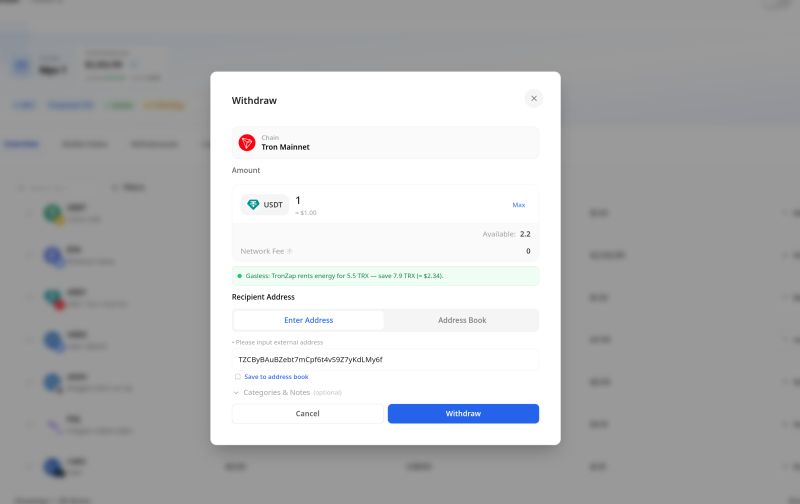
The cost saving compounds: a fintech running 5,000 USDT transfers per day on TRON can reduce gas overhead by more than half without changing any part of the settlement workflow.
| Chain | Gas model | Treasury risk without Gas Station | With Fystack Gas Station |
| TRON | Energy + Bandwidth; burns TRX if insufficient; 6.5 to 13 TRX per transfer without Energy | Manual TRX top-up per wallet; failed transactions if TRX depleted; fee cost tied to TRX price volatility | TronZap Energy Renting integrated; automated delegation; up to 60% fee reduction; no manual TRX management |
| Ethereum | ETH gas; base fee + priority fee; highly variable; can spike during network congestion | ETH reserves required per address; ETH price exposure on balance sheet; timing-sensitive transfers affected by gas spikes | Centralised ETH gas tank; automated top-up across wallets; single reserve monitored at infrastructure level |
| Solana | SOL fees; near-zero base; priority fee market since 2024; very low absolute cost per transfer | Low-risk but still requires SOL balance per wallet; during high-congestion periods priority fees can spike unexpectedly | Automated SOL funding from central reserve; consistent fee coverage regardless of network conditions |
The deeper point is architectural. Gas token management is not a problem that scales gracefully with manual processes. At low volume, a treasury lead can monitor TRX balances and top up wallets as needed. At high volume - thousands of USDT transfers per day across multiple chains - the manual approach creates a systemic operational risk. One depleted wallet at the wrong time becomes a settlement failure, a compliance gap, or a missed SLA.
Custody infrastructure that handles gas management natively, at the infrastructure layer, removes this operational category entirely from the treasury team's daily workflow.
What Control Actually Means at the Infrastructure Level
CFOs often think of treasury control in terms of policies and processes: who can approve a transaction, what the signing authority thresholds are, how often reconciliations happen. These are necessary. But in a multi-chain environment, policy-level controls are insufficient unless the underlying infrastructure enforces them consistently across all chains.
Three areas where infrastructure control matters most:
| Control dimension | What it means in practice | Where it breaks without proper infra |
| Signing policy consistency | Same approval threshold (e.g. 3-of-5) applied uniformly across TRON, ETH, and Solana wallets | Different thresholds per chain → weaker chain becomes the path of least resistance |
| Wallet segregation enforcement | Hot/warm/cold separation enforced at key management level, not just labelled in spreadsheets | Compromised hot wallet key can access reserve funds if boundaries exist only in documentation |
| Unified policy engine | Spending limits, counterparty whitelists, and asset-type restrictions applied at custody layer across all chains | Whitelisted address on ETH is not automatically whitelisted on TRON without a cross-chain policy engine |
The architecture that solves this is not a dashboard. It is custody infrastructure with native multi-chain support, where key management, policy enforcement, and transaction signing are handled by a single system with a unified view, rather than a patchwork of chain-specific tools.
How MPC key management works, and why it is the foundation for consistent signing policy across multiple chains. Explore Fystack's MPC architecture overview
What Good Custody Architecture Looks Like for Multi-Chain Treasury
The following is a practical checklist for evaluating whether your custody infrastructure can actually support multi-chain stablecoin treasury operations. These are minimum requirements, not aspirational features.
| Requirement | Why it matters | Red flag if absent |
| Unified balance view with per-chain breakdown | Real-time treasury position without manual reconciliation | Finance team maintains a master spreadsheet aggregating from multiple explorer APIs |
| Per-chain confirmation threshold settings | Define what "settled" means per chain based on risk tolerance | All chains treated as instantly final, or forced to same wait time regardless of finality model |
| Asset-type tagging (USDT vs USDC) | Enables issuer-level reporting and policy enforcement | All stablecoins reported as one category with no issuer distinction |
| Wallet segregation at infra level | Prevents cross-contamination between operational and reserve funds | Segregation exists only in naming conventions or documentation |
| Cross-chain audit log with consistent timestamps | Single source of truth for compliance reporting and external audit | Audit reconstruction requires pulling from three explorers in three different formats |
| Consistent signing policy across all chains | Eliminates the weakest-link problem in multi-signature approval | Signing thresholds configured separately per chain, no central policy engine |