Best Crypto Cards in Singapore (2026): FX Fees, Cashback, MAS Status and SGD Support Compared

Unlike the US or Europe, Singapore does not need crypto cards to replace its banks. The city already runs one of the fastest payment systems in the world. Crypto cards survive here for a different reason: cross-border treasury spending, stablecoin payroll, and cheaper regional FX. They are not trying to beat Visa at buying coffee.
TL;DR
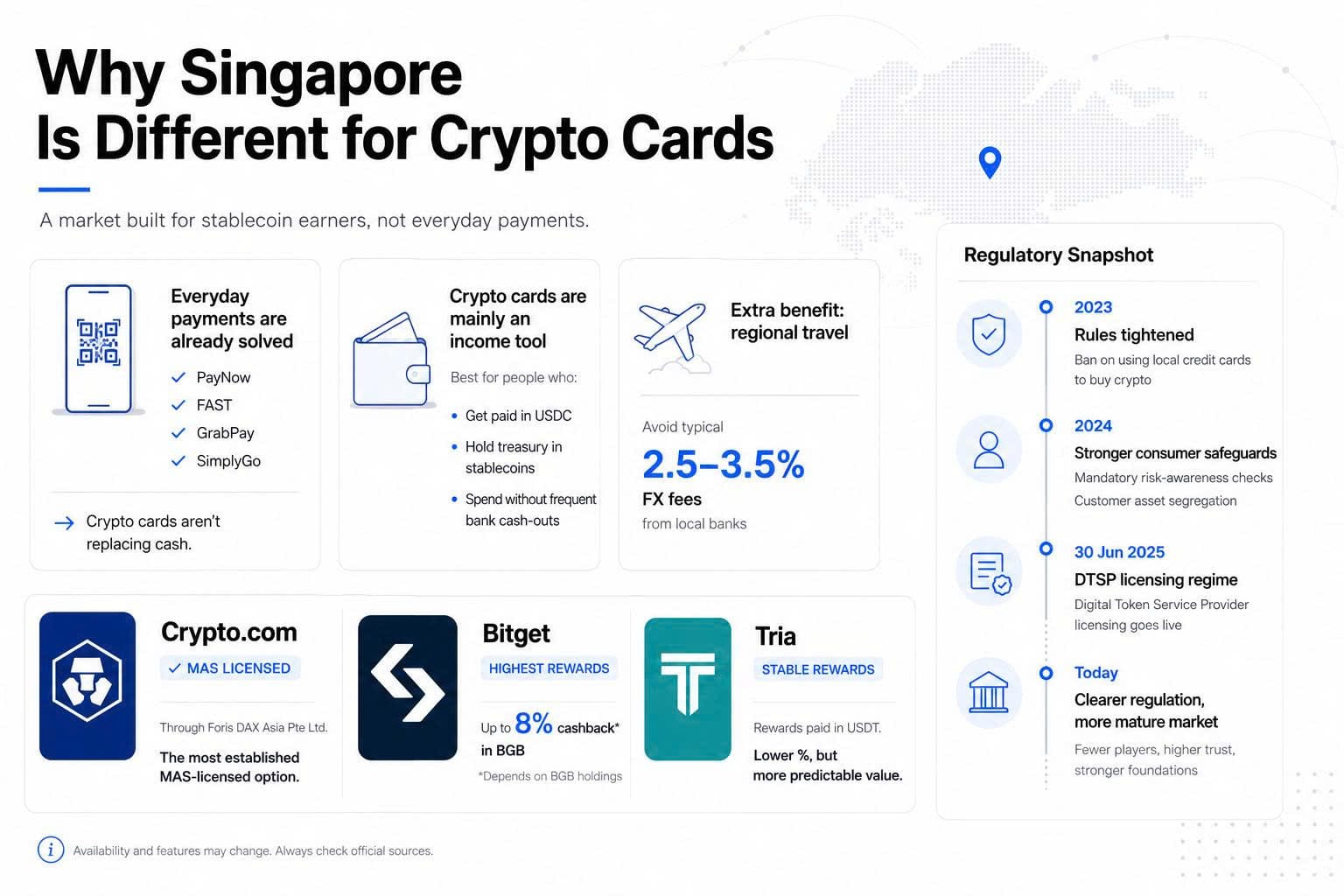
Singapore is one of the most unusual crypto card markets in Asia. Day-to-day demand is low, because PayNow, FAST, GrabPay, and SimplyGo already cover most spending.
But regulatory clarity and product maturity are among the strongest in the region, thanks to a dense population of founders, VCs, and Web3 staff who get paid in stablecoins.
A crypto card here is not really a payments tool. It is an income tool. It exists for people who are paid in USDC, who want to hold a treasury in stablecoins instead of converting constantly, or who do not want to cash out through a bank every time they spend.
It is also useful for spending crypto that has gained value (Singapore does not tax personal capital gains) and for regional travel, where DBS, OCBC, and UOB typically charge 2.5 to 3.5 percent on foreign currency transactions.
Why Singapore Is a Paradox Market
1. This is an income problem, not a payment problem.
Singapore does not have a payments gap. Visa and Mastercard are accepted almost everywhere, and PayNow reaches most of the population. So what is a crypto card actually for?
Three real user groups explain it. Web3 employees who get paid in USDC. Traders who do not want to cash out through a bank account every time they spend. Freelancers and founders who want to hold a treasury in stablecoins rather than converting back and forth into SGD. That is the real job to be done here, not replacing a debit card.
2. Low demand, high product quality.
Most Singapore residents are already fully banked. Apple Pay, GrabPay, and PayNow are everywhere, so everyday adoption of crypto cards stays low. But because Singapore concentrates so many founders, VCs, and stablecoin-salaried workers, and because MAS runs one of the clearest regulatory frameworks in the region, the cards built for this market tend to be more compliant and better built than cards aimed at markets with higher crypto spending but looser oversight.
3. Crypto cards are becoming a treasury tool, not just a personal spending tool.
A growing number of DAOs, startups, and agencies now hold treasury in USDC and spend it directly through a crypto card, covering hotels, flights, and SaaS subscriptions without routing everything through a traditional corporate bank account. This B2B angle rarely shows up in consumer card comparison articles.
Quick Comparison
| Need | Best card |
| Lowest FX fee | Bitget Card, Crypto.com Icy, Kolo (0% advertised FX) |
| Highest raw cashback | Bitget Card (up to 8% BGB) |
| Spending USDC directly | Jupiter Global (self-custody, Solana wallet) |
| Frequent regional travel | Bitget Card or Crypto.com Icy |
| Self-custody, keep your own keys | Tria Signature, ether.fi Core |
| Free card to test with | KAST K Card, Kolo Card |
| High spenders who want lounge access | Plasma One Platinum, xPlace Platinum |
| MAS-licensed issuer | Crypto.com (Foris DAX Asia) |
What Is a Crypto Card?
A crypto card is a Visa or Mastercard, issued as a debit, prepaid, or "crypto-backed credit" card, that you load with crypto or stablecoins and use anywhere the card network is accepted. The amount converts to SGD (or sometimes USD) at the moment you pay.
There are two custody models worth understanding before you compare any cards:
Custodial means the issuer holds your assets on your behalf, similar to using a centralized exchange account. Crypto.com, Bitget, KAST, and Kolo work this way.
Self-custody (also called non-custodial) means you hold your own private keys, and the card simply draws from your own wallet. Tria, ether.fi, Plasma One, and Jupiter Global work this way.
Neither model is automatically "better." Custodial cards are usually simpler to use day to day. Self-custody cards give you more control but ask you to manage your own wallet security.
Throughout this guide, "crypto card" covers crypto debit cards, prepaid crypto cards, Visa crypto cards, and stablecoin spending cards. People search for these terms interchangeably (crypto debit card Singapore, crypto Visa card Singapore, stablecoin card Singapore, USDC card Singapore), and they generally refer to the same category of product.
Key Facts (Singapore, July 2026)
- More than 40 crypto cards are tracked as globally available in Singapore, but only a small number are issued through a MAS-licensed Singapore entity
- Traditional bank FX fees (DBS, OCBC, UOB) on non-SGD transactions: roughly 2.5 to 3.5 percent
- FX fees on the better crypto cards: 0 to 1.8 percent
- Singapore does not tax personal capital gains, so crypto held as a personal investment and spent through a card is generally not a taxable event
- Current GST rate: 9 percent
How We Ranked
This guide compares crypto cards available in Singapore using the following criteria:
- FX fee when spending outside SGD
- Realized cashback after transaction fees, not just the headline rate
- Annual or issuance fees
- Regulatory status, meaning whether the issuing entity appears on the MAS Financial Institutions Directory
- Card network (Visa or Mastercard) and custody model
- SGD support and funding channels such as PayNow and FAST
- ATM withdrawal support and Apple Pay or Google Pay availability
- Global acceptance
Fee and reward data was cross-checked against MAS's own announcements on regulatory changes and IRAS's tax guidance for digital tokens, plus a specialist crypto card comparison source (SpendNode) for individual card figures. Cashback and fee terms change often, so verify current numbers directly with each issuer before applying.
Top Crypto Cards in Singapore, Compared
| Card | Base cashback | FX fee | Annual fee | Card type | Custody | MAS-licensed entity? |
| Crypto.com Icy White / Rose Gold | 4% (requires a CRO stake) | 0% | Not published | Prepaid | Custodial | Yes, through Foris DAX Asia Pte Ltd |
| Bitget Card | 0.5% to 8%, depending on BGB holdings, not fixed | 0% plus a 0.9% transaction fee | Free | Debit | Custodial | No, not through a MAS-licensed Singapore entity |
| Tria Signature | 4.5% on the first SGD 1,000 spent per month | 1% plus 0.5% per payment | About USD 109/year | Debit | Self-custody | No |
| ether.fi Core Card | 3%, no staking required | 1% | Free | Crypto-backed credit | Self-custody | No |
| Jupiter Global | 2% base, 4% for a month after a qualifying referral | 0% on USD-billed spend, 1 to 1.8% otherwise | Free | Virtual debit | Hybrid | No |
| Kolo Card | 2%, paid in BTC | 0% | Free | Prepaid | Custodial | No |
| KAST K Card | 1.5%, capped at the first USD 2,000 spent per month | 0.5% | Free | Prepaid | Custodial | No |
| Plasma One Platinum | 4% base (requires locking 100,000 XPL) | 1% | Free, but token lockup required | Crypto-backed credit | Self-custody | No |
| xPlace Platinum | 4%, paid in USDC | 0% | About USD 999/year | Crypto-backed credit | Self-custody | No |
A few notes on reading this table.
The FX fee column shows the fee each issuer advertises. Card networks like Visa and Mastercard can still apply their own small conversion spread on top, so an advertised 0% FX fee does not always mean zero total conversion cost.
Headline cashback rates like Bitget's 8% usually depend on holding a large amount of that issuer's token, so most users will earn less than the advertised maximum unless they meet that tier.
Advertised Cashback vs. Realized Reward
This distinction matters more than most comparison articles admit. A cashback percentage is only worth what it says if it is paid in something stable.
Nominal cashback is not the same as net cashback. The rate printed on a card's marketing page is the starting point, not the final number. To get from one to the other, subtract each of these in order:
- FX fee (the currency conversion cost on non-SGD spend)
- Network spread (the small markup Visa or Mastercard may add on top of the advertised FX fee)
- Token price volatility (if the reward is paid in a token rather than a stablecoin, its value can rise or fall before you use it)
- Staking or lockup requirements (capital you must lock up to unlock a cashback tier, which carries its own opportunity cost)
What is left after those deductions is your actual, realized reward, and it can look very different from the number in the headline.
Bitget advertises up to 8% cashback in BGB, its own exchange token. If BGB's price drops 25% before you convert or spend it, your realized reward could end up far lower than 8%, sometimes even a net loss compared to what you paid in fees.
Tria takes the opposite approach. It pays cashback in USDT, a stablecoin pegged to the US dollar. The advertised rate is lower (4.5% on the first SGD 1,000 of monthly spend), but the value does not swing with token prices.
When comparing cards, always ask what currency the reward is paid in, and what you had to lock up to earn it, before comparing headline percentages directly.
Pros and Cons by Card
| Card | Pros | Cons |
| Crypto.com Icy | MAS-licensed issuer, Changi lounge access, stable cashback rate | Requires locking a large amount of CRO to keep the tier; reward value depends on CRO's price |
| Bitget Card | Highest advertised cashback (up to 8%), 0% FX fee | Requires holding significant BGB to reach top tiers; 0.9% transaction fee applies |
| Tria Signature | Cashback paid in USDT, so less price risk; self-custody | Cashback only applies to the first SGD 1,000 spent each month; annual fee |
| ether.fi Core | Free, no staking required, lets ETH holders keep earning staking yield while spending | 1% FX fee on non-SGD spend |
| Jupiter Global | Completely free; a good fit for USDC salary earners | FX fee rises to 1 to 1.8% on non-USD spend |
| Kolo Card | Free, 0% FX, passive BTC accumulation | Cashback rate is modest compared to the top cards |
| KAST K Card | Free, easy to test | Cashback capped at a low monthly spend (around USD 30/month max) |
| Plasma One Platinum | High cashback, yield on stablecoin balances, travel perks | Requires locking 100,000 XPL for 12 months, which carries token price risk |
| xPlace Platinum | No token lockup, 0% FX, very high spending limit | High annual fee (about USD 999/year) |
Which Card Fits Which Type of User
| Persona | Best card | Why |
| Digital nomad who travels the region often | Bitget Card | High raw cashback plus 0% FX on trips like Singapore-Kuala Lumpur or Singapore-Bangkok |
| Crypto founder who needs clear legal standing | Crypto.com (Foris DAX Asia) | The issuing entity is listed on the MAS Financial Institutions Directory |
| Web3 employee paid in USDC | Jupiter Global | Free, funds directly from a self-custody Solana wallet, 0% FX on USD-billed spend |
| DeFi native who wants to hold their own keys | Tria Signature or ether.fi Core | Self-custody, with cashback paid in USDT or no staking requirement |
| Startup or DAO managing a stablecoin treasury | ether.fi Core or Jupiter Global | Lets you spend directly from an on-chain treasury without routing through a corporate bank account |
FX Fees Should Be Compared Against MYR, THB, and IDR, Not Just USD
Singapore residents rarely fly to the US regularly. Their common destinations are Johor Bahru, Bangkok, Bali or Jakarta, Tokyo, and Seoul. So the more useful FX benchmark is SGD to MYR, SGD to THB, and SGD to IDR, not SGD to USD, which is what most crypto card comparisons default to.
| Destination | How often people go | Bank FX fee (DBS/OCBC/UOB) | Benefit of a 0% FX card |
| Johor Bahru (MYR) | Weekend trips, shopping and dining | About 3.0 to 3.25% | Direct savings on every swipe across the causeway |
| Bangkok (THB) | A few times a year, leisure or business | About 2.5 to 3.5% | Adds up meaningfully over a multi-day trip |
| Jakarta or Bali (IDR) | Business or leisure travel | About 2.5 to 3.5%, often wider for IDR | Bigger savings, since IDR spreads tend to run wider |
| Tokyo (JPY) | Higher-end leisure travel | About 2.5 to 3.5% | Frequent foreign spending can make FX costs add up quickly, making low-FX cards more valuable. |
For a Singapore resident who travels the region regularly, a card's FX fee usually matters more than its headline cashback rate.
Crypto Cards vs. Traditional Multi-Currency Cards (Wise, YouTrip)
| Need | Crypto card | Wise | YouTrip |
| Spend USDC or USDT directly | Yes | No | No |
| Low or 0% FX fee | Depends on the card | Yes | Yes |
| Cashback paid in crypto | Yes | No | No |
| MAS-licensed issuer | Depends (Crypto.com yes, most others no) | Yes | Yes |
| Good fit for stablecoin treasury or income | Yes | No | No |
| Good fit if you just want to solve travel FX | Not necessary | Yes | Yes |
If your only goal is avoiding FX fees while traveling, and crypto is not otherwise part of your finances, Wise or YouTrip is the simpler choice. Neither requires holding crypto or going through crypto-specific KYC.
Crypto Card Regulation in Singapore
MAS is not really trying to ban crypto cards. It is separating customer assets from company balance sheets, a lesson drawn directly from FTX's collapse. That framing explains the last two years of rule changes better than reading them as a plain list of laws. The goal is that if an exchange or card issuer fails, Singapore users' funds are not pooled with the company's own funds and lost along with it.
On the technical side, the Monetary Authority of Singapore (MAS) regulates crypto services under the Payment Services Act (PSA) 2019, amended in 2021. Exchanges and card-adjacent services need a Major Payment Institution (MPI) or Standard Payment Institution (SPI) licence to offer Digital Payment Token (DPT) services. You can check which entities hold these licences on the MAS Financial Institutions Directory.
The 2023-2025 Tightening
A few key rules landed over this period.
In November 2023, MAS confirmed that locally issued credit cards could no longer be used to buy digital payment tokens. It also required DPT providers to assess new retail customers' risk awareness before letting them trade.
On 4 October 2024, customer asset safeguarding rules took effect. Licensed DPT firms now have to keep customer assets in trust accounts, separated from the company's own operating funds.
From 30 June 2025, the Digital Token Service Provider (DTSP) licensing regime under the Financial Services and Markets Act 2022 came into force. Any Singapore-incorporated entity providing digital token services to overseas clients now needs a DTSP licence, and MAS has said it will only grant one in "extremely limited circumstances." The maximum penalty for operating without one is SGD 250,000 in fines or three years in prison.
In practice, this rule targets Singapore-incorporated firms serving customers outside the country. It does not stop Singapore residents from using cards issued by globally licensed providers. It did push some firms, including Bitget, to publicly confirm plans to relocate staff to Dubai and Hong Kong.
Which Issuers Are Active, and Which Have Exited
Binance left Singapore's retail market back in 2021-2022, after MAS told it to stop soliciting Singapore users. Binance Card is not available here.
Bybit's card is not available to Singapore residents, and Bybit currently sits on MAS's Investor Alert List.
Wirex offers a multi-currency Visa card in some markets. Before applying in Singapore, check the latest availability and licensing status on Wirex's official website and the MAS Financial Institutions Directory.
Crypto.com, through Foris DAX Asia Pte Ltd, remains the clearest MAS-licensed option among the crypto-first cards.
Is Spending Crypto Through a Card Taxed in Singapore?
Singapore does not tax capital gains. Under IRAS guidance, gains from disposing of digital tokens held as a long-term personal investment are generally not taxable for individuals. But there are three distinct scenarios worth separating clearly.
Disposing of a personal investment. If you bought crypto and held it long-term, then spent or sold it, this is generally not taxable.
Trading or business-like activity. High-frequency, high-volume buying and selling can be treated as a business rather than a personal investment. IRAS applies what is called a "badges of trade" test, looking at frequency, volume, holding period, and intent. If your activity gets classed this way, it is taxed as ordinary income at progressive rates, reaching 22 to 24% at the top bracket from the 2024 assessment year onward.
Tokens received as salary or payment for work. If you are paid in USDC as employment income, that is taxed as ordinary income at the same progressive rates as a SGD salary, regardless of what currency it is paid in.
On GST: paying with a digital token does not add an extra layer of GST. The 9% GST rate still applies to the underlying goods or services you buy, charged by the merchant as usual.
This is general information, not tax advice. Keep records of your cost basis, acquisition dates, and counterparties, and talk to a tax professional if your situation is not straightforward.
How to Choose the Right Crypto Card in Singapore
Start with the FX fee. If you regularly spend outside SGD, whether traveling or shopping on foreign websites, a 0% FX card like Bitget or Crypto.com Icy will save you meaningfully more than the 2.5 to 3.5% that DBS, OCBC, and UOB typically charge.
Next, think about custody model. If you want to keep control of your own assets and avoid relying on an exchange's operational risk, self-custody cards like Tria or ether.fi offer greater control over your assets, though they require you to manage your own wallet security.
Consider what you are actually holding. If you have crypto that has appreciated significantly and want to take advantage of Singapore's no-capital-gains-tax treatment, a card that spends directly from your wallet without routing through an exchange cuts out a step. If your income already comes in as a stablecoin salary, a free card like Jupiter Global is a better fit than one that requires staking a token.
Factor in regulatory comfort. If legal clarity matters to you, stick with issuers listed on the MAS Financial Institutions Directory. Right now, that mainly means Crypto.com through Foris DAX Asia.
Finally, do not overlook ATM access and Apple Pay or Google Pay support. This affects your daily experience far more than the headline cashback rate, especially since physical cards typically take 3 to 7 business days to arrive in Singapore via SingPost.
Related Reading
The treasury use case mentioned earlier, spending directly from an on-chain stablecoin balance, depends on how that balance is secured behind the scenes. If you want to go deeper on that side of the stack, see our guides on MPC wallets, stablecoin custody, USDC, and treasury management.
FAQ
Is spending crypto through a card legal in Singapore?
Yes. MAS regulates crypto-related services under the Payment Services Act 2019. Issuers with a MAS licence, such as Crypto.com through Foris DAX Asia, operate legally and under supervision. Singapore residents can also use cards from providers licensed elsewhere without breaking local rules.
Which crypto cards have 0% FX fees in Singapore?
Bitget Card, Crypto.com Icy, Kolo Card, and xPlace Platinum all advertise a 0% FX fee. Some still charge a separate transaction fee. Bitget, for example, adds a 0.9% transaction fee even though its FX fee is 0%.
Do Binance Card or Bybit Card work in Singapore?
No. Binance exited Singapore's retail market in 2021-2022. Bybit's card is not available to Singapore residents, and Bybit currently appears on MAS's Investor Alert List.
Is crypto card spending taxed in Singapore?
Singapore does not tax personal capital gains, so spending crypto held as a personal investment is generally not taxable. Tokens received as salary are taxed as ordinary income at progressive rates, and high-frequency trading activity can be reclassified as a business and taxed accordingly.
This article is general information, not financial or tax advice. Fees, cashback rates, and licensing status change frequently, so confirm current details directly with each issuer before applying.