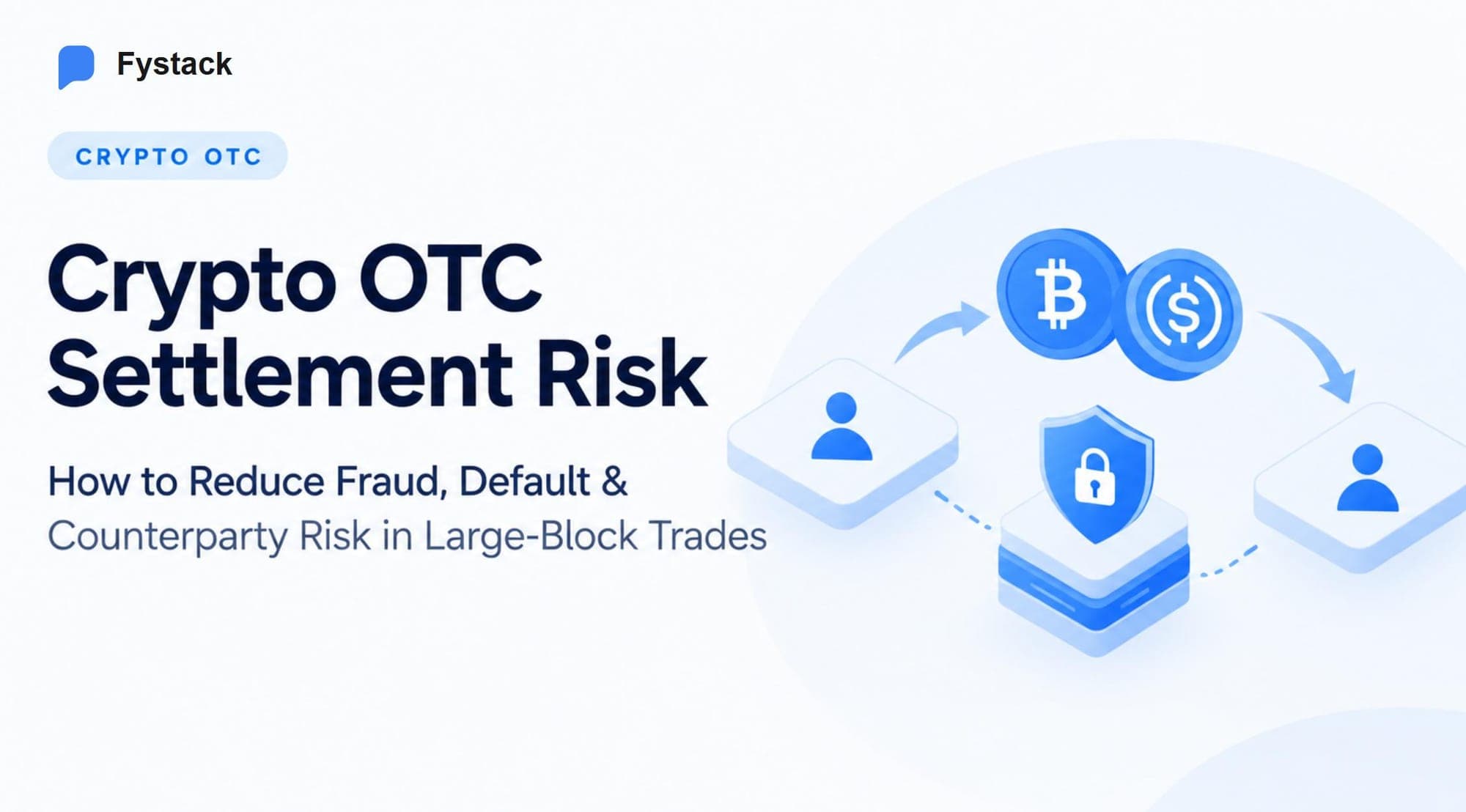
Crypto OTC Settlement Risk: How to Reduce Fraud, Default, and Counterparty Risk in Large-Block Trades

A $500,000 crypto OTC trade rarely fails because someone miscalculated the price. It fails because the wrong person confirmed the deal, the funds went to the wrong wallet, the fiat transfer arrived late, or the counterparty failed to pay after receiving the crypto.
OTC desks can agree a large block trade in minutes. But settlement can take much longer. For many OTC workflows, it still depends on chat-based instructions, shared spreadsheets, payment confirmations, and manual wallet operations. As ticket sizes move from $100,000 toward $1 million and beyond, a small operational gap can turn into a large loss.
According to Finery Markets' 2026 institutional OTC outlook, 40% of surveyed institutions now name OTC as their first-choice execution venue, routing more than half of their trading activity off-screen.
The real question is not how to execute trades faster. It is how to increase settlement capacity without increasing operational risk at the same rate.
Crypto OTC settlement risk is not a pricing problem. It is a control problem.
Key Takeaways
- Crypto OTC settlement risk comes from counterparty default, payment diversion, confirmation disputes, and operational errors.
- Pre-funding reduces counterparty exposure, while post-funding leaves the desk exposed until payment is complete.
- Quorum approval and controlled settlement reduce operational risk, but they do not eliminate counterparty risk.
What Is Crypto OTC Settlement Risk?
Crypto OTC settlement risk is the financial and operational risk that a privately negotiated crypto trade fails, partially or fully, between the moment two parties agree on the trade and the moment both sides have received what they are owed.
For a typical OTC trade, that means moving two things: crypto and fiat or stablecoins. The trade may be agreed quickly, but the two legs do not always move at the same time.
That difference matters. When one side has already delivered value and the other side has not, someone is carrying exposure. The longer that window remains open, the more opportunity there is for fraud, operational mistakes, payment delays, or counterparty default.
Crypto OTC Settlement Risk: 3 Failure Points in Large-Block Trades
Most crypto OTC settlement risk comes down to a few recurring points in the workflow. They do not require a hacked exchange or a broken smart contract. They can happen during an ordinary trade when information moves between people, systems, and payment rails.
1. Counterparty Impersonation and Payment Diversion
Buyer A negotiates with an OTC desk, which in turn settles with Seller B.
An attacker does not need to intercept the whole conversation to break this. Compromising an account, impersonating an authorized contact, or redirecting payment instructions midway through the deal can be enough to change where the money goes. The desk still believes it is settling with the right counterparty. What has changed is who instructed the transfer and where the funds are going.
This is sometimes called payment diversion fraud or business email compromise. It is also related to the broader concept of a man-in-the-middle attack.
KYC establishes a counterparty's identity at onboarding. It does not authenticate every settlement instruction that follows.
2. Confirmation Disputes From Network and Messaging Delay
A trader quotes a price for BTC/USDT. The counterparty confirms. Agreeing on a trade is not the same as completing it, and the gap between the two is where disputes can start.
A network delay, a missed message, or a slow reply can leave both sides with a different understanding of the execution time, price, amount, or settlement deadline. Nobody has to act in bad faith for this to happen.
A trade moves through three practical states: trade agreed, settlement authorized, and settlement executed. Confirmation disputes become harder to resolve when a desk cannot clearly show when each state was reached.
3. Counterparty Default After Crypto Delivery
The desk sends $500,000 of crypto. The counterparty receives it. The fiat payment does not arrive, arrives late, or arrives short.
Once a blockchain transaction reaches the required confirmations, it generally cannot be unilaterally reversed by the sender. For the period between sending crypto and receiving fiat, the desk is carrying credit exposure to the counterparty.
This is what makes the choice between pre-funding and post-funding important.
Pre-Funding vs. Post-Funding OTC: Where the Exposure Sits
Every OTC desk sits somewhere between two settlement models, and each one moves exposure to a different place rather than removing it.
Pre-Funding OTC: Lower Counterparty Exposure, Higher Capital Friction
In a pre-funded model, the counterparty sends fiat or stablecoin before crypto is released. The buyer pays first, so the desk is not taking the same risk of delivering crypto before receiving payment.
This materially reduces counterparty credit exposure because the funds are already in hand. It does not eliminate settlement risk entirely. Fraud, misattributed payments, and compliance issues can still happen before the crypto is released.
The trade-off is capital friction. The counterparty's capital is committed earlier, which can make pre-funding harder to use with new relationships or counterparties that are not yet comfortable trusting the desk first.
Post-Funding OTC: Less Upfront Friction, More Settlement Exposure
In a post-funded model, the desk sends crypto first and waits for fiat or stablecoin to arrive. This can reduce upfront friction and make the process easier for established counterparties.
It does not automatically make settlement faster. Actual speed still depends on the banking rail, blockchain confirmation times, and compliance checks.
What it does change is who carries the exposure. Until the payment leg completes, the desk has already transferred the asset and is waiting for the counterparty to perform.
| Dimension | Pre-Funding OTC | Post-Funding OTC |
| Counterparty exposure | Lower: funds received before crypto is released | Higher: desk carries exposure until payment arrives |
| Capital efficiency | Lower: counterparty capital locked earlier | Higher: no upfront capital lock for the counterparty |
| Execution speed | Slower to start: waits on incoming funds | Depends on banking rail and confirmations |
| Best fit for | New or higher-risk counterparties | Established counterparties, verified payment history |
Neither model eliminates crypto OTC settlement risk. In traditional finance, delivery-versus-payment (DvP) settlement ties both legs of a trade together: the asset and the cash move at the same moment, or neither moves at all.
Many bilateral crypto OTC trades still settle the two legs as separate steps. The space between those steps determines how much value is exposed at once.
Call this the Settlement Gap: the window between trade confirmation and the point where both legs are complete. The important question is not simply whether a desk uses pre-funding or post-funding. It is how wide the settlement gap is, and what controls exist inside it.
Institutional OTC Risk Management: Separating Trade Execution From Fund Control
As deal flow grows, the instinct is often to add more people and more manual checks. But more people do not necessarily create better controls.
A trader may confirm a deal over Telegram, an operator may copy the wallet address by hand, finance may check a spreadsheet, and a manager may approve the transfer over chat. Adding another person to that chain does not close the settlement gap. It creates another handoff, another place for an error, and another person who can be socially engineered.
Institutional OTC risk management is less about how many people look at a transaction and more about whether the people who can approve a transfer are structurally different from the person who requested it.
Separating Trade Execution From Treasury Authorization
The person who finds the deal should not automatically be the same person who can move the funds. Traders can own sourcing, pricing, negotiation, client communication, and settlement requests. Treasury or operations can verify settlement details, confirm the counterparty, check the destination wallet, and authorize the fund movement.
This separation requires more than a written policy. The wallet infrastructure also needs to enforce who can initiate, verify, and approve a transaction.
For more on how role-based access can structure custody operations, see Digital Asset Custody Platform Onboarding on Fystack: Creating a Workspace & Role-Based Access.
A Four-Layer Operating Model for OTC Settlement
Desks that want to scale settlement without scaling risk can organize the workflow around four layers:
- Trade layer: pricing, negotiation, and client relationship
- Risk layer: counterparty verification, screening, and exposure limits
- Treasury layer: fund custody and settlement authorization
- Settlement layer: transaction approval, execution, and audit trail
The trader does not need to become slower. The important part is that fund movement does not depend on one person's judgment alone.
Quorum Approval: A Control Layer for Large-Block Crypto OTC Settlement
Separating trade execution from treasury authorization is the principle. Quorum approval is one way to enforce it in practice.
Imagine a trader agrees to sell $750,000 of BTC and submits a settlement request. The trader can create the transaction but cannot move the funds alone. The request goes to an approval group, where two of three authorized treasury approvers review and approve it. Only then can the wallet execute the transfer.
If the trader's account is compromised, the attacker still cannot move the funds alone.
Quorum approval means a transaction needs a predefined number of authorized approvers, such as 2-of-3, before it can execute. The group size and threshold are policy choices rather than a fixed industry rule.
| Risk | Single-Operator Workflow | Quorum Approval Workflow |
| Wrong destination wallet | One operator can approve and send alone | Multiple approvers independently verify |
| Trader account compromise | Trader can initiate and execute alone | Trader can request, not execute alone |
| Internal fraud | Single point of control | Segregation of duties |
| Operational error | One mistake triggers the transfer | Independent review catches errors first |
| Large single-ticket exposure | One person can authorize the full ticket | Full ticket needs multiple approvals |
Quorum approval fixes the internal control layer: insider risk, unauthorized transfers, single-operator compromise, and operational error. It does not fix counterparty credit risk, a counterparty's failure to pay, or blockchain congestion. Those require different controls.
Example Approval Policy
There is no universal approval threshold for OTC desks. Actual limits should reflect ticket size, counterparty risk, liquidity, and internal risk appetite.
For example:
- Below $100,000: single approval
- $100,000 to $500,000: 2-of-3 approval
- $500,000 to $1,000,000+: 2-of-3 or 3-of-5, depending on treasury policy and counterparty history
A threshold nobody hits is not a control.
A policy engine that enforces the threshold before signing turns quorum approval from a guideline into an actual control. Fystack's custody infrastructure is built around this model, combining MPC-based key management with multi-party approval at the signing layer.
Crypto OTC Escrow and Controlled Settlement
Quorum approval controls who can authorize a transfer. Escrow and other controlled-settlement mechanisms control when the transfer actually happens relative to the rest of the deal.
Why Crypto OTC Escrow Matters for Large-Block Trades
Between "trade confirmed" and "funds received," there is a settlement window that can run from seconds to much longer, depending on the payment rail, asset, and counterparty.
Escrow can reduce the value exposed during that window by making the release of funds conditional on predefined requirements.
In an institutional context, escrow can have a specific legal or contractual meaning, and not every controlled-settlement approach is a formal escrow arrangement. The operational principle is the same: value should not move simply because someone says the trade is ready. It should move when the required conditions have been verified.
What Counts as Settlement Evidence?
Before releasing funds, a desk needs enough evidence to show that the trade is ready to settle. That evidence usually comes from three places:
- Blockchain evidence: transaction hash, destination address, amount, and confirmation depth
- Off-chain evidence: bank transfer confirmation, payment reference, and settlement instruction
- Internal evidence: approved trade, approved counterparty, and completed approval quorum
The more valuable the transaction, the more important it becomes to keep these records connected rather than scattered across chats, spreadsheets, and separate systems.
Pre-Funding vs Escrow: Two Different Ways to Control Exposure
Pre-funding reduces exposure by changing the order of settlement: payment arrives before delivery.
Escrow reduces exposure by making release conditional on verified settlement requirements, regardless of which leg happens first.
Pre-funding changes the sequence. Escrow changes the condition.
The two approaches are not interchangeable, and a desk does not necessarily have to choose one. They can work together when the value of the transaction justifies multiple layers of control.
How Fystack Helps OTC Desks Scale Settlement Without Scaling Operational Risk
Fystack is self-hosted custody infrastructure built around MPC-based key management, so the desk's controls do not depend on a third-party custodian's internal review process.
| OTC Desk Challenge | How Self-Hosted Custody Infrastructure Helps |
| Single-person fund control | Quorum policy enforced at the signing layer |
| Manual wallet operations | Wallets and limits enforced as policy, not by hand |
| Large exposure on one ticket | Approval thresholds scale with ticket size |
| Inconsistent verification | Approval and execution captured in an owned audit trail |
| Scaling deal volume | Standardized controls across transaction volume |
Fystack provides a security and control layer across the settlement workflow:
- MPC-based key management: Fystack uses MPC to remove the need for a single private key to exist in one place, reducing the impact of a single point of compromise.
- Multi-party approval: Quorum approval can require multiple authorized parties to approve a transaction before signing. A trader can initiate a settlement request without having the ability to move funds alone.
- Policy enforcement: Spending limits, transaction rules, and destination controls can be enforced programmatically rather than relying on manual checks or written procedures.
- Self-hosted infrastructure: Fystack is self-hosted, giving institutions direct control over their custody infrastructure and operational environment instead of depending on a third-party custodian to manage the underlying system.
- HSM-backed security: For organizations with additional hardware security requirements, Fystack can support HSM-backed key protection alongside its MPC-based architecture.
- Auditability: Approval activity and transaction history are captured in an auditable trail, making it easier to connect who requested, reviewed, approved, and executed a settlement.
These controls address different parts of the settlement gap. MPC helps protect key material. Quorum controls who can authorize a transaction. Policy controls what the system allows. Self-hosting gives the institution control over its infrastructure and data environment. Audit trails provide evidence of what happened.
The point is not to replace the desk's risk policy. It is to give that policy a way to operate during the transaction itself.
A policy tells people what they should do. Infrastructure determines what the system will allow them to do.
A Practical Crypto OTC Settlement Risk Checklist
Before releasing funds on a large-block trade, a desk should be able to answer yes to each of the following:
- Is the counterparty independently verified, not just confirmed over chat?
- Is the trade instruction unambiguous: price, amount, asset, and deadline?
- Is the destination wallet address verified through a second channel?
- Is the trade within the desk's approved exposure limit?
- Has the required approval quorum actually been reached?
- Has payment or fiat transfer evidence been independently verified?
- Is the blockchain transaction confirmed to the desk's required depth?
- Is there a complete, exportable audit trail for the settlement?
If the honest answer to several of these is "we trust the trader," the desk may have more settlement exposure than its trade volume alone suggests.
FAQ: Crypto OTC Settlement Risk
What is settlement risk in crypto OTC trading?
Crypto OTC settlement risk is the risk that a privately negotiated trade fails, partially or fully, between price agreement and the point where both the crypto and fiat or stablecoin legs are exchanged. It includes counterparty default, fraud, payment delays, and operational errors.
How is settlement risk different from counterparty risk?
Counterparty risk is one component of settlement risk: the risk that the other party fails to meet its obligation. Settlement risk is broader and also covers payment delays, incorrect instructions, and operational errors during the exchange process itself.
What is the difference between pre-funding and post-funding in OTC?
Pre-funding means the counterparty sends payment before receiving crypto. This lowers the desk's exposure but increases capital friction.
Post-funding means the desk sends crypto first and waits for payment. This reduces upfront friction but leaves the desk exposed until payment arrives.
What is quorum approval in crypto custody?
Quorum approval requires a set number of authorized approvers, such as two of three, to approve a transaction before it can execute. It reduces the risk that one trader or operator can move funds alone, but it does not remove counterparty credit risk.
Fystack provides self-hosted digital asset custody infrastructure for fintechs, payment providers, exchanges, OTC desks, and enterprises managing institutional-scale digital asset flows.
If you are evaluating your custody and compliance infrastructure, the Fystack team would be happy to discuss your requirements and explore the right implementation approach.