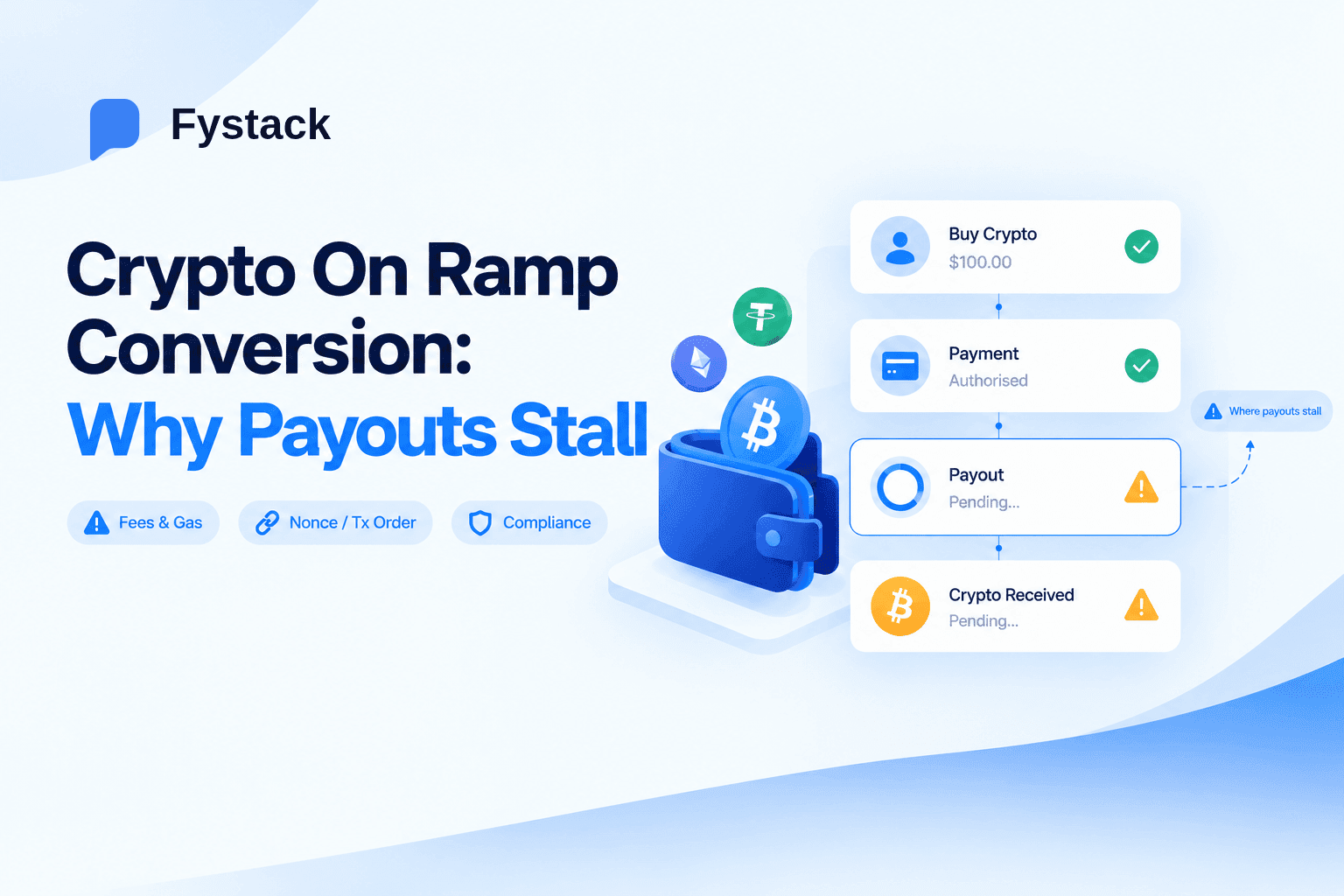
Crypto On Ramp Payout Delays: Why Withdrawals Stall

Ted Nguyen
Author
BD & Growth @Fystack
TL;DR
Only about one in five people who start a crypto purchase finish it, and a stalled payout churns the ones who did. Here is where payouts stall and what an operator can fix.
On 13 June 2022, Binance stopped Bitcoin withdrawals for about three hours. An underpriced consolidation batch blocked every customer withdrawal spending its output.
Binance absorbed it in a news cycle. For a smaller ramp, three hours of silence on paying customers converts straight into tickets and churn.
Post mortem of our temporary BTC network withdrawal suspension.
— Binance (@binance) June 13, 2022
🔸 Temporary pause duration: ~3 hours
🔸 Impact: $BTC network withdrawals only. Users could still withdraw #Bitcoin on other networks without delay (ERC20 & BEP20). Deposits unaffected.
🧵More details 👇
Crypto On Ramp Conversion Rate Benchmarks
Getting someone to the payout step is expensive. Onramper puts the industry figure at 22 percent of fiat to crypto transactions succeeding, and Mercuryo put its own rate at 21 percent in the first half of 2026. Both companies sell on-ramp infrastructure, so both numbers are self reported.
Card authorisation alone falls from 66 percent on orders under $26 to 19 percent above $5,000, across a survey of nine of the largest on-ramps.

Most of that loss happens before payment, at KYC, card authorisation, and payment method fit, all owned by regulators, issuers, and local markets. Anyone who reaches the payout step has cleared all three, leaving the remaining risk inside your own infrastructure.
How Pending Withdrawals Drive Support Complaints
Customers tolerate a wait they can watch. In a study cited by Nielsen Norman Group, people shown a moving progress bar were willing to wait three times longer on average than people shown nothing.
Of more than 8,300 US crypto complaints filed with the CFPB between 2018 and 2022, 16 percent were categorised as "money was not available when promised", the regulator's version of the same ticket.
Why Crypto Payouts Get Stuck
The public record points to three causes. The first two are decided by the platform sending the transaction, while the third answers to regulation as much as to internal policy.
Underpriced fees
MoonPay's incident history carries 15 crypto delivery incidents between October 2025 and September 2026, by our count roughly one every 23 days. One states the cause: "The orders were stuck due to a big spike in network fees." Banxa logged a 46.3 hour delivery delay in January 2026.
Transaction ordering
On Ethereum, every transaction from a wallet carries a sequence number called a nonce, and one stuck transaction holds up every later one. Geth treats anything arriving after a gap as non-executable, queues it, and evicts it after three hours by default. Replacing the stuck transaction takes a fee at least 10 percent higher than the original.
Mainstream JavaScript libraries still ship nonce bugs, including a 2026 viem issue that left a gap which never cleared, and a former Optimism engineer who interviewed six candidates for this work reported that "not one knew the answer," adding that he did not either.
Ethereum engineering puzzle 🧩
— Norswap 🏴☠️✨ (@norswap) June 16, 2024
You're writing a backend service that has to submit transactions to the chain using an in-memory private key. You might need to submit multiple transactions on the same block, and retry them if they don't land.
Pause here — do you already see an…
Compliance is measured in days
Kraken holds withdrawals for 24 hours, 72 hours, or seven days depending on the trigger. MoonPay says a flagged order may take up to 72 hours to clear review. MoonPay, Ramp Network, Transak, and Onramper all call delivery time an estimate, and none publishes an SLA for the crypto leg.
Fee pricing and nonce handling are worth raising directly with whoever runs your custody.
How to Reduce Crypto Payout Delays
The fastest delay to remove is the wait on a human approver. A $40 order held for manual review costs more in support time than it earns, and the customer sees the same silence Binance created for three hours. A policy rule with an Allow effect releases those orders straight to signing, while a Deny rule on hourly outflow sets a ceiling no Allow can override.
A payout wallet without native token cannot be sent at all, and the failure surfaces as a queue that stops moving. A gas tank funds source wallets automatically, and a balance alert fires before one empties. On TRON, a connected energy rental account covers each transfer, falling back to standard fees if that account itself runs dry.
None of this is visible to the person waiting. Each withdrawal moves through a fixed set of states, and a webhook fires on each one:
Those events arrive at your backend, which is what an order screen needs to show progress instead of a spinner. A withdrawal.failed lands the moment it happens, before the customer has any reason to open a ticket.
How to Measure Payout Speed
Most ramps can quote their card approval rate to the decimal and cannot say how long their last hundred payouts took from settlement to wallet, yet delivery time is what decides retention.
Fystack is stablecoin custody and payment infra, self hosted, with policy controlled payout approval, automated gas funding, and a webhook on every withdrawal state.
Frequently Asked Questions
What is a typical crypto on ramp conversion rate?
Published figures land near one in five. Onramper cites 22 percent and Mercuryo reported 21 percent for the first half of 2026, both self-reported by companies selling on-ramp infrastructure. Most of the loss happens before payment.
Why do crypto withdrawals get stuck?
Usually an underpriced fee, an earlier transaction from the same wallet blocking the queue, or a compliance hold.
How long should crypto delivery take after payment?
MoonPay, Ramp Network, Transak, and Onramper all call it an estimate rather than an SLA. The longest waits come from fiat settlement and compliance review, which MoonPay says can reach 72 hours.