Build vs. Buy Stablecoin Wallet Infrastructure: What Fintechs Should Consider

Ted Nguyen
Author
BD & Growth @Fystack
Every stablecoin ramp, payment gateway and OTC desk needs wallet infrastructure to receive, store and move customer funds. But building and operating that infrastructure comes with security, engineering and operational costs that are easy to underestimate.
In July 2025, Indian crypto exchange CoinDCX lost approximately $44 million from a single internal operational account. The company absorbed the loss using its own reserves, as TechCrunch reported.
For fintechs launching stablecoin payment rails, the decision to build wallet infrastructure in house or use an external provider affects more than development costs. It determines how much engineering capacity goes into custody, how security responsibilities are managed and how costs scale with transaction volume.
For most fintechs, buying is the more practical choice. The key is finding a provider with sustainable pricing, reliable security controls and a recovery process that does not leave the business dependent on a single vendor.
Key Takeaways
- Building costs more than development: Security specialists, infrastructure, audits and ongoing maintenance create a permanent operating expense.
- Engineering resources have an opportunity cost: Most fintechs gain more from improving payment workflows, local integrations and customer experience than maintaining wallet infrastructure.
- Buying requires careful vendor selection: Evaluate pricing at projected transaction volumes and make sure your business retains control over key recovery.
What Does Stablecoin Wallet Infrastructure Actually Cover?
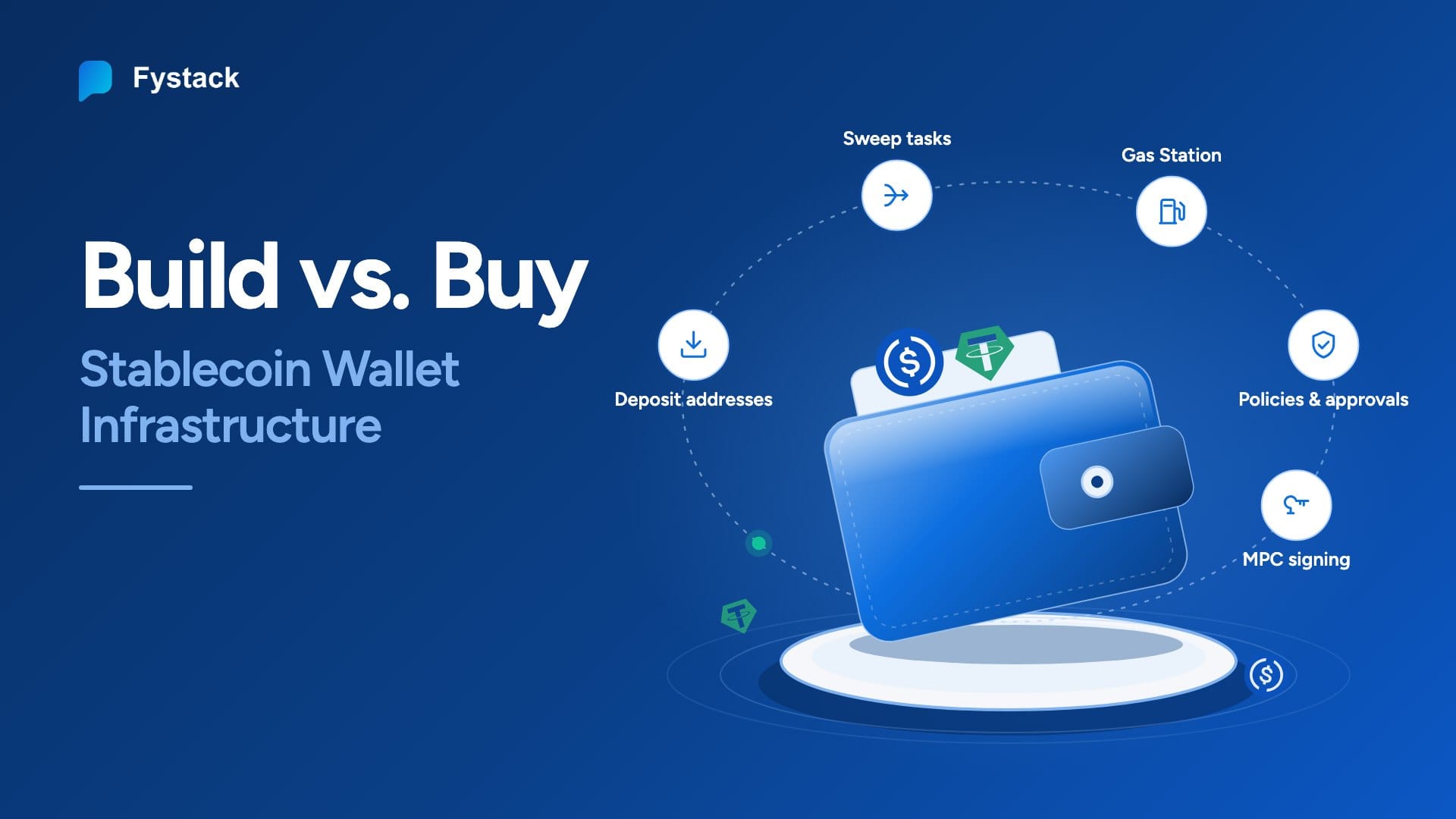
Stablecoin wallet infrastructure manages the full lifecycle of customer funds, from the moment a deposit arrives to the moment a withdrawal is completed.
A typical setup involves several connected components:
- Deposit addresses: Each customer receives a dedicated address to identify and reconcile incoming payments.
- Fund consolidation: Incoming deposits are swept into central treasury wallets for easier liquidity management.
- Gas management: Wallets need sufficient native tokens to pay blockchain transaction fees.
- Transaction approval: Withdrawal requests pass through predefined policies and approval workflows before execution.
- Key management and signing: Private key material must remain protected throughout the transaction lifecycle.
Each component is relatively straightforward in isolation. The challenge is making them work reliably together across multiple blockchain networks, while maintaining security, availability and accurate fund reconciliation.
Our stablecoin payment gateway build guide explores how these components fit into a production payment system.
The Real Cost of Building Wallet Infrastructure In House
Building wallet infrastructure is not a one-time engineering project. It creates an ongoing responsibility across five areas, each requiring dedicated resources.

Security is where the consequences are greatest. According to Chainalysis, attacks targeting private key infrastructure and signing processes accounted for 88% of losses at centralized services in the first quarter of 2025. The cybersecurity skills shortage makes this challenge harder: 88% of respondents in ISC2's 2025 workforce study reported at least one significant security incident linked to a skills shortage.
Time is another constraint. Wallet provider Para estimates that building a production-grade, multi-chain wallet system takes six to twelve months for a specialized team, before ongoing maintenance is considered. This is a vendor estimate, but it illustrates the engineering commitment involved in running stablecoin payment infrastructure in house.
The financial commitment therefore extends well beyond the initial launch. A business must continue funding the people, systems and security processes required to keep the infrastructure reliable.
Where Should Fintechs Spend Their Engineering Resources?
For stablecoin ramps and payment gateways, competitive advantage rarely comes from owning the wallet infrastructure itself. It comes from how efficiently the business moves money for its customers.
Three areas typically have a more direct impact on growth:
- Payout speed and reliability: Faster, more predictable withdrawals improve customer experience and reduce operational friction.
- Local payment integrations: Connecting with regional banks, payout partners and local payment methods expands market coverage.
- Pricing and liquidity: Competitive conversion rates and sufficient liquidity help businesses attract and retain customers.
Wallet infrastructure supports all three, but building it internally does not automatically make any of them better.
The opportunity cost matters. Engineering hours spent maintaining signing systems, monitoring gas balances and resolving failed sweeps are hours that cannot be spent improving payment products or expanding local integrations. And when payout delays already contribute to support requests, refunds and customer churn, those priorities become even more important.
For most fintechs, using an established wallet provider frees up resources to focus on the parts of the business that differentiate them in the market.
How to Evaluate Stablecoin Wallet Providers
Buying infrastructure reduces the burden of building and maintaining it, but choosing the wrong provider can create a different set of problems. Three areas deserve particular attention.
1. Model Pricing at Projected Transaction Volume
An attractive entry price does not necessarily translate into sustainable costs as the business grows.
Some providers impose volume limits or time restrictions on their entry plans. For example, Fireblocks offers its Essentials plan for up to six months before customers move to a custom arrangement, with published custom pricing starting at $36,000 per year. Utila moves customers exceeding $3 million in quarterly outbound volume to a custom plan without publishing the corresponding price.
Instead of comparing monthly subscription fees alone, model the total cost at several projected transaction volumes over the next 12 to 24 months.
Pay particular attention to:
- Included transaction volume and overage fees.
- Volume thresholds that trigger custom pricing.
- Contract duration and minimum commitments.
- Whether fees are based on transaction volume or assets under custody.
The pricing basis matters. Transaction-based fees generally move with payment activity, while custody-based fees increase with the value of assets held, even when transaction activity remains unchanged.
2. Check the Support Model
Infrastructure problems can directly affect customer funds and payment operations. When a sweep fails or a withdrawal gets stuck, the business needs a provider that can respond quickly.
Review the provider's support commitments, escalation process and availability. This is particularly important for startups and smaller fintechs that may not qualify for the same support arrangements as enterprise customers.
3. Retain Control Over Key Recovery
A provider should reduce operational complexity without becoming a single point of dependency.
Before signing a contract, establish what happens if the provider becomes unavailable, discontinues a service or can no longer support the business.
Look for the ability to export key material, documented recovery procedures and access to the signing implementation. Open-source signing components can provide an additional layer of transparency and reduce reliance on proprietary infrastructure.
Managing the Risks of Using an External Provider
Buying wallet infrastructure does not eliminate risk. It changes where some of that risk sits.
The WazirX incident in July 2024 illustrates the problem. Following a $230 million wallet exploit involving infrastructure operated with custody provider Liminal, both companies disputed responsibility, while customer withdrawals remained suspended.
Prime Trust offers another example. In 2023, the custody provider lost access to a wallet and reportedly spent $76.4 million on ETH to cover customer withdrawals before filing for bankruptcy.
These cases highlight why vendor selection should go beyond security certifications and product demonstrations.
A proper contingency plan should answer three questions:
- Can you recover your keys? The business should have a documented way to retrieve and restore key material without depending entirely on the provider.
- Can you continue operating? Understand how funds and signing operations can be migrated if the provider becomes unavailable.
- Can you verify the technology? Access to security documentation, architecture details and open-source components provides greater visibility into how the infrastructure works.
The objective is not to eliminate every dependency. It is to make sure that one provider's failure does not prevent the business from accessing or recovering its own funds.
Build or Buy: Which Approach Makes More Sense?
Building wallet infrastructure makes sense when custody technology is a core part of the product, the business has specialized security expertise and maintaining the infrastructure creates a genuine competitive advantage.
For most stablecoin ramps, payment gateways and OTC desks, buying is the more efficient route. It reduces the engineering and operational burden while allowing teams to concentrate on payment products, liquidity and market expansion.
But the decision should not end at choosing a provider. Pricing must remain viable as transaction volume grows, and the business must retain a clear path to recover its keys and continue operating independently.
Fystack provides stablecoin custody and payment infrastructure with pay-as-you-go pricing based on transaction volume. Each workspace supports key share export, while mpcium, Fystack's open-source signing engine, provides greater transparency into the signing layer.
Fystack also makes its security documentation, including ISO 27001 certification, available through its Trust Center.