Nigeria's CBN Stablecoin Rules: Licensing and Compliance Steps for Operators

Ted Nguyen
Author
BD & Growth @Fystack
Operating a stablecoin ramp, payment gateway or wallet service in Nigeria without the required Central Bank of Nigeria (CBN) approval can attract a minimum fine of ₦100 million, plus ₦1 million for each day the breach continues.
The penalty comes under the CBN's Regulations for the Operations of Non-Security Virtual Assets in Nigeria, effective 5 November 2026.
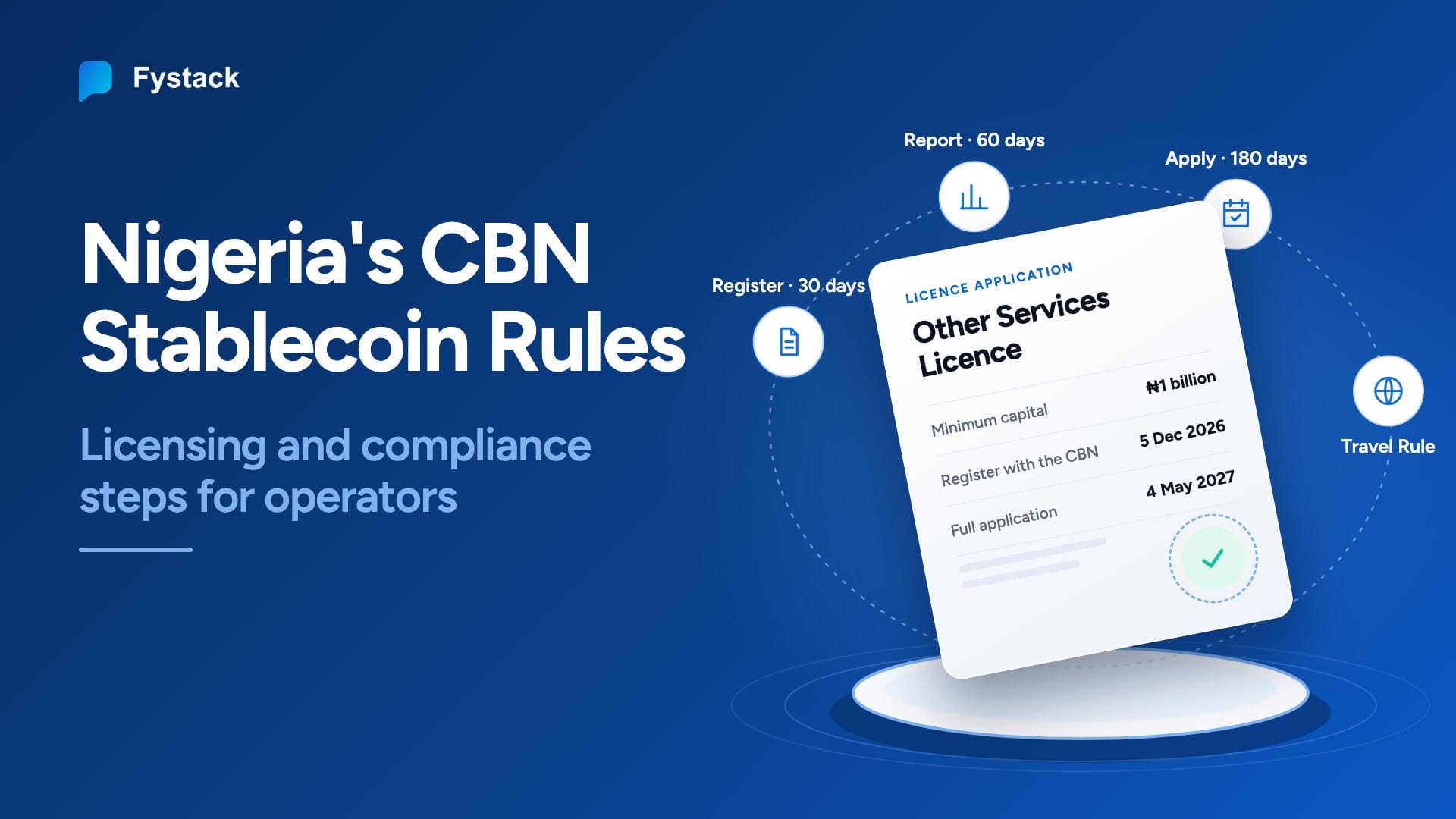
Existing operators have 180 days to obtain the appropriate licence or authorisation, with earlier registration and reporting deadlines. For most custody, gateway and wallet providers, the key requirements are a ₦1 billion capital floor and registration by 5 December 2026.
Key Takeaways
- Register with the CBN within 30 days, begin supervisory reporting within 60 days and submit a complete licence application within 180 days.
- Custody, gateway and wallet providers generally fall under the Other Services framework, with a ₦1 billion minimum capital requirement.
- Foreign operators serving Nigerian customers are also in scope and must assess local incorporation and management requirements.
What the CBN Stablecoin Rules Cover
The regulations cover stablecoin issuers and providers of non-security virtual asset services, including custody, wallets, payment gateways, transfers, remittances and settlement.
They apply to businesses operating in or from Nigeria, as well as foreign entities directing regulated services at Nigerian customers. An existing SEC licence does not automatically authorise non-security virtual asset activities. Businesses providing both types of services may need approval from both regulators.
Which Licence Does Your Business Need?
The CBN establishes three main licensing categories, alongside specific authorisation routes for existing regulated businesses.

The appropriate route depends on the operator's existing regulatory status. The ₦1 billion requirement also applies in addition to existing SEC or principal financial institution capital requirements.
P2P trading requires specific CBN approval within the relevant licence or authorisation. Holding an Other Services Licence alone does not automatically permit a business to operate a P2P platform.
CBN Registration Deadlines for Existing Operators
Existing operators must meet four milestones from the regulations' commencement date of 5 November 2026.

Until the application is decided, existing operators may continue only at their prevailing scale and under interim CBN conditions. The regulations do not define a universal threshold for prevailing scale, so businesses planning new corridors or higher transaction volumes should clarify their position with the CBN.
Missing the application deadline means operators must stop regulated activities until they obtain the required approval.
Daily Compliance Requirements for Stablecoin Operators
Beyond licensing, the regulations introduce operational requirements affecting customer identification, transaction processing and settlement.

The Travel Rule applies to both domestic and cross-border transfers. Even below the USD/EUR 1,000 threshold, providers must collect and retain basic originator and beneficiary information. Higher-value transfers require additional identification details and secure information sharing.
For ramps and gateways, dedicated deposit addresses can help attribute incoming transfers to individual customers. However, address attribution alone does not satisfy Travel Rule obligations. Operators still need customer identification, screening and information-sharing processes.
Our guides to crypto off-ramps and pre-signing KYT screening explore these controls in more detail.
For cross-border trade, receiving export proceeds in stablecoins does not automatically count as repatriation. Funds must be redeemed or converted and credited to the exporter's export-proceeds domiciliary account with an Authorised Dealer within the applicable foreign-exchange period.
What Operators Should Do Before May 2027
Existing operators should use the transition period to prepare across five areas:
- Identify regulated activities: Map custody, wallet, gateway, exchange and settlement services.
- Determine the approval route: Confirm whether the business needs an Issuer Licence, Other Services Licence, Other Services Authorisation or approval to extend existing activities.
- Assess capital requirements: Confirm the applicable capital threshold and supporting documentation.
- Review operational controls: Check customer identification, transaction monitoring, Travel Rule processes and incident reporting.
- Prepare local operations: Foreign operators should assess Nigerian incorporation, physical office and resident management requirements.
Building Compliant Stablecoin Payment Infrastructure
Nigeria's new framework raises requirements across licensing, customer identification and transaction monitoring. Operators need infrastructure that supports accurate fund attribution, controlled withdrawals and reliable transaction records.
Fystack provides stablecoin custody and payment infrastructure with dedicated deposit addresses per customer, approval groups for withdrawal controls and an audit trail of signing activity.
These capabilities support transaction attribution, authorisation and operational record-keeping, while licensing and broader regulatory compliance remain the operator's responsibility.