Hot, Warm and Cold Wallets: How Exchanges Limit Hack Losses

A supermarket keeps a little cash in each register, more in the safe in the back office, and most of its money in the bank. If someone robs a register, the shop loses a few hundred dollars, not the whole week's takings.
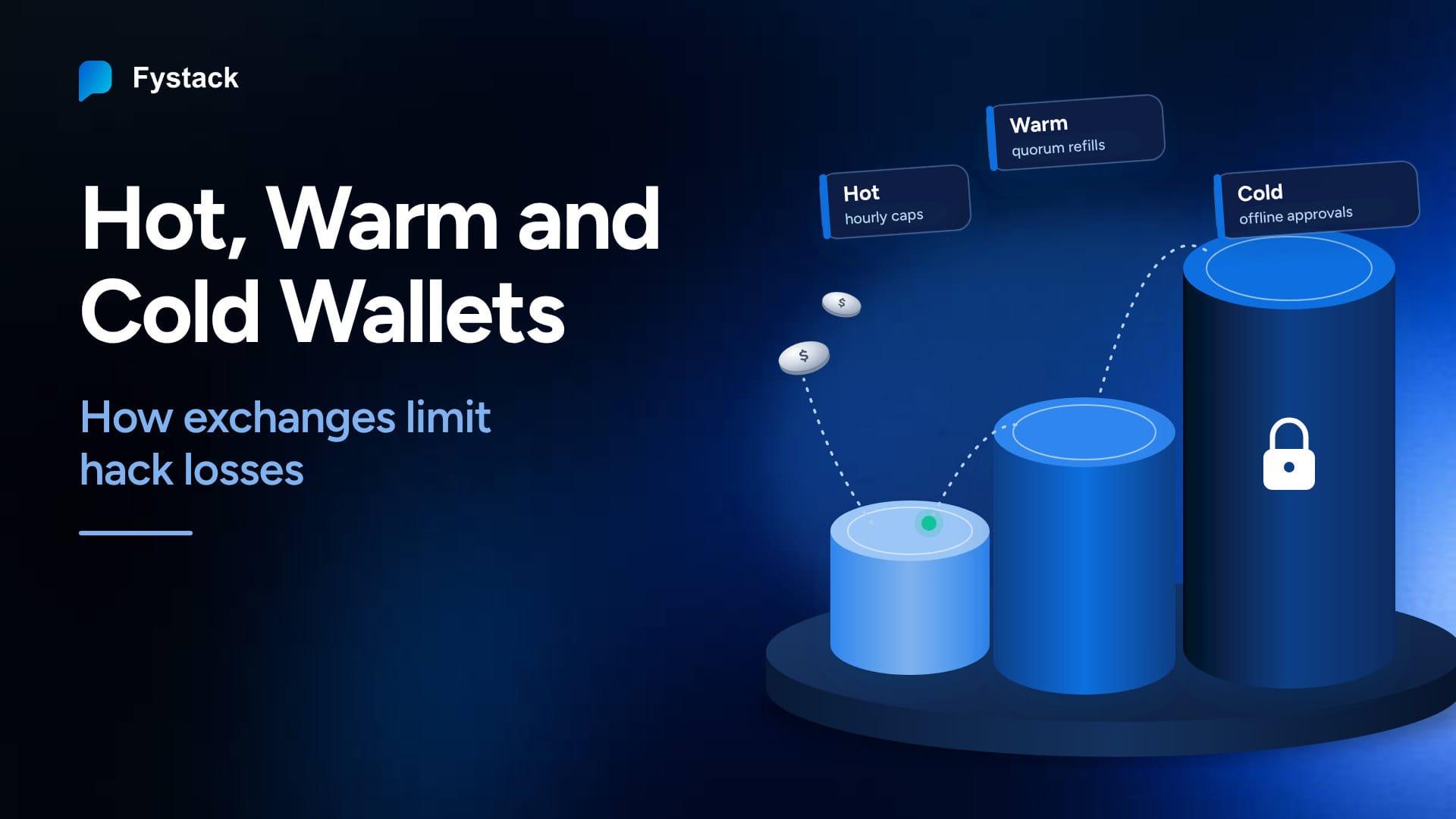
A crypto exchange works the same way. It keeps a small amount in a hot wallet (the register), a larger amount in a warm wallet (the back-office safe), and most customer funds in a cold wallet (the bank vault). This split is the main reason one hack does not take everything. It applies whether the exchange runs its own self-hosted MPC wallet infrastructure or uses a custody provider.
We will follow one example: an exchange that holds $200 million for its customers, who withdraw about $6 million on a normal day.
Key takeaways
- Hot wallets pay customers instantly, warm wallets top up the hot wallet, and cold wallets keep the savings.
- Splitting money this way limits how much one hack can take, while keeping withdrawals fast.
- Keep everything hot and one hacked laptop can drain the exchange. Keep everything cold and customers wait days for their money.
- A simple starting point: about one day of withdrawals in hot, a few days in warm, the rest in cold.
What Are Hot, Warm and Cold Wallets?
The three wallets differ in one thing: how easily money can leave them. A hot wallet is connected to the internet and pays out automatically, with no person involved. A warm wallet is also online, but a person must approve each payment. A cold wallet is kept offline or behind the strictest approvals, and money leaves it rarely.
| Wallet | Like a shop's | Online? | Who approves a payment | How fast | Used for |
| Hot | Cash register | Yes | Nobody: it pays automatically, within limits | Seconds | Everyday customer withdrawals |
| Warm | Back-office safe | Yes | One or more people | Minutes to hours | Topping up the hot wallet |
| Cold | Bank vault | No, or tightly restricted | Several senior people, often with offline steps | Hours to days | Long-term savings |
"Connected to the internet" matters because anything that can sign payments automatically can also be tricked into signing a bad one. The more automatic a wallet is, the less money it should hold.
Why Do Exchanges Split Funds Across Wallets?
Exchanges split funds because they need two things that pull in opposite directions: speed and safety. Customers expect withdrawals in minutes, at any hour. That needs money in a wallet that pays automatically. But money in an automatic wallet is the easiest to steal.
No single wallet can be both fast and hard to steal from. So exchanges use three: a small fast one, a medium one that needs approval, and a large slow one. Each wallet does one job well.
What Happens If You Don't Split?
If you don't split, you pick one of two bad outcomes.
Everything hot: one hack can take everything. If all $200 million sits in a wallet that pays automatically, then anyone who takes over the system that asks it to pay can empty it. That system runs on servers and laptops that people use every day. One stolen login or infected laptop is enough.
Everything cold: customers wait, and start to worry. If all $200 million needs several people to approve each payment, a withdrawal at 2 a.m. waits until morning. On a busy day, the queue grows. Customers who cannot get their money out quickly start to ask whether the exchange still has it, and a slow day can turn into a bank run.
The split is how exchanges avoid both: customers are paid quickly from a small hot wallet, and a hack of that wallet takes a small share, not the whole exchange.
How Much Should Sit in Each Wallet?
A simple way to decide is to start from how much customers actually withdraw, not from a fixed percentage.
- Hot: about one normal day of withdrawals. For our exchange, $6 million, or 3% of the total.
- Warm: enough to refill the hot wallet for about five days. That is $30 million, or 15%.
- Cold: everything else. $164 million, or 82%.
On a busy day when customers withdraw $15 million, the hot wallet runs out after the first $6 million. The warm wallet tops it up with $9 million and still has $21 million left. Customers keep getting paid, and nobody has to open the cold wallet.
These numbers are an example. Vendor guides often suggest ranges such as 5 to 10% hot, 15 to 25% warm and 65 to 80% cold, as in Cobo's warm wallet guide. Your own split depends on how your customers withdraw and which chains you support.
How Money Moves Between the Wallets
Money moves between the wallets the way a shop moves cash between the register and the safe: on a few simple rules, written down in advance.
- Top up hot when it runs low. For example, when the hot wallet drops below half its target, move money in from warm.
- Move extra money down. When deposits push the hot wallet well above its target, move the extra to warm.
- Refill warm from cold rarely, and with more people. Several senior approvers sign off on any move out of cold.
- Get an alert before customers notice. The team should hear about a low balance before a withdrawal fails.
We trace the full path of a deposit, from customer address to cold storage, in how money moves inside a centralized exchange.
Cold Doesn't Mean Safe: Lessons From Bybit and Binance
The split limits losses only if each wallet is also protected properly. Two recent hacks show what happens when it is not.
Bybit, February 2025: a cold wallet lost $1.5 billion. Attackers broke into a computer at Bybit's wallet software provider and changed what Bybit's staff saw on screen when approving a payment. Staff thought they were approving a routine transfer and approved the theft instead, as BleepingComputer reported. The lesson: approvers need a separate way to check what they are signing.
Binance, October 2026: hot wallets lost about $6.3 billion. Attackers spent months getting into engineers' computers, then reached the system that signs hot wallet payments. Most of the money left within about 20 minutes, according to TRM Labs. Binance found no evidence that private keys leaked, and its incident report is summarised by The Block. The lesson: how much sits in hot wallets, and how fast it can leave, decides the size of the loss.
| Wallet | Main protection | If it is hacked, you could lose |
| Hot | Limits on how much can leave per payment and per hour, and a list of approved addresses | Up to the hourly limit, or everything in it if there are no limits |
| Warm | Two or more people must approve, and money can only go to the hot wallet | One top-up, if one person can approve alone |
| Cold | Several senior approvers who check each payment on a separate device | Everything in it, if approvers can be shown a fake payment |
Our crypto custody security guide covers the wider controls around signing.
A Quick Checklist for Exchange Teams
Ask these five questions for every chain you support. They build on the setup we describe in MPC infrastructure for exchanges and OTC desks.
- How much sits in the hot wallet, and is it based on real withdrawal data?
- What is the most that can leave the hot wallet in one hour, and does the system enforce it?
- Can one person or one computer move money out of warm or cold alone?
- How do approvers check what they sign, apart from the screen that shows it?
- Who gets an alert when a wallet runs low, including at night?
Where Fystack Fits
Fystack is self-hosted custody infrastructure that exchanges and fintechs run on their own servers. It provides MPC wallets for each tier, automatic sweeps from customer deposit addresses, a policy engine that sets limits and approved addresses before anything is signed, approval groups for moving money between tiers, and low-balance alerts to Slack or Telegram. Our guide to moving funds from hot to cold with Fystack shows the workflow, and signing runs on mpcium, an open-source MPC engine. The trade-off: self-hosting means your team runs and maintains the servers.
FAQ
What is the difference between hot, warm and cold wallets?
A hot wallet is online and pays automatically. A warm wallet is online but needs a person to approve each payment. A cold wallet is offline or behind the strictest approvals and holds long-term savings.
Why do exchanges use hot, warm and cold wallets?
To be fast and safe at the same time. A small hot wallet pays customers quickly, while most funds sit in wallets that are much harder to steal from.
What happens if an exchange keeps all its funds in a hot wallet?
One hacked server or laptop that can request payments could empty the whole wallet in minutes.
How much should an exchange keep in a hot wallet?
A common starting point is about one normal day of withdrawals, topped up from a warm wallet when it runs low.
Is a cold wallet always safe?
No. In 2025, Bybit lost $1.5 billion from a cold wallet after attackers changed what its staff saw when approving a payment.
What Comes Next
Hackers increasingly go after the systems and people that approve payments, not the keys themselves. That makes the split between hot, warm and cold wallets, and the rules around each, a business decision as much as a technical one.
A useful exercise: for each wallet, assume the system that approves its payments is hacked, and ask how much could leave before anyone notices.
If you are reviewing your own wallet setup, see how Fystack's policy engine works.
About Fystack: Fystack is a self-hosted custody platform for fintech teams. Its core signing infrastructure, mpcium, is open-source on GitHub. Fystack supports Ethereum, Base, Solana, Polygon, BNB Chain, Bitcoin, TRON, Stellar and more.