Stablecoins vs Tokenized Deposits vs CBDCs: What Treasury & Custody Teams Need to Know

Stablecoins, tokenized deposits, and central bank digital currencies are often grouped together under one label: tokenized money.
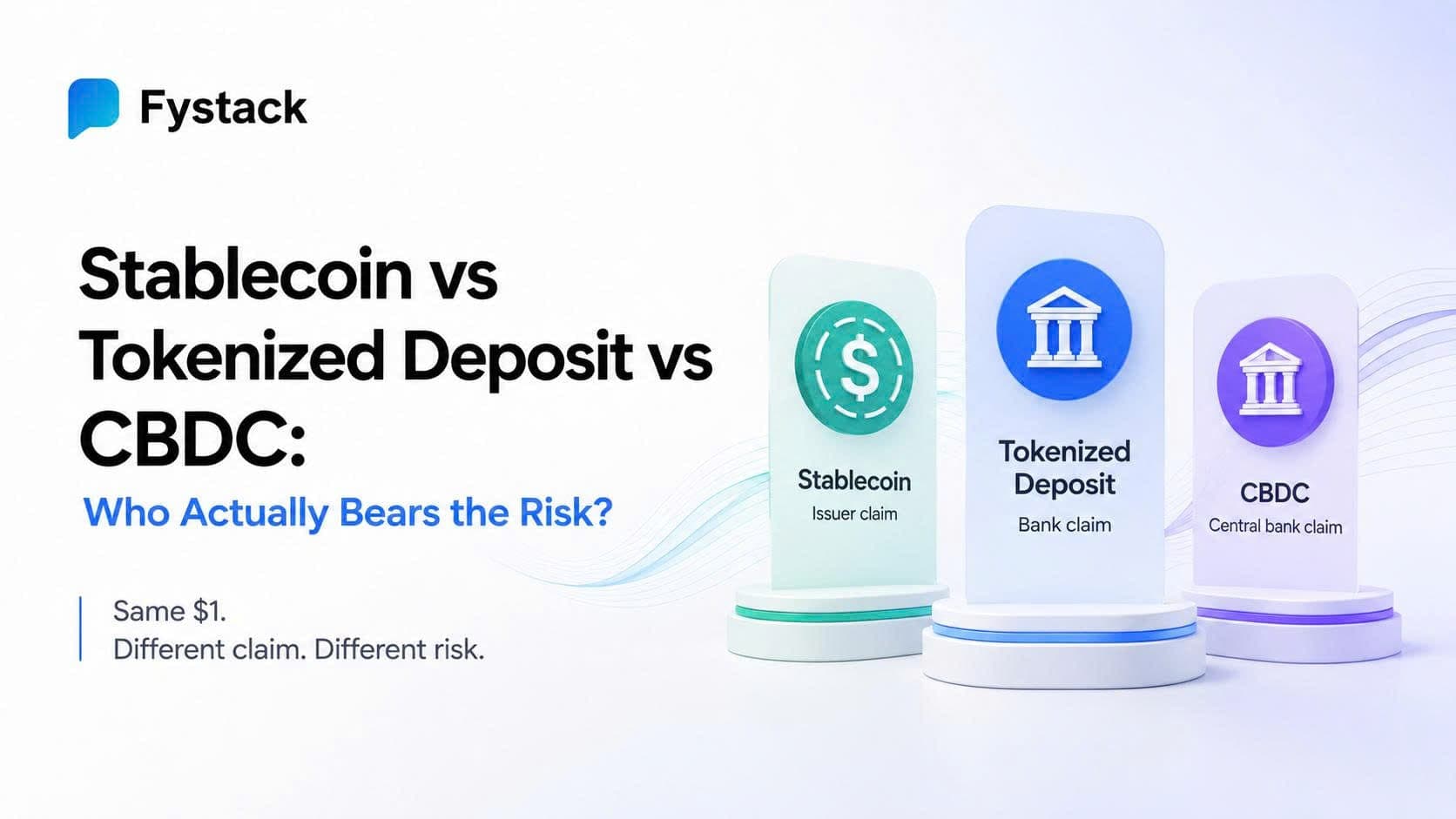
But they are not the same type of asset. A stablecoin, a tokenized deposit, and a CBDC can all move a dollar in seconds. They do not give you the same legal claim on that dollar.
Ask three people what they hold, and each will say the same thing: "I hold $1." But $1 in USDC, $1 in a tokenized bank deposit, and $1 in a CBDC carry different counterparty risk. Same denomination, same settlement speed, sometimes even the same blockchain. When something breaks, a different party is on the hook.
The blockchain tells you how the dollar moves. The issuer tells you what happens when it stops.
Key takeaway
- Tokenized money is not one asset class. It covers three distinct legal claims: stablecoins (a redemption claim against a private issuer), tokenized deposits (a claim against a regulated bank), and CBDCs (a claim against a central bank).
- The real difference between these instruments is counterparty risk, not technology. All three can settle in seconds on similar rails, but the party standing behind the token is different in each case.
- Banks are increasingly positioning tokenized deposits for institutional and wholesale flows in 2026, bringing them into more direct competition with stablecoins.
- For exchanges, neobanks, and fintechs holding more than one token type, custody infrastructure has to account for different legal claims and redemption paths. Treating all "tokenized money" the same way is a design mistake, not a simplification.
Quick answer
- Stablecoin → you trust a private issuer and its reserve manager
- Tokenized deposit → you trust a regulated commercial bank
- CBDC → you trust a central bank
Three tokens, three failure modes
| Stablecoin | Tokenized Deposit | CBDC | |
|---|---|---|---|
| What you trust | Issuer + reserves | Commercial bank | Central bank |
| Main failure point | Redemption / issuer | Bank access / operations | Governance, access & jurisdiction |
| Biggest advantage | Open, permissionless liquidity | Deposit protection, existing bank rails | Sovereign backing |
| Biggest limitation | Issuer dependence | Closed to one bank's clients today | Access and design still limited in most markets |
The Custodian Ladder: Three Levels of Risk Behind Tokenized Money

Most explainers on this topic stop at definitions: what a stablecoin is, what a tokenized deposit is, what a CBDC is. That information is already well covered.
What is missing is a way to compare them on the one thing that actually matters when you are deciding where to hold money: who absorbs the loss if the arrangement fails.
This is where a simple framework helps. Think of it as a ladder with three rungs, each one trading a different kind of independence for a different kind of protection. On this ladder, "custodian" does not mean whoever holds your private keys. It means the entity you are ultimately trusting to honor the claim.
Why this framework matters. Regulators, banks, and issuers each describe their own instrument as the safer or more efficient option, which makes it hard to compare them on equal terms. The Custodian Ladder cuts through that by asking one question at every rung: if the entity behind this token fails, defaults, or gets frozen out, what happens to the holder?
An instrument can be safer at the balance-sheet level while being more limited at the access level, so "safer" and "better" are not always the same question. The question is not which instrument looks most like a "digital dollar." It is who stands behind it when something breaks.
Stablecoin Risk: A Claim on a Private Issuer
A stablecoin is not the same thing as $1 sitting in a bank account, even though it spends the same way. It generally represents a redemption claim against a private issuer, backed by reserve assets, not a bank deposit. That difference is where the risk lives.
USDC and similar stablecoins are backed by reserves such as cash and short-term Treasury bills. Those reserves sit within the issuer's own reserve structure, not as a direct deposit claim held by the token holder, and they are not covered by deposit insurance.
In practice, that means redemption depends on the issuer staying solvent and operationally able to process redemptions. Some issuers, including Circle and Paxos, also retain the technical ability to freeze or blacklist specific wallet addresses at the smart contract level, which makes stablecoins closer to what one banking publication has called a pseudo-bearer instrument than a pure bearer asset like cash.
The scale is significant. Total stablecoin supply peaked above $320 billion in mid-2026 before contracting to roughly $290 billion to $300 billion by early August 2026, and stablecoins have already settled trillions of dollars in transaction volume. In the US, the GENIUS Act, signed into law in July 2025 and still working through rulemaking, has given issuers a clearer regulatory path, part of why adoption has accelerated.
Regulatory clarity changes the rules an issuer must follow. It does not change who is on the hook if reserves are mismanaged or a redemption freeze occurs. For teams building wallet infrastructure around stablecoins, that distinction shapes how private keys and redemption flows are architected and secured.
Tokenized Deposit Risk: A Claim on a Regulated Bank
A tokenized deposit is not a bank's copy of a stablecoin. It is a bank deposit represented as a digital token, and banks are building it to defend deposits, not to chase crypto. Stablecoins compete for that same funding base by offering 24/7, programmable access outside normal banking hours.
The underlying claim stays a bank liability. It remains within the regulated banking system, eligible for deposit insurance where the underlying deposit qualifies, and usable by the bank for lending like any other deposit. Banks describe this as programmable bank money rather than crypto, and that choice of words is deliberate.
The trade-off is access. A stablecoin is open to anyone with a compatible wallet. A tokenized deposit comes with a bank relationship, KYC, and account ownership attached. Users inherit the bank's protections, but they also inherit its gatekeeping.

Who is live today:
- JPMorgan has moved furthest. Its Kinexys platform has reported daily transaction volume ranging from roughly $5 billion to more than $7 billion in 2026 depending on the period and which flows are counted, across its blockchain-based financial infrastructure, which spans deposit tokens (JPM Coin), tokenized collateral, and intraday repo, not deposit tokens alone. JPMorgan has been notably cautious about deeper stablecoin involvement.
- Citi has taken the opposite stance, expanding Citi Token Services for tokenized deposits while partnering with Coinbase on stablecoin rails, treating the two instruments as complementary rather than competing.
- UBS is exploring tokenized deposit products for corporate clients as part of a "fast follower" strategy, with an initial rollout possibly starting in Switzerland, though this remains at the evaluation stage rather than a live product.
The biggest limitation so far has been interoperability: a token issued by one bank has generally only been usable between that bank's own clients. That is starting to change.
DBS, Singapore's largest bank, and JPMorgan's Kinexys are developing an interoperability framework that would let tokenized deposits move between the two banks across both public and permissioned blockchains, including public chains like Base. A JPMorgan client would be able to pay a DBS client in JPM Deposit Tokens, with the recipient choosing to redeem for fiat or convert to a DBS token. This is still in development, not live, but it is an important early example of cross-border, cross-bank interoperability for tokenized deposits, and one of the few involving a major APAC institution rather than a US-only network.
Fragmentation between banks has been the biggest weakness of tokenized deposits, and it is exactly the problem banks are now trying to solve. That is what makes the DBS-JPMorgan pilot worth watching.
Separately, a group of major US banks, including JPMorgan Chase, Bank of America, Citi, and Wells Fargo, is building a shared tokenized deposit network through The Clearing House, targeted for launch in the first half of 2027.
For platforms handling both stablecoins and tokenized deposits, this matters because the two instruments carry different settlement and liveness risk profiles, even when they move at similar speeds on paper.
CBDC Risk: A Claim on a Central Bank
A CBDC is not a government-backed stablecoin. It is a direct liability of a central bank, not a private company or commercial bank, and that difference removes private issuer risk entirely: there is no reserve manager to trust and no redemption queue tied to a company's balance sheet.
Removing one risk does not remove risk altogether, it relocates it. A CBDC replaces private issuer risk with governance, access, and jurisdiction risk instead: a central bank can adjust monetary policy, impose capital controls, or restrict how the currency is used in ways a private issuer or commercial bank cannot.
Most CBDC discussion focuses on retail use, but wholesale CBDC is the branch that matters more for institutional settlement. Central banks including the BIS have been running wholesale CBDC experiments aimed at interbank and cross-border settlement, distinct from consumer-facing retail CBDC. Access and design still vary widely by jurisdiction, which is why this rung matters less to most exchanges and fintechs today than the first two, even as wholesale pilots continue to develop.
Every rung of the Custodian Ladder moves the same dollar of value. What changes is the counterparty standing behind it.
Stablecoin vs Tokenized Deposit vs CBDC: Full Comparison
| Dimension | Stablecoin | Tokenized Deposit | CBDC |
| Issuer | Non-bank private company (e.g. Circle, Tether) | Regulated commercial bank | Central bank |
| Legal claim | Redemption claim against the issuer | Claim against a commercial bank | Direct claim on the central bank |
| Primary risk exposure | Issuer, reserve, and redemption risk | Bank credit, operational, and access risk | Public-system, governance, and access risk |
| Deposit insurance | Generally no | Yes, subject to applicable deposit-insurance rules | Not applicable, backed directly by the state |
| Funds bank lending | No, reserves must stay segregated | Yes, remains part of the bank's balance sheet | No |
| Who can use it | Anyone with a compatible wallet | Mostly clients of the issuing bank today | Depends on jurisdiction and CBDC design |
| Cross-institution settlement | Native, runs on public chains | Emerging, early interbank pilots underway | Depends on CBDC design, wholesale pilots ongoing |
| Custody requirement | Self-custody or third-party wallet infrastructure | Bank-managed, standard account custody | Central bank-managed or licensed intermediary |
Why Tokenized Money Looks Similar While the Risk Stays Different
Three structural forces explain why these instruments increasingly look alike, even as the underlying risk stays different.
Regulatory clarity. Frameworks like the GENIUS Act in the US have given stablecoin issuers a defined path to operate, narrowing the gap between how a regulator treats a stablecoin issuer and how it treats a bank.
Defensive positioning by banks. Deposits are the core funding base of the banking system. Tokenized deposits are, in large part, a response built to defend deposit franchises against 24/7, programmable stablecoin access, not a product banks wanted to build for its own sake.
Institutional demand for always-on settlement. Corporate treasury teams want instant, programmable, 24/7 money movement regardless of which instrument delivers it. That shared demand is pulling stablecoin issuers and banks toward similar-looking products, even though one is not simply a substitute for the other. Tokenized deposits are gaining ground specifically in wholesale flows because they preserve yield and existing balance sheet treatment in a way stablecoins cannot.
What This Means for Exchanges, Neobanks, and Custody Infrastructure
If a platform holds treasury or client funds across more than one rung of the Custodian Ladder, that difference is not a detail to abstract away.
A few concrete implications follow:
- Separate redemption and compliance paths per instrument. A stablecoin redemption depends on issuer operations and can be frozen at the smart contract level. A tokenized deposit redemption depends on the issuing bank and standard banking compliance. These cannot share one workflow.
- Treat counterparty concentration as a treasury risk, not just a market risk. Holding treasury exclusively in one issuer's stablecoin or one bank's deposit token concentrates exposure at a single rung of the ladder. Diversifying across rungs is a legitimate way to manage that exposure.
- Evaluate custody infrastructure for multi-asset-class support, not just multi-chain support. The next custody problem is not supporting more chains. It is supporting different kinds of claims. This is part of why institutional custody layers are moving toward more flexible architectures, including self-hosted, multi-party key management that can adapt reconciliation logic per instrument type rather than assuming every token behaves like a stablecoin.
- Watch interbank interoperability pilots closely. Programs like the DBS-JPMorgan framework are early signals of where tokenized deposit liquidity will eventually be able to move. Platforms in APAC in particular should track this given DBS's role in it.
About Fystack
Fystack is an enterprise-grade, self-hosted MPC custody platform for fintech teams and crypto businesses. The core signing infrastructure, mpcium, is open-source. Fystack supports multi-chain wallet operations across TRON, ETH, BNB, Solana, Polygon, and more, with a policy engine that enforces spend rules before any signing happens.
If you are building payment infrastructure that involves automated signing, wallet custody, or agent payment flows, Fystack has the full product overview. The policy engine source is on GitHub.
Frequently Asked Questions
What is tokenized money?
Tokenized money is any form of currency represented as a digital token on a blockchain or distributed ledger. It includes stablecoins, tokenized deposits, and central bank digital currencies, each backed by a different party with a different risk profile.
Is USDC a tokenized deposit?
No. USDC is a stablecoin issued by Circle, a non-bank company. It represents a redemption claim against the issuer, not a customer deposit at a regulated bank, and it does not carry deposit insurance the way a tokenized deposit does.
Are tokenized deposits safer than stablecoins?
Tokenized deposits can carry bank-level protections, including deposit insurance where the underlying deposit qualifies, that most stablecoins do not have. That makes them lower counterparty risk in a narrow sense, but they currently have more limited interoperability between institutions than public stablecoins.
How is a CBDC different from a tokenized deposit?
A CBDC is a direct liability of a central bank, while a tokenized deposit is a liability of a commercial bank. A CBDC removes private issuer and bank counterparty risk, but introduces governance, access, and jurisdiction risk instead.
Which banks are using tokenized deposits in 2026?
JPMorgan's Kinexys platform and Citi's Token Services are the most advanced live deployments. DBS and JPMorgan are developing cross-bank interoperability, UBS is evaluating tokenized deposit products for corporate clients, and a consortium including JPMorgan Chase, Bank of America, Citi, and Wells Fargo is building a shared network through The Clearing House, targeted for the first half of 2027.
Are tokenized deposits replacing stablecoins?
Not entirely. Stablecoins are expected to remain dominant in retail, crypto-native, and public-chain use cases, while tokenized deposits are gaining ground in wholesale and institutional settlement, where preserving yield and existing bank balance sheet treatment matters more than public accessibility.
How should institutions custody stablecoins and tokenized deposits together?
Institutions holding both need custody infrastructure that treats each instrument's redemption path, compliance requirements, and counterparty exposure separately, rather than applying one wallet or key management model to all tokenized money. That typically means multi-party key management flexible enough to support different asset classes as bank-issued and issuer-issued tokens both grow.