We just completed a full security audit with Adevar Labs.
Back to Blog

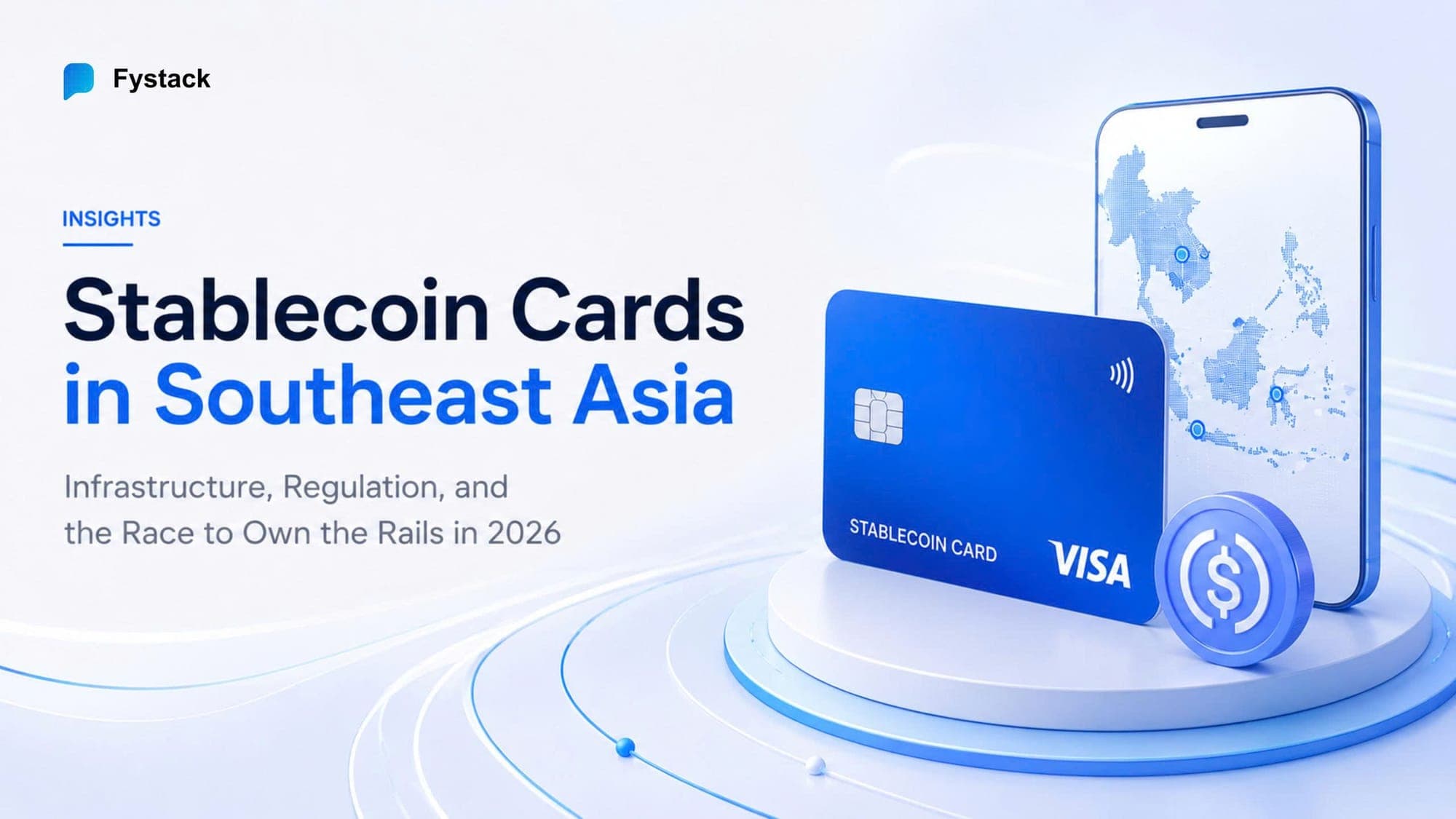
Stablecoin Cards in Southeast Asia: Infrastructure, Economics, and Regulatory Reality in 2026

Phoebe Duong

Phoebe Duong

Author

August 4, 2026
9 min read
Stablecoin Cards in Southeast Asia: Infrastructure, Economics, and Regulatory Reality in 2026

Global monthly transaction volume on stablecoin-linked cards has grown from roughly $100 million in early 2023 to over $1.5 billion by late 2025, a compound annual growth rate of about 106% (Krause, SSRN, 2026). In Southeast Asia specifically, StraitsX reports a 40x increase in card transaction volume and an 83x increase in cards issued between Q4 2024 and Q4 2025 (CoinDesk, March 2026).

This article is for fintech founders, payment providers, and product teams evaluating whether stablecoin cards are commercially viable across Southeast Asia in 2026.

TL;DR

  • Stablecoin cards are growing fast because they solve remittance cost, ride on Singapore's regulatory clarity, and reward whoever owns the settlement layer.
  • Infrastructure matters more than card design: the card is easy to copy, the settlement and treasury layer underneath it is not.
  • Full-stack issuers like Rain and Reap capture more margin per transaction by owning interchange, FX spread, and reserve yield directly.
  • Southeast Asia is five different regulatory markets, not one: Singapore, Thailand, Vietnam, Indonesia, and the Philippines each define "stablecoin payment" differently.

What Is a Stablecoin Card?

A stablecoin card is a physical or virtual payment card linked directly to a wallet holding stablecoins, typically USDC or USDT, instead of a fiat bank balance. When the cardholder pays at a point of sale, the stablecoin balance is converted to the local currency at the moment of settlement, so the merchant is paid in fiat and the cardholder never manually converts anything.

This is different from a traditional crypto card, which is usually funded with volatile assets like BTC or ETH and carries price-swing risk and higher network fees between the moment of funding and the moment of spend. A stablecoin card removes that volatility layer, which is a large part of why issuers and networks are now treating it as a distinct product category rather than a crypto novelty.

Why Stablecoin Cards Are Booming in Southeast Asia Right Now

Three forces are driving this growth simultaneously.

Remittance cost. Southeast Asia and its diaspora corridors carry some of the highest traditional remittance fees in the world. Stablecoin rails settle near-instantly and at a fraction of the cost of correspondent banking, which makes card-based spend a natural extension of that infrastructure.

Regulatory clarity in Singapore. MAS has moved from experimentation (Project Orchid) to production-grade settlement infrastructure (Project BLOOM), giving issuers a credible regulatory anchor to build against, even as neighboring markets remain fragmented (more on this below).

Full-stack issuer economics. A new category of card issuer is capturing significantly more margin per transaction by owning the entire stack instead of splitting revenue across a sponsor bank, program manager, and processor. We break this down in Part 2.

Infrastructure, From Pre-Funded Wallets to Invisible Rails

What "invisible" settlement means

The defining trait of a modern stablecoin card is that the cardholder doesn't know they're using one. They tap or scan, the transaction succeeds, and the merchant receives local currency. The blockchain layer sits entirely behind the payment rail the user already recognizes, a card network logo, a QR code, a tap-to-pay prompt.

Global monthly transaction volume on stablecoin-linked cards has grown from roughly $100 million in early 2023 to over $1.5 billion by late 2025, a compound annual growth rate of about 106% (Krause, SSRN, 2026). In Southeast Asia specifically, StraitsX reports a 40x increase in card transaction volume and an 83x increase in cards issued between Q4 2024 and Q4 2025 (CoinDesk, March 2026). This article is for fintech founders, payment providers, and product teams evaluating whether stablecoin cards are commercially viable across Southeast Asia in 2026. TL;DR Stablecoin cards are growing fast because they solve remittance cost, ride on Singapore's regulatory clarity, and reward whoever owns the settlement layer. Infrastructure matters more than card design: the card is easy to copy, the settlement and treasury layer underneath it is not. Full-stack issuers like Rain and Reap capture more margin per transaction by owning interchange, FX spread, and reserve yield directly. Southeast Asia is five different regulatory markets, not one: Singapore, Thailand, Vietnam, Indonesia, and the Philippines each define "stablecoin payment" differently. What Is a Stablecoin Card? A stablecoin card is a physical or virtual payment card linked directly to a wallet holding stablecoins, typically USDC or USDT, instead of a fiat bank balance. When the cardholder pays at a point of sale, the stablecoin balance is converted to the local currency at the moment of settlement, so the merchant is paid in fiat and the cardholder never manually converts anything. This is different from a traditional crypto card, which is usually funded with volatile assets like BTC or ETH and carries price-swing risk and higher network fees between the moment of funding and the moment of spend. A stablecoin card removes that volatility layer, which is a large part of why issuers and networks are now treating it as a distinct product category rather than a crypto novelty. Why Stablecoin Cards Are Booming in Southeast Asia Right Now Three forces are driving this growth simultaneously. Remittance cost. Southeast Asia and its diaspora corridors carry some of the highest traditional remittance fees in the world. Stablecoin rails settle near-instantly and at a fraction of the cost of correspondent banking, which makes card-based spend a natural extension of that infrastructure. Regulatory clarity in Singapore. MAS has moved from experimentation (Project Orchid) to production-grade settlement infrastructure (Project BLOOM), giving issuers a credible regulatory anchor to build against, even as neighboring markets remain fragmented (more on this below). Full-stack issuer economics. A new category of card issuer is capturing significantly more margin per transaction by owning the entire stack instead of splitting revenue across a sponsor bank, program manager, and processor. We break this down in Part 2. Part 1: Infrastructure, From Pre-Funded Wallets to Invisible Rails What "invisible" settlement means The defining trait of a modern stablecoin card is that the cardholder doesn't know they're using one. They tap or scan, the transaction succeeds, and the merchant receives local currency. The blockchain layer sits entirely behind the payment rail the user already recognizes, a card network logo, a QR code, a tap-to-pay prompt. Case study: the KBank–StraitsX corridor under Project BLOOM MAS launched Project BLOOM (Borderless, Liquid, Open, Online, Multi-currency) in October 2025 to expand settlement using tokenized bank liabilities and regulated stablecoins across G10 and Asian currencies, covering both retail-adjacent and wholesale use cases like corporate treasury and agentic payments. Founding participants include Circle, DBS, OCBC, Partior, Stripe, UOB, Ant International, StraitsX, and Coinbase. One of the concrete corridors operating under this framework connects Thailand and Singapore: KASIKORNBANK (KBank), Orbix Technology, and StraitsX collaborate so that a Thai traveler can scan a QR code at a Singapore merchant using KBank's wallet, with the backend automatically converting Thai baht to XSGD, StraitsX's Singapore-dollar-pegged stablecoin, which currently holds more than 70% of the non-USD stablecoin market in Southeast Asia (IDN Financials, March 2026). The user sees a successful QR payment. Nothing about the conversion is visible to them. The technical layer: real-time settlement The hard problem underneath all of this is settlement speed. A card transaction has to authorize in milliseconds, which means the infrastructure connecting a stablecoin balance to a card network can't rely on manual pre-funding or batch conversion. This is where programmable wallets do the actual work: a wallet exposed through an API that lets a card processor check and move on-chain balance in real time, without requiring the user, or the issuer's operations team, to manually swap stablecoin to fiat ahead of every transaction. The wallet becomes an extension of the card processor's ledger rather than a separate step in the flow. Key takeaway: Stablecoin cards aren't replacing Visa or Mastercard. They're replacing the settlement layer behind them.  The biggest misconception about stablecoin cards is that they compete with card networks. They don't: they compete with legacy settlement. Part 2: Economics, Full-Stack Issuers Are Collapsing the Stack The traditional stack A conventional card program typically splits revenue across three parties: a sponsor bank that holds the banking license, a program manager that runs operations, and a processor that handles authorization and settlement. Each layer takes a cut, which compresses margin for everyone below the top of the stack. Rain and Reap: the full-stack issuer model A newer category of issuer, Rain and Reap being the clearest examples, holds direct principal membership with card networks and combines program management with issuance itself, bypassing the traditional sponsor-bank dependency. By issuing directly and managing settlement, they capture more of the interchange fee, the FX spread, and the yield on reserve assets, instead of splitting all three across intermediaries. The scale difference is material: Rain grew roughly 38x in 2025 to more than $3 billion annualized after becoming a direct Visa principal member; Reap is reported at more than $6 billion annualized, skewing toward corporate spend (insights4vc, April 2026). Why most fintechs underestimate the operational complexity The instinct for a fintech evaluating this model is to ask "should we issue directly too?" The harder question is whether the team can actually run what direct issuance requires: real-time liquidity management across currencies, reconciliation between on-chain and off-chain ledgers, treasury operations that don't rely on manual intervention, and a compliance function that can absorb regulatory change without breaking the product. Full-stack issuance isn't a licensing decision, it's an operations decision, and most teams underestimate how much of it has to be automated to work at transaction volume. Traditional issuer vs. full-stack issuer<table> <thead> <tr> <th></th> <th>Traditional stack</th> <th>Full-stack issuer</th> </tr> </thead> <tbody> <tr> <td>Revenue capture</td> <td>Split across sponsor bank, program manager, processor</td> <td>Interchange + FX spread + reserve yield captured directly</td> </tr> <tr> <td>Margin per transaction</td> <td>Compressed by intermediary layers</td> <td>Materially higher (see Rain/Reap scale above)</td> </tr> <tr> <td>Operational control</td> <td>Limited, dependent on partner SLAs</td> <td>Full control over settlement and liquidity</td> </tr> <tr> <td>Compliance burden</td> <td>Largely inherited from sponsor bank</td> <td>Owned directly by the issuer</td> </tr> <tr> <td>Time to launch</td> <td>Faster (fewer licenses required)</td> <td>Slower, but defensible long-term</td> </tr> </tbody> </table>   Why infrastructure, not the card, is becoming the competitive advantage The card itself is not a differentiator. Any team can design a card, negotiate a BIN sponsorship, and ship a product in a quarter. What's hard to copy is the layer underneath it: liquidity that moves in real time, treasury that reconciles itself, and compliance that adapts per jurisdiction without a rebuild. As more issuers converge on similar card products, the actual competitive moat is shifting to whoever controls that settlement and treasury layer, which is exactly why full-stack issuers are pulling ahead on margin, not just on volume. Why Building One Stablecoin Card Across Southeast Asia Is Still Difficult Southeast Asia is not one regulatory environment; it's five, and none of them define "stablecoin as a payment instrument" the same way.<table> <thead> <tr> <th>Country</th> <th>Crypto asset status</th> <th>Stablecoin as payment</th> <th>Main friction (as of July 2026)</th> </tr> </thead> <tbody> <tr> <td>Singapore</td> <td>Regulated, sandbox-first (MAS)</td> <td>Permitted under MAS framework</td> <td>Most mature market in the region</td> </tr> <tr> <td>Thailand</td> <td>Digital asset, not legal tender</td> <td>Prohibited as direct payment</td> <td>BOT and SEC are actively investigating high-value USDT flows for AML concerns</td> </tr> <tr> <td>Vietnam</td> <td>Ownership legalized (Law 71/2025/QH15, effective Jan 1, 2026)</td> <td>Prohibited as a direct payment instrument (Resolution 05/2025)</td> <td>All settlement must convert to VND</td> </tr> <tr> <td>Indonesia</td> <td>Regulated digital financial asset (OJK)</td> <td>Permitted only as a "means of transaction," explicitly not a "means of payment" (Law 4/2026)</td> <td>The legal line between the two categories is narrow and easy to cross unintentionally</td> </tr> <tr> <td>Philippines</td> <td>VASP framework active (BSP Circular 1108)</td> <td>No dedicated card framework yet</td> <td>Over 20 registered VASPs, but card-specific regulation hasn't caught up</td> </tr> </tbody> </table>   Singapore: what this means for builders Singapore offers the clearest regulatory pathway in the region and is the natural base for a Southeast Asia-facing card program. But building here alone doesn't solve the rest of the region, it solves one jurisdiction out of five. Thailand: what this means for builders As of July 2026, the Bank of Thailand and the Thai SEC are running an active enforcement campaign against USDT flows: cash deposits above 5 million baht (roughly $150,000) now require source-of-funds verification, and regulators are investigating a suspected $307 million-per-year laundering case, with 40% of USDT sellers on local platforms identified as non-residents. This isn't a static legal restriction; it's a live enforcement environment that can tighten with little notice. Any card program touching Thailand needs compliance infrastructure built for that pace of change, not a one-time legal review. Vietnam: what this means for builders Vietnam legalized ownership and trading of digital assets on January 1, 2026, but Resolution 05/2025 explicitly bans issuing fiat-backed stablecoins domestically, and foreign stablecoins cannot be used as a direct payment instrument, every transaction has to settle in VND. A card program here has to treat "asset ownership is legal" and "stablecoin payment is legal" as two separate facts, because they are. Indonesia: what this means for builders Indonesia's Law 4/2026 permits stablecoins as a "means of transaction" after exchange recommendation and OJK approval, but is explicit that this is not the same as being a lawful "means of payment." The distinction is legally real, not just semantic, and a card product that blurs it risks being classified as an illegal payment instrument even while technically compliant on the asset side. Philippines: what this means for builders The BSP's VASP framework is one of the more mature in the region, with more than 20 registered entities including Coins.ph and Maya. But there's no card-specific regulation yet, which means a builder is operating in a framework designed for exchanges and wallets, not necessarily for card issuance, worth confirming directly with BSP before assuming coverage. Why one card architecture no longer works across Southeast Asia The five markets above don't just have different rules; they have different definitions of what a stablecoin card legally is. A product built around Singapore's framework doesn't translate to Vietnam's asset-ownership-without-payment model, and Indonesia's transaction/payment distinction has no equivalent in Thailand's enforcement-driven environment. Treating this as one regional rollout with local tweaks is the mistake; the compliance and settlement layer has to be designed to flex per jurisdiction from the start. We go deeper on this in One Region, Six Rulebooks: A Business Guide to Stablecoin Compliance in Southeast Asia. Builder Checklist: Before You Launch a Stablecoin Card in Southeast Asia Can your custody layer support programmable, real-time settlement? Can your treasury automate liquidity across multiple currency corridors? Which jurisdiction will legally issue the card, and does that license actually cover card issuance? Who owns compliance in each market you touch, and what happens when a rule changes overnight, as in Thailand? Can your infrastructure adapt to five different rulebooks without a product rebuild? Takeaway Three things are true at the same time in 2026. The infrastructure behind stablecoin cards is becoming invisible to the end user: the blockchain layer disappears behind a familiar QR scan or tap. The economics are shifting toward whoever controls settlement and treasury directly, not whoever has the nicest card design. And the regulatory picture across Southeast Asia is fragmenting further, not converging: five markets, five different answers to what "stablecoin payment" legally means. If your team is evaluating stablecoin card infrastructure across Southeast Asia, the hardest part is rarely card issuance: it is designing custody, treasury, and compliance that can scale across multiple jurisdictions. That's where Fystack focuses. FAQ What is a stablecoin card? A payment card linked to a stablecoin wallet instead of a fiat account. The stablecoin converts to local currency at the point of sale, so the cardholder spends without manually swapping currencies and without the price volatility of a traditional crypto card. Is stablecoin payment legal in Vietnam in 2026? Owning and trading digital assets is legal under Law 71/2025/QH15, effective January 1, 2026. However, Resolution 05/2025 prohibits using stablecoins as a direct payment instrument, transactions must settle in Vietnamese dong. Why is Thailand cracking down on USDT transactions? As of July 2026, the Bank of Thailand and Thai SEC are jointly investigating high-value USDT flows over AML concerns, including a suspected $307 million-per-year laundering case, and now require source-of-funds verification for large cash deposits. How do full-stack issuers like Rain and Reap make money? By holding direct card network membership and managing issuance themselves, they capture interchange, FX spread, and reserve yield directly instead of splitting that revenue across a sponsor bank, program manager, and processor. What is Project BLOOM? A Monetary Authority of Singapore initiative launched in October 2025 to expand settlement using tokenized bank liabilities and regulated stablecoins across multiple currencies, covering both cross-border payments and wholesale use cases like corporate treasury. How does Fystack infrastructure help card issuers scale across Southeast Asia? By providing the programmable custody, treasury automation, and jurisdiction-adaptable compliance layer that full-stack card issuance requires, so issuers can adapt to each market's rules without rebuilding their core infrastructure.

Case study: the KBank–StraitsX corridor under Project BLOOM

MAS launched Project BLOOM (Borderless, Liquid, Open, Online, Multi-currency) in October 2025 to expand settlement using tokenized bank liabilities and regulated stablecoins across G10 and Asian currencies, covering both retail-adjacent and wholesale use cases like corporate treasury and agentic payments. Founding participants include Circle, DBS, OCBC, Partior, Stripe, UOB, Ant International, StraitsX, and Coinbase.

One of the concrete corridors operating under this framework connects Thailand and Singapore: KASIKORNBANK (KBank), Orbix Technology, and StraitsX collaborate so that a Thai traveler can scan a QR code at a Singapore merchant using KBank's wallet, with the backend automatically converting Thai baht to XSGD, StraitsX's Singapore-dollar-pegged stablecoin, which currently holds more than 70% of the non-USD stablecoin market in Southeast Asia (IDN Financials, March 2026). The user sees a successful QR payment. Nothing about the conversion is visible to them.

The technical layer: real-time settlement

The hard problem underneath all of this is settlement speed. A card transaction has to authorize in milliseconds, which means the infrastructure connecting a stablecoin balance to a card network can't rely on manual pre-funding or batch conversion.

This is where programmable wallets do the actual work: a wallet exposed through an API that lets a card processor check and move on-chain balance in real time, without requiring the user, or the issuer's operations team, to manually swap stablecoin to fiat ahead of every transaction. The wallet becomes an extension of the card processor's ledger rather than a separate step in the flow.

Key takeaway: Stablecoin cards aren't replacing Visa or Mastercard. They're replacing the settlement layer behind them.

The biggest misconception about stablecoin cards is that they compete with card networks. They don't: they compete with legacy settlement.

Economics, Full-Stack Issuers Are Collapsing the Stack

The traditional stack

A conventional card program typically splits revenue across three parties: a sponsor bank that holds the banking license, a program manager that runs operations, and a processor that handles authorization and settlement. Each layer takes a cut, which compresses margin for everyone below the top of the stack.

Rain and Reap: the full-stack issuer model

A newer category of issuer, Rain and Reap being the clearest examples, holds direct principal membership with card networks and combines program management with issuance itself, bypassing the traditional sponsor-bank dependency. By issuing directly and managing settlement, they capture more of the interchange fee, the FX spread, and the yield on reserve assets, instead of splitting all three across intermediaries.

The scale difference is material: Rain grew roughly 38x in 2025 to more than $3 billion annualized after becoming a direct Visa principal member; Reap is reported at more than $6 billion annualized, skewing toward corporate spend (insights4vc, April 2026).

Why most fintechs underestimate the operational complexity

The instinct for a fintech evaluating this model is to ask "should we issue directly too?" The harder question is whether the team can actually run what direct issuance requires: real-time liquidity management across currencies, reconciliation between on-chain and off-chain ledgers, treasury operations that don't rely on manual intervention, and a compliance function that can absorb regulatory change without breaking the product. Full-stack issuance isn't a licensing decision, it's an operations decision, and most teams underestimate how much of it has to be automated to work at transaction volume.

Why most fintechs underestimate the operational complexity

Traditional issuer vs. full-stack issuer

Traditional stack Full-stack issuer
Revenue capture Split across sponsor bank, program manager, processor Interchange + FX spread + reserve yield captured directly
Margin per transaction Compressed by intermediary layers Materially higher (see Rain/Reap scale above)
Operational control Limited, dependent on partner SLAs Full control over settlement and liquidity
Compliance burden Largely inherited from sponsor bank Owned directly by the issuer
Time to launch Faster (fewer licenses required) Slower, but defensible long-term

Why infrastructure, not the card, is becoming the competitive advantage

The card itself is not a differentiator. Any team can design a card, negotiate a BIN sponsorship, and ship a product in a quarter. What's hard to copy is the layer underneath it: liquidity that moves in real time, treasury that reconciles itself, and compliance that adapts per jurisdiction without a rebuild. As more issuers converge on similar card products, the actual competitive moat is shifting to whoever controls that settlement and treasury layer, which is exactly why full-stack issuers are pulling ahead on margin, not just on volume.

Why Building One Stablecoin Card Across Southeast Asia Is Still Difficult

Southeast Asia is not one regulatory environment; it's five, and none of them define "stablecoin as a payment instrument" the same way.

Why Building One Stablecoin Card Across Southeast Asia Is Still Difficult
Country Crypto asset status Stablecoin as payment Main friction (as of July 2026)
Singapore Regulated, sandbox-first (MAS) Permitted under MAS framework Most mature market in the region
Thailand Digital asset, not legal tender Prohibited as direct payment BOT and SEC are actively investigating high-value USDT flows for AML concerns
Vietnam Ownership legalized (Law 71/2025/QH15, effective Jan 1, 2026) Prohibited as a direct payment instrument (Resolution 05/2025) All settlement must convert to VND
Indonesia Regulated digital financial asset (OJK) Permitted only as a "means of transaction," explicitly not a "means of payment" (Law 4/2026) The legal line between the two categories is narrow and easy to cross unintentionally
Philippines VASP framework active (BSP Circular 1108) No dedicated card framework yet Over 20 registered VASPs, but card-specific regulation hasn't caught up

Singapore: what this means for builders

Singapore offers the clearest regulatory pathway in the region and is the natural base for a Southeast Asia-facing card program. But building here alone doesn't solve the rest of the region, it solves one jurisdiction out of five.

Thailand: what this means for builders

As of July 2026, the Bank of Thailand and the Thai SEC are running an active enforcement campaign against USDT flows: cash deposits above 5 million baht (roughly $150,000) now require source-of-funds verification, and regulators are investigating a suspected $307 million-per-year laundering case, with 40% of USDT sellers on local platforms identified as non-residents. This isn't a static legal restriction; it's a live enforcement environment that can tighten with little notice. Any card program touching Thailand needs compliance infrastructure built for that pace of change, not a one-time legal review.

Vietnam: what this means for builders

Vietnam legalized ownership and trading of digital assets on January 1, 2026, but Resolution 05/2025 explicitly bans issuing fiat-backed stablecoins domestically, and foreign stablecoins cannot be used as a direct payment instrument, every transaction has to settle in VND. A card program here has to treat "asset ownership is legal" and "stablecoin payment is legal" as two separate facts, because they are.

Indonesia: what this means for builders

Indonesia's Law 4/2026 permits stablecoins as a "means of transaction" after exchange recommendation and OJK approval, but is explicit that this is not the same as being a lawful "means of payment." The distinction is legally real, not just semantic, and a card product that blurs it risks being classified as an illegal payment instrument even while technically compliant on the asset side.

Philippines: what this means for builders

The BSP's VASP framework is one of the more mature in the region, with more than 20 registered entities including Coins.ph and Maya. But there's no card-specific regulation yet, which means a builder is operating in a framework designed for exchanges and wallets, not necessarily for card issuance, worth confirming directly with BSP before assuming coverage.

Why one card architecture no longer works across Southeast Asia

The five markets above don't just have different rules; they have different definitions of what a stablecoin card legally is. A product built around Singapore's framework doesn't translate to Vietnam's asset-ownership-without-payment model, and Indonesia's transaction/payment distinction has no equivalent in Thailand's enforcement-driven environment. Treating this as one regional rollout with local tweaks is the mistake; the compliance and settlement layer has to be designed to flex per jurisdiction from the start. We go deeper on this in One Region, Six Rulebooks: A Business Guide to Stablecoin Compliance in Southeast Asia.

Builder Checklist: Before You Launch a Stablecoin Card in Southeast Asia

  • Can your custody layer support programmable, real-time settlement?
  • Can your treasury automate liquidity across multiple currency corridors?
  • Which jurisdiction will legally issue the card, and does that license actually cover card issuance?
  • Who owns compliance in each market you touch, and what happens when a rule changes overnight, as in Thailand?
  • Can your infrastructure adapt to five different rulebooks without a product rebuild?

Takeaway

Three things are true at the same time in 2026. The infrastructure behind stablecoin cards is becoming invisible to the end user: the blockchain layer disappears behind a familiar QR scan or tap. The economics are shifting toward whoever controls settlement and treasury directly, not whoever has the nicest card design. And the regulatory picture across Southeast Asia is fragmenting further, not converging: five markets, five different answers to what "stablecoin payment" legally means.

If your team is evaluating stablecoin card infrastructure across Southeast Asia, the hardest part is rarely card issuance: it is designing custody, treasury, and compliance that can scale across multiple jurisdictions. That's where Fystack focuses.

FAQ

What is a stablecoin card?

A payment card linked to a stablecoin wallet instead of a fiat account. The stablecoin converts to local currency at the point of sale, so the cardholder spends without manually swapping currencies and without the price volatility of a traditional crypto card.

Is stablecoin payment legal in Vietnam in 2026?

Owning and trading digital assets is legal under Law 71/2025/QH15, effective January 1, 2026. However, Resolution 05/2025 prohibits using stablecoins as a direct payment instrument, transactions must settle in Vietnamese dong.

Why is Thailand cracking down on USDT transactions?

As of July 2026, the Bank of Thailand and Thai SEC are jointly investigating high-value USDT flows over AML concerns, including a suspected $307 million-per-year laundering case, and now require source-of-funds verification for large cash deposits.

How does Fystack infrastructure help card issuers scale across Southeast Asia?

By providing the programmable custody, treasury automation, and jurisdiction-adaptable compliance layer that full-stack card issuance requires, so issuers can adapt to each market's rules without rebuilding their core infrastructure.
Share this post