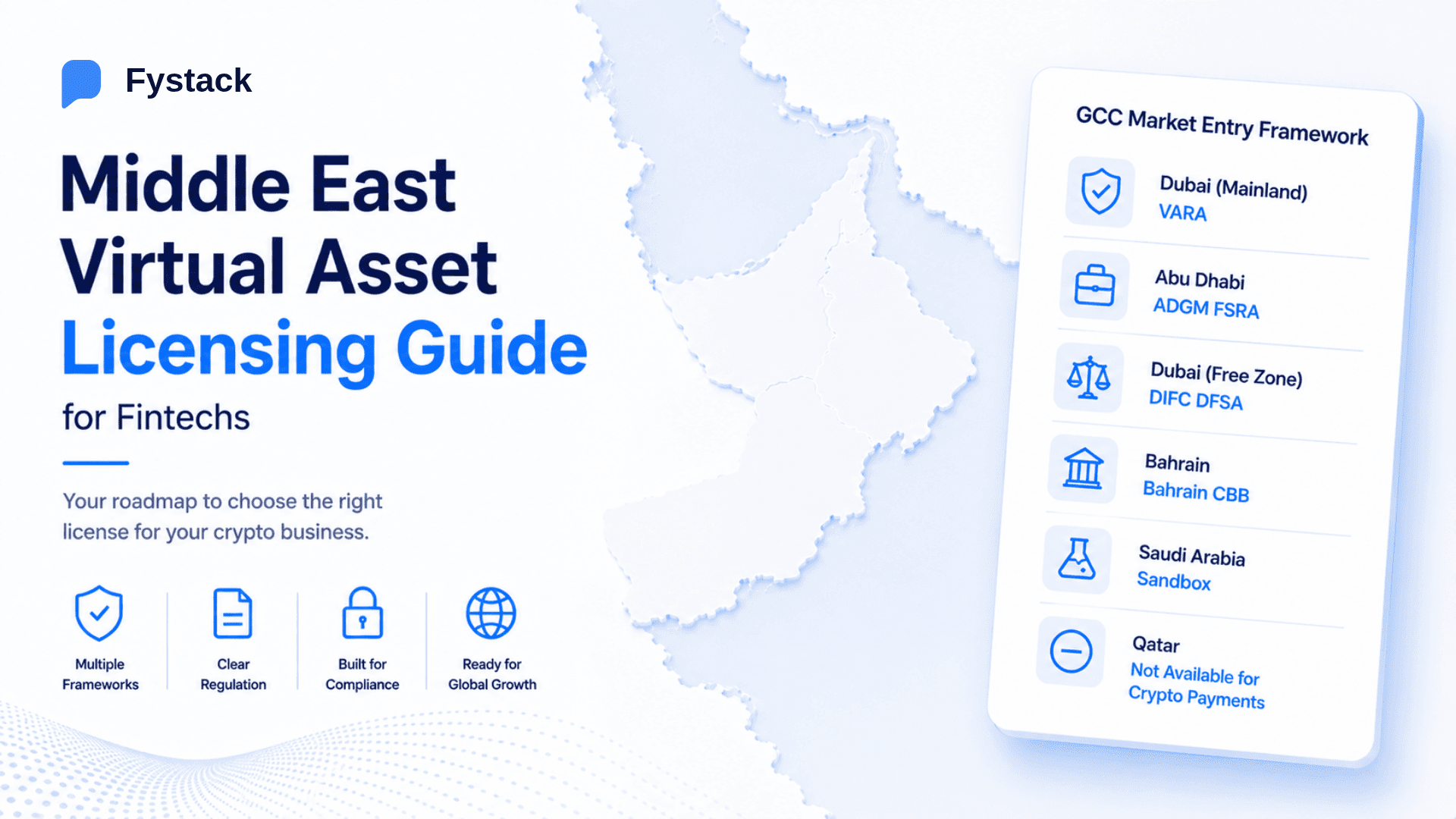
Middle East Virtual Asset Licensing Guide for Fintechs 2026

Ted Nguyen
Author
BD & Growth @Fystack
You're building a payment product that touches crypto.
A partner or investor tells you: "You should get a UAE license." So you Google it. And you immediately run into VARA. Then ADGM. Then DIFC. Then the federal CMA. Four different frameworks.
This guide breaks down the current GCC landscape (UAE, Bahrain, Saudi Arabia, Qatar) in practical terms for founders and product leads evaluating market entry.
Key Terms Explained
Before anything else, here's a quick glossary. These terms come up constantly in GCC compliance discussions and can be confusing if you're seeing them for the first time.
Term | Meaning |
GCC | Gulf Cooperation Council (UAE, Saudi Arabia, Bahrain, Kuwait, Oman, Qatar) |
VASP | Virtual Asset Service Provider: any business that exchanges, transfers, holds, or manages crypto on behalf of others. |
VARA | Virtual Assets Regulatory Authority: Dubai's dedicated crypto regulator. Covers mainland Dubai entities only. |
ADGM / FSRA | Abu Dhabi Global Market: a financial free zone in Abu Dhabi. FSRA is its regulator. A separate legal jurisdiction from Dubai. |
DIFC / DFSA | Dubai International Financial Centre: a financial free zone in Dubai. DFSA is its regulator. Also a separate jurisdiction from mainland Dubai. |
CBB | Central Bank of Bahrain: Bahrain's single regulator for all financial services including crypto. |
Travel Rule | A FATF requirement: when you send a crypto transfer, you must pass along the sender's and receiver's identity details. Now law in 85 of 117 jurisdictions. |
AML | Anti-Money Laundering: the compliance obligations all financial businesses must follow to detect and report suspicious activity. |
FATF | Financial Action Task Force: the global standard-setter for AML/CFT rules. Countries that don't meet FATF standards get put on a "grey list," which causes banking problems. |
Which UAE Regulatory Framework Applies to Your Fintech
Getting a UAE crypto license is more complicated than it sounds. The UAE runs four distinct regulatory frameworks. Which one applies to you depends on where you incorporate and what services you offer (e.g., payments, custody, exchange, advisory).
The UAE has a mainland (governed by federal law) and financial free zones that function as distinct legal jurisdictions with their own regulators and courts.
- VARA regulates virtual asset activities across the Emirate of Dubai (excluding DIFC)
- ADGM regulates activities within Abu Dhabi Global Market.
- DIFC regulates activities within the Dubai International Financial Centre.
- Federal CMA provides the baseline rules for onshore activities outside those three.
VARA (Virtual Assets Regulatory Authority)
VARA is Dubai's dedicated crypto regulator, launched in 2022. If your company incorporates in mainland Dubai and deals in any of these 7 activities, you need a VARA license: Exchange, Brokerage, Advisory, Asset management, Lending, Staking, and Custody.
VARA requires VASPs to designate two senior individuals as Responsible Individuals, each must be a full-time employee, a UAE resident or UAE passport holder, and individually approved by VARA before the license is granted. Any change to those individuals requires prior VARA approval.
As of February 2026, VARA was formally recognized as a competent authority for UAE corporate tax purposes.
ADGM FSRA (Abu Dhabi Global Market)
ADGM has a broader scope than VARA: it covers Virtual Assets, Fiat-Referenced Tokens (their term for stablecoins), Digital Securities, Derivatives, and Funds.
Therefore, the profile of operators here tends to be larger and the application process is more rigorous and expects documented history and governance structures.
DIFC DFSA
DIFC DFSA covers entities inside the Dubai International Financial Centre, a free zone inside Dubai's financial district.
As of January, 2026, firms must now assess the suitability of each crypto token themselves (no more central approved list). The amendments also tightened governance, custody, and disclosure rules.
Federal CMA (Capital Market Authority)
Federal CMA issued Decision No. 4/R.M/2026 creating an eight-category federal licensing framework for virtual asset activities. This applies to entities that don't fall inside VARA, ADGM, or DIFC. In practice, this means mainland entities outside of Dubai. Key requirements include:
● Annual technology audit
● 72-hour incident reporting
● Six-year transaction record retention
● Ban on privacy tokens (like Monero)
● Ban on algorithmic stablecoins (like the old TerraUST model)
Important: federal law applies on top of the free zones. Even if you're licensed inside ADGM or DIFC, Federal Decree-Law 6/2025 and federal AML law still apply.
The Travel Rule is now live in 85 jurisdictions, and FATF’s March 2026 data shows stablecoins make up 84% of flagged volume.
— Fystack (@fystack) June 4, 2026
Having a KYT tool is no longer enough. Regulators now require that screening happens before a transaction is signed. 🧵 pic.twitter.com/727isq51LI
Capital Requirements Overview (2026)
Capital requirements vary significantly by regulator and activity:
- VARA: Activity-based minimum capital (typically ranging from USD 135k to over USD 1M depending on services)
- ADGM / DIFC: Generally higher, especially for custody, exchanges, or those handling client assets
- Bahrain CBB: Often lower entry thresholds, making it more accessible for early-stage fintechs
- Federal CMA: Specific capital floors introduced under the 2026 framework
Always verify current figures directly with the regulator or legal counsel, as they can change and depend on your business model.
How Bahrain Crypto Licensing Works for Fintechs
Bahrain often gets overlooked, which is a mistake.
Bahrain offers a simpler model with the Central Bank of Bahrain (CBB) as the single regulator.
The rules are in the Crypto-Asset Module (Volume 6). In July 2025, the CBB added the Stablecoin Issuance and Offering (SIO) Module, providing a dedicated framework for stablecoin issuance, reserves, and redemptions.
For a payment fintech that settles in USDT, USDC, or any other stablecoin, this is an advantage. Bahrain gives you regulatory clarity that simply doesn’t exist yet in Saudi Arabia or Qatar. Bahrain also enforces the Travel Rule, which means the same VASP-to-VASP data transmission requirements you'll find in the UAE.
If you're familiar with the stablecoin custody requirements under MiCA and MAS, the Bahrain framework asks for comparable compliance infrastructure.
Saudi Arabia Has No Crypto License Available Yet
Saudi Arabia has active sandboxes (SAMA/CMA) and progress on real estate tokenization, but as of June 2026 there is still no formal VASP licensing framework for crypto payments or custody. New regulations are expected in the future, but the market remains in a watch-and-warn phase for most payment use cases.
For Gulf-to-South Asia corridors, see our breakdown of custody requirements in Pakistan PVARA and India VDA breakdown.
Why Qatar Is Not an Option for Crypto Payment Businesses
Qatar’s 2024 Digital Assets Framework in the QFC regulates investment and security tokens but explicitly excludes cryptocurrencies and most stablecoins. For crypto payment and custody activities, Qatar is currently not available.
How to Choose the Right Hub for your Fintech Businesses
Here's a direct comparison of the three viable frameworks.
Criteria | VARA (Dubai) | ADGM FSRA (Abu Dhabi) | Bahrain CBB |
Who it's for | Crypto-native fintechs, payment processors, custody providers. | Institutional operators, asset managers, large exchanges | Early-stage to growth fintechs, stablecoin payment operators. |
Complexity | High | High | Lower |
Stablecoin framework | Federal CMA bans algorithmic stablecoins and privacy tokens | FRT framework in place | SIO Module: dedicated rules for issuance, reserves, and redemption |
Travel Rule | Enforced | Enforced | Enforced |
These are not mutually exclusive. Some operators get their Bahrain CBB license first (faster and more accessible) while running a VARA or ADGM application in parallel.
Risks to Know Before You Enter the Market
Before you finalize your market entry plan, these are the real risks that can catch you off guard.
We break them down in the table below:
Risk Area | What It Means |
Free Zone vs Federal Law | Getting a license in ADGM or DIFC does not remove federal UAE rules |
Sanctions Screening | You must check against multiple international and local sanctions lists at once |
Fast Regulatory Changes | UAE rules are updated very frequently |
Saudi Arabia Licensing | No official licensing framework or timeline is available |
GCC Licensing Status in 2026
The region offers real opportunity but requires careful planning. Licensing timelines are often longer than expected (typically 12–24 months for VARA). Building robust compliance infrastructure (Travel Rule, KYT, custody, audit logging) adds further time.
For teams entering this market, Fystack offers self-hosted MPC custody that deploys inside any jurisdiction, with threshold signing policies, pre-signing KYT integration, and audit-ready logging built in from day one.
You can explore mpcium, Fystack's open-source MPC daemon built in Go. It is a self-contained system you deploy on your own servers, in whichever jurisdiction you operate in.
If you have questions about wallet infrastructure or custody architecture for your UAE or Bahrain deployment, share your setup and what you are trying to solve and our team will follow up directly.
Frequently Asked Questions (FAQs)
What is the difference between VARA and ADGM?
VARA is Dubai's crypto regulator, covering entities incorporated in mainland Dubai. ADGM covers entities in the Abu Dhabi Global Market free zone: a separate legal jurisdiction. You can't substitute one for the other.
Can a Bahrain CBB license cover UAE customers?
No. A CBB license authorizes operations in Bahrain. To serve UAE-resident customers, you need a UAE license.
Does the UAE Travel Rule apply to all crypto transfers?
UAE AML frameworks require VASPs to comply with FATF Recommendation 16. The specific threshold and technical requirements vary by framework and activity type. Confirm the exact obligations with compliance counsel under your specific license.