Why Stablecoin Adoption Looks Different in Every Asian Market (2026)

A stablecoin is a type of cryptocurrency built to hold a steady value, usually by staying pegged 1-to-1 with a currency like the US dollar. Unlike Bitcoin, its price doesn't swing up and down. That stability is why people and businesses use it to move money, not just to trade.
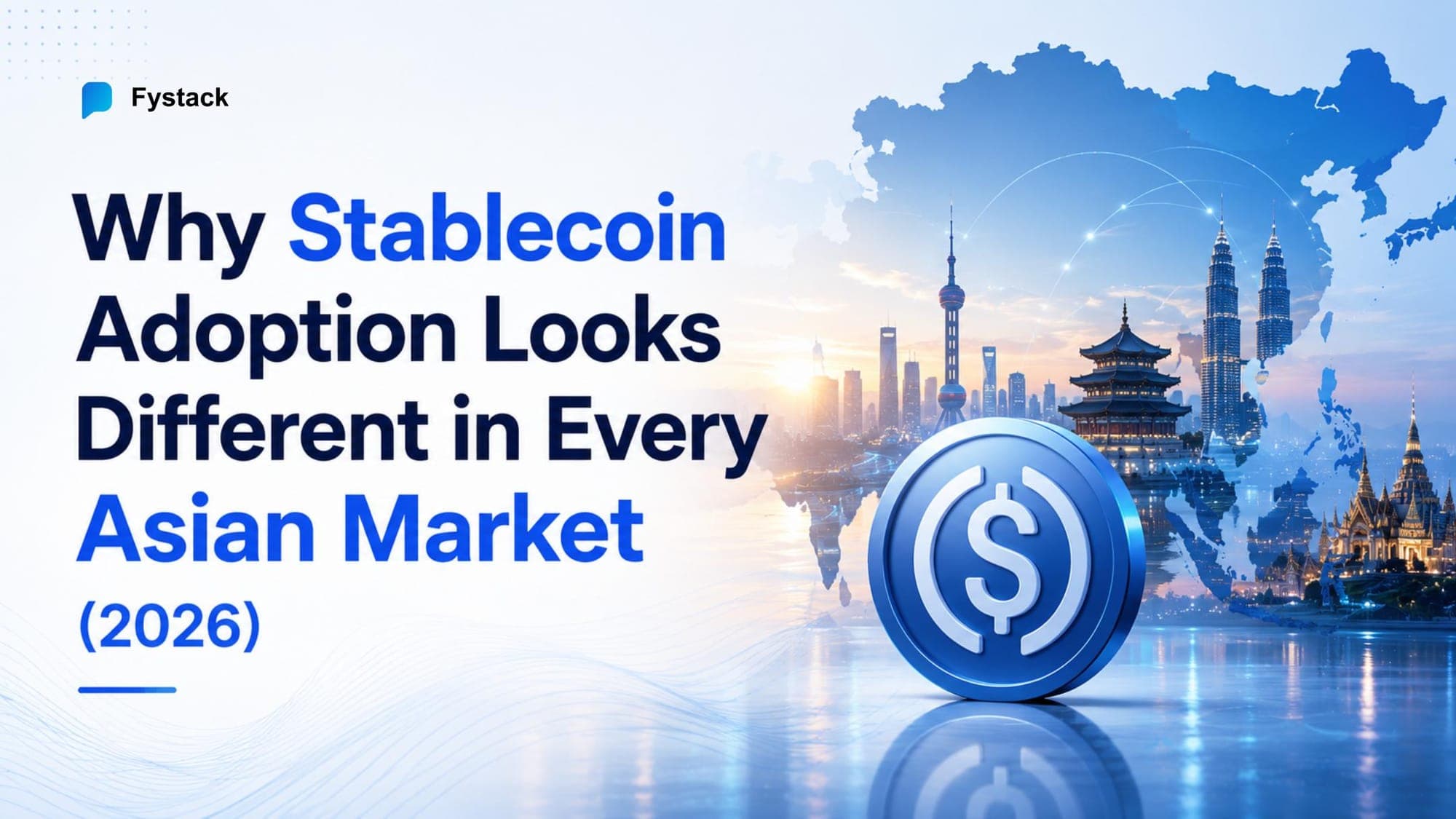
Stablecoin use looks completely different depending on which Asian country you're in, because each market uses it to solve a different problem, not because of some shared regional trend. This shift, from something crypto traders speculate on to something people actually use to send and receive money, is happening faster in Asia than anywhere else.
Asia-Pacific handles roughly 60% of all stablecoin payment activity worldwide. That's about $245 billion out of the $390 billion moved through stablecoins in 2025, according to a McKinsey and Artemis Analytics report from February 2026. But almost all of that volume comes from just three places: Singapore, Hong Kong, and Japan. Vietnam, the Philippines, and Indonesia show up just as often in adoption data, but for completely different reasons, which is the whole point of this piece.
Key takeaway
Stablecoin adoption across Asia comes down to six different behaviors, not one regional trend. Here's the short version:
- Vietnam → people use it to trade quickly, like cash they park between deals
- Philippines → people use it to send money home, and trust spreads through friends and family, not ads
- Indonesia → people use it to protect their savings from a weakening local currency
- Singapore → people and businesses use it because it's regulated and trustworthy
- Hong Kong → banks and businesses use it to move money across borders faster and cheaper
- South Korea → traders use it to shift money quickly between exchanges
Treating "Asia" as one single stablecoin market, with one set of rules and one type of user, is the most common mistake companies make when they try to expand into the region.
Vietnam: Trading Liquidity
Vietnam isn't using stablecoins as a savings account. People use them as working cash that moves between one trade and the next. Most Vietnamese users hold USDT (a dollar-pegged stablecoin) for a short time, as a tool for trading, not as somewhere to park money long-term.
Vietnam ranks fourth in the world for crypto adoption according to Chainalysis, a firm that tracks blockchain activity. It's also the third-biggest crypto market in the Asia-Pacific region by transaction value, worth about $220 billion in the year up to June 2025, up 55% from the year before.
This trading-heavy habit is now running into new rules. Vietnam's Law on Digital Technology Industry, which took effect January 1, 2026, officially recognizes crypto assets as something people can legally trade and invest in. But it leaves stablecoins out of that definition for now, so they fall under a separate set of rules that's still being written.
That's one reason some infrastructure companies are building products specifically for Vietnam instead of just extending what they already built for other countries.
If you're a business trying to enter Vietnam, the old route, informal trading between individuals, isn't where the opportunity is anymore. The government has approved five bank-backed exchanges to legally operate: CAEX (backed by VPBank), TCEX (backed by Techcombank), LPEX (backed by LPBank), VIXEX (backed by VIX Securities), and a joint venture between MB Bank and Dunamu, the South Korean company that runs the Upbit exchange.
The pattern here is already clear. Dunamu isn't launching its own competing exchange in Vietnam. Instead, it's helping MB Bank build one, providing the technology, legal compliance know-how, and investor protection expertise, in exchange for a stake in the business. OKX Ventures and HashKey Capital did the same thing with CAEX: they put in money and expertise rather than starting a rival platform. For most infrastructure and technology companies, the realistic way into Vietnam is partnering with one of these five licensed exchanges, not trying to compete with them.
Philippines: Community-Led Remittances
In the Philippines, stablecoin adoption doesn't spread through advertising. It spreads because people trust the person who told them about it. Filipinos living and working abroad sent home $39.62 billion in 2025, an all-time record, according to the country's central bank. The biggest sources of that money were the US, Singapore, and Saudi Arabia.
Most Filipinos already use mobile payment apps like GCash and Maya every day. New ways of sending money, including stablecoins, spread through the same channels people already trust: gaming communities, networks of overseas workers, and local influencers, long before any company runs a paid ad campaign. A money-transfer product succeeds in Manila because someone's cousin already used it and said it worked.
That means a brand-new wallet app trying to compete head-on with GCash and Maya faces long odds. What's actually working is a different model: in April 2026, Maya partnered with Lydian, a stablecoin technology company backed by Tether (the company behind the world's biggest stablecoin) and the trading firm Cantor Fitzgerald.
In that deal, Maya handles the parts that require a license, its network of merchants, its fraud and compliance checks, and its relationship with the central bank, while Lydian supplies the technology that actually moves the stablecoins behind the scenes. GCash took a similar approach earlier, plugging in crypto-to-cash conversion through a partnership with the exchange Binance instead of building that capability from scratch. The lesson: the winning move is providing the technology behind an app people already trust, not trying to build a new app to replace it.
Indonesia: Dollar Hedge
Indonesian users generally aren't trading stablecoins for profit. They're using them to protect their money from a weakening rupiah, Indonesia's currency. For most people, a dollar-pegged stablecoin is the easiest way to hold US dollars without needing an actual US bank account, which most Indonesians can't easily get.
That changes what actually matters when designing a product for this market. The user isn't comparing interest rates or blockchain speeds. They're asking a much simpler question: can I get in and out of dollars easily and reliably? Reducing friction when someone signs up, and making sure they can convert back to cash smoothly, matters far more than adding extra features. We cover this pattern in more depth in our breakdown of stablecoin adoption across Southeast Asia.
On the business side, Indonesia works differently from most markets: instead of many separate companies competing, there's one consolidated structure everyone plugs into. ICEx Group, licensed by Indonesia's financial regulator (called OJK) in early 2026, combines three separate functions, the exchange itself, the clearing process (matching and confirming trades), and custody (safely storing the actual assets), all under one umbrella. It's backed by 11 of Indonesia's biggest crypto exchanges, including Indodax, Tokocrypto, and Upbit Indonesia.
When OSL Group, a global stablecoin company listed on the Hong Kong stock exchange, wanted to enter Indonesia, it didn't try to launch on its own. Its local arm, OSL Indonesia, simply joined the ICEx consortium as a founding shareholder. For most infrastructure companies, joining that consortium, particularly its custody arm, is the realistic way in, rather than trying to build a separate, independent product for the Indonesian market.
Singapore: Regulatory Trust
In Singapore, being seen as trustworthy and well-regulated isn't just a nice-to-have, it's basically the product itself. Banks and other institutions here prefer to work with stablecoin issuers that are officially regulated, rather than unregulated alternatives. Singapore's Payment Services Act gives the country something Vietnam and Indonesia don't have yet: a financial regulator that both everyday users and big institutions already trust.
There are regulated, Singapore-dollar-pegged stablecoins available, like XSGD from a company called StraitsX, and people do trust them. But in practice, dollar-pegged stablecoins are still what most people actually use day to day. Singapore isn't really a huge growth market for stablecoin usage itself. It's more like the country other parts of Asia point to when they want to prove they're playing by the rules.
That trust-first reputation shapes how companies actually enter this market: you generally need a license before you can operate. Companies like Paxos, Ripple, and Circle (the company behind the USDC stablecoin) all got their own Major Payment Institution license, a formal approval from Singapore's central bank, the Monetary Authority of Singapore (MAS), rather than trying to work around the edges of the rules.
StraitsX has taken a different approach: instead of competing for its own license-holders, it built infrastructure that other companies plug into. It connected its stablecoin directly into Grab's payment system (Grab is Southeast Asia's biggest ride-hailing and delivery app) in November 2025, and it now powers a cross-border payment link with a Thai bank called KBank, under a MAS pilot program named Project BLOOM. So there are really only two ways in: get your own license, or build on top of an already-licensed company's existing rails.
Hong Kong: Settlement Efficiency
Hong Kong treats stablecoins as plumbing for moving money, not as some new philosophy. What matters here is how fast money moves, how cheap it is to move, and how easily it crosses borders, not any bigger ideological debate about crypto. Hong Kong's monetary authority (the HKMA) now issues formal licenses to stablecoin companies, and HSBC and a joint venture called Anchorpoint Financial, backed by Standard Chartered, were among the first companies licensed in April 2026. Our guide to entering Hong Kong's crypto market breaks down exactly what those licensing requirements involve.
Nobody in Hong Kong is really debating whether stablecoins are a good idea in principle. The only question that matters is whether they move money faster and cheaper than the old way of doing it, and increasingly, the answer is yes.
The way into this market is through banks, not consumer apps. Since HSBC and Anchorpoint are already licensed issuers, the realistic path for most businesses is a partnership with one of those licensed banks around treasury or settlement services, not trying to build a consumer-facing wallet app that competes for everyday users' attention.
South Korea: Exchange Infrastructure
South Korean users generally don't hold onto stablecoins for long. They move through them quickly. Stablecoins here mostly function as a way to shift money between different crypto exchanges, not as somewhere to store value. It's closer to using a faster settlement pipe inside a trading habit people already have, rather than adopting a brand-new financial product.
Products built around the idea of long-term storage or savings tend to flop in this market. What actually gets used is speed, and the ability to move easily between different exchanges.
That points to a two-step path in, not just one. Exchanges like Upbit, Bithumb, Coinone, and Korbit are the easiest way to get initial access to trading activity, especially since Upbit is about to become part of Naver's payment ecosystem once their merger closes in mid-2026 (Naver is one of Korea's biggest internet companies).
But one industry analysis put it well: exchanges are "the right starting point and the wrong ending point." Korean banks are building their own won-denominated stablecoins (the won is Korea's currency), and they're looking for infrastructure partners, not competitors. MoonPay Korea signed a banking partnership with Woori Bank in April 2026. Fireblocks, a crypto security company, is already embedded inside NH Bank's systems. Solana, a blockchain network, partnered directly with Shinhan Card, a major payments company. The lasting relationship is the one with a bank. The exchange is just where most companies start.
Three Patterns That Show Up Across All Six Markets
Stablecoins tied to local currencies barely register. Across the Asia-Pacific region, non-dollar stablecoins make up a tiny slice of total activity. Chainalysis recorded roughly $9.4 billion in Thai-baht-pegged stablecoins over a twelve-month period, which is small compared to USDT and USDC (the two biggest dollar-pegged stablecoins), which together account for over 95% of the entire global stablecoin market. Being pegged to the US dollar isn't just a nice feature people like. For most users, it's the entire reason they use a stablecoin at all.
New regulations change who's allowed to offer stablecoin services, not how much people want to use them. Vietnam's new digital asset law, Hong Kong's licensing system, and Singapore's regulatory framework all tighten the rules around who can legally provide stablecoin services. None of them seem to be reducing how much people actually want easy access to dollar-pegged, instantly transferable money.
People expect stablecoin apps to feel as simple as the apps they already use. Users who grew up using Grab, Shopee, GCash, and MoMo judge a stablecoin wallet against the payment app they already open every day, not against other crypto products. Complicated steps like managing your own private keys (the passwords that control your crypto) or manually picking which blockchain to use are exactly why otherwise good products lose users right at sign-up across Southeast Asia.
Why the Six Markets Diverge
Stablecoins get adopted differently in each country because each country is really trying to solve a different financial problem. On the surface, these six markets look completely different from each other, but the underlying reasons largely come down to three things: how developed a country's banking system already is, how easy it is for regular people to get access to US dollars, and what payment habits people already had before stablecoins showed up.
- Countries with developed financial systems (Singapore, Hong Kong): here, stablecoins are competing directly with banks, so trust, transparency, and reliable settlement are what decide whether people adopt them.
- Countries where US dollars are hard to access (Indonesia): stablecoins substitute for a US dollar bank account that most people can't easily open in the first place.
- Countries with a strong retail trading culture (Vietnam, South Korea): stablecoins are mainly used as a trading tool, not something people save in.
- Countries with large numbers of workers sending money home (Philippines): stablecoins are stepping in to replace services like Western Union.
The Same Stablecoin, Six Different Jobs
The same stablecoin ends up solving six completely different problems, depending on where you are. USDT isn't valuable just because it's "programmable money" in some abstract, technical sense. It's valuable because each market uses it to replace a different piece of everyday financial infrastructure. In Vietnam, it's short-term trading cash. In Indonesia, it's a stand-in for a US dollar account. In the Philippines, it's a cheaper way to send money home. The asset itself never changes. What changes is the job it's actually doing for the person using it.
The Six Stablecoin Behaviors Framework at a Glance
| Market | Primary driver | Typical use case |
| Vietnam | Trading liquidity | Parking funds between trades |
| Philippines | Community-led remittances | Cross-border transfers |
| Indonesia | Dollar hedge | Currency protection |
| Singapore | Regulatory trust | Institutional payments |
| Hong Kong | Settlement efficiency | Cross-border capital movement |
| South Korea | Exchange infrastructure | Liquidity movement between exchanges |
What Builders Should Actually Do
If you're building across APAC: don't localize the language. Localize the behavior. Translation is easy. Matching what each market actually needs from a stablecoin product is the harder, more valuable work.
| Market | Localize for | Primary channel |
| Vietnam | Fast deposit, fast withdrawal | Licensed exchange partnerships (CAEX, TCEX, LPEX, VIXEX, MB-Dunamu) |
| Philippines | Cash-in/cash-out, remittance flows | Infrastructure partner behind Maya/GCash (e.g. the Maya-Lydian, GCash-Binance model) |
| Indonesia | Easy fiat on-ramp, dollar exposure | Join the ICEx Group consortium (exchange, clearing, custody) |
| Singapore | Compliance, audit trail | Get an MAS MPI license, or build on StraitsX's rails |
| Hong Kong | Treasury operations, settlement | Bank partnerships (HSBC, Anchorpoint-style issuers) |
| South Korea | Exchange connectivity, API access | Exchanges (Upbit, Bithumb) for liquidity, bank partnerships (Woori, NH, Shinhan) for the real payment layer |
Why This Matters for Infrastructure, Not Just Go-to-Market
A stack built for Singapore's compliance-first flows and a stack built for Vietnam's high-frequency trading flows are not the same stack, even when they're moving the same USDT.
- Singapore-style flows need auditability, redemption guarantees, and regulator-ready reporting.
- Vietnam-style flows need speed and low friction without every transaction reading as a compliance event.
Businesses serving more than one of these markets from a single custody layer usually discover this gap after building for one behavior pattern first, a mismatch we break down further in how MPC wallets and stablecoins unlock just-in-time liquidity for enterprises. Designing for APAC as a portfolio of six distinct behaviors, not one region, is what separates infrastructure that scales across all six from infrastructure that has to be rebuilt for each one.
FAQ
Is stablecoin adoption the same across Asia?
No. Adoption is driven by different behaviors in each market: trading liquidity in Vietnam, remittances in the Philippines, dollar hedging in Indonesia, regulatory trust in Singapore, settlement efficiency in Hong Kong, and exchange infrastructure in South Korea.
Why do Vietnamese users hold USDT?
Most Vietnamese users hold USDT as short-term trading liquidity rather than long-term savings, using it to move quickly between trading opportunities.
How are stablecoins used for remittances in the Philippines?
Stablecoins are increasingly used alongside traditional channels to send money from overseas Filipino workers back home, layered onto a market that already sends over $39B a year in remittances and is highly fluent in mobile wallets.
Which Asian countries have regulated stablecoin frameworks?
Singapore (Payment Services Act), Hong Kong (Stablecoins Ordinance, licensing through the HKMA), and Vietnam (Law on Digital Technology Industry, effective 2026) all have formal or forming regulatory frameworks, though each defines and treats stablecoins differently.
Why does stablecoin adoption look so different across Asian countries?
Adoption patterns trace back to three structural factors: how mature a country's financial system already is, how easy it is to access U.S. dollars locally, and existing payment habits like remittances or retail trading. Each market uses stablecoins to solve a different underlying financial problem.