Data Residency in Cross-Border Stablecoin Settlement for Fintechs

Ted Nguyen
Author
BD & Growth @Fystack
TL;DR
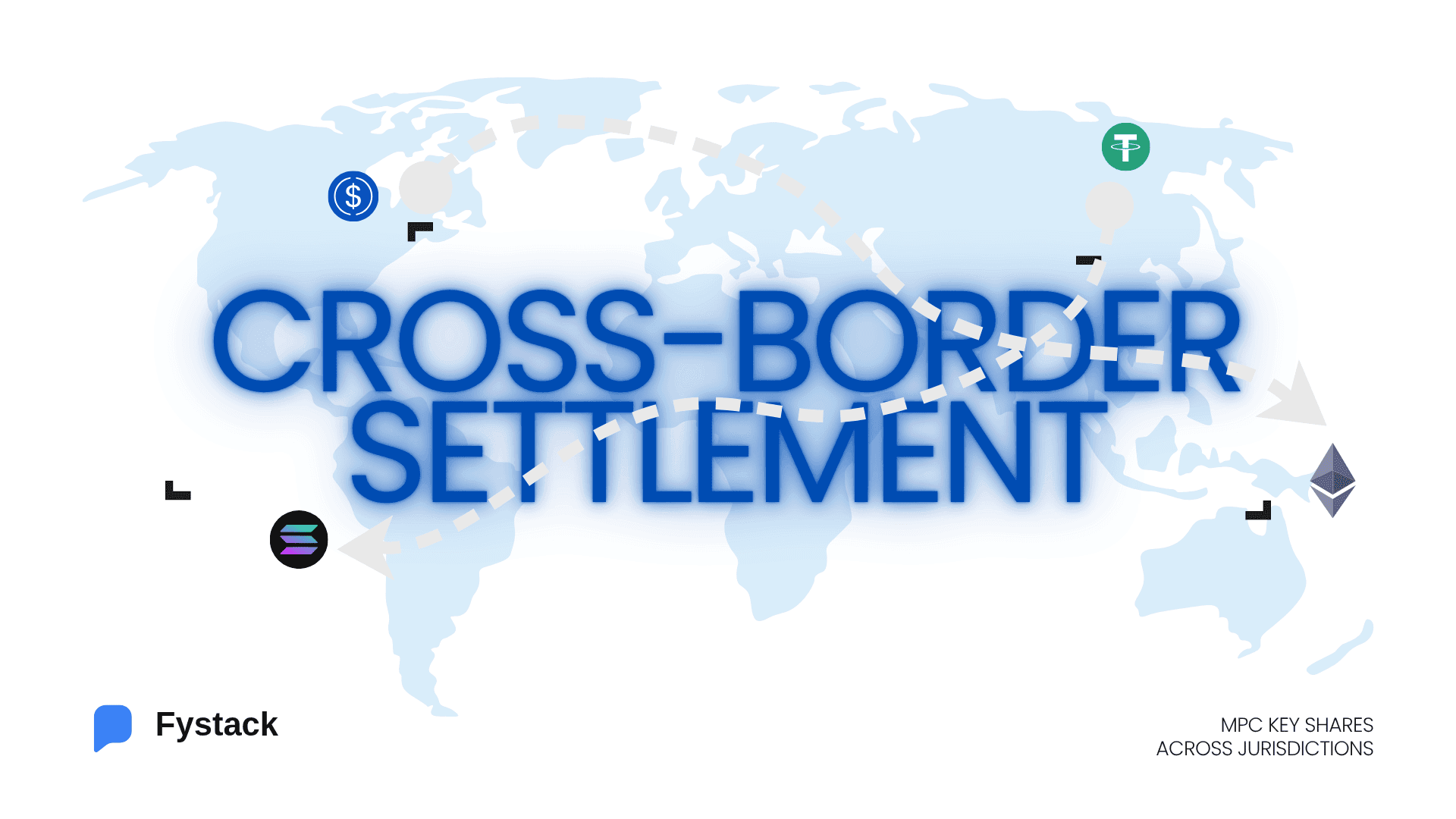
- Running stablecoin settlements across US-LATAM, EU-Africa, and Asia-Pacific puts your infrastructure inside six or more regulatory environments at once, each with different rules about where data must live.
- Most SaaS custody vendors have data centers in a limited set of regions, leaving large parts of the world without a local infrastructure option.
- Three patterns help fintechs stay compliant: separating compliance data by country, isolating local payment rails, and splitting MPC key shares by jurisdiction.
Key Regulations Covered
Acronym | Regulation |
HKMA | Hong Kong Monetary Authority |
MAS Notice 658 | Monetary Authority of Singapore — Outsourcing Notice |
GDPR Art. 44 | General Data Protection Regulation, Article 44 (Eu) |
LGPD | Lei Geral de Proteção de Dados (Brazil) |
NDPA | Nigeria Data Protection Act |
Six Words That Changed How CTOs Think About Signing
In February 2024, Hong Kong's banking regulator published a custody document with six words no other regulator had written before: "localisation expectations in relation to private keys." That document forced a reckoning most fintech CTOs had not prepared for. Few had mapped which jurisdiction their signing infrastructure actually sat inside.
A payment company running 3 corridors is operating inside 6 or more jurisdictions at once. Each has different rules about where data must live, how payment flows must be routed, and in Hong Kong's case, where signing infrastructure must sit.
Most SaaS custody vendors have infrastructure in a small number of regions. The gap between where a vendor's servers sit and where your product operates is an infrastructure problem as much as a compliance one. This post covers three patterns that close it.
Why Signing Infrastructure Has a Border Problem
Most companies pick a custody vendor and move on. The product scales across corridors; the signing layer stays in one place. When a regulator in one of those countries looks at your infrastructure and finds nothing inside their borders, the signing layer ends up inside scope regardless of whether it is named in any rule.
Why SaaS Custody Models Hit Regional Limits
SaaS vendors design for scale, not jurisdiction. Their orchestration stays inside their own infrastructure regardless of where individual nodes sit, and adding a new region is on their roadmap. Your key material sits in shared infrastructure alongside clients from other jurisdictions. Physical presence and legal control are different things, and SaaS models routinely separate them.
Compliance Data Payment Rails and MPC Key Shares
Each pattern solves a different part of the problem. Most fintechs need all three.
Pattern | What it fixes | Relevant regulators |
Compliance data separation | KYC and transaction records stay inside the country they came from | GDPR (EU), NDPA (Nigeria), LGPD (Brazil) |
Isolated payment systems | Local fiat rails run locally; stablecoin corridor sits above them | MAS (Singapore), CBN (Nigeria), HKMA (Hong Kong) |
Distributed MPC key shares | Signing authority stays inside each country | All corridors |
Compliance data separation keeps KYC records, transaction histories, and identity data inside the country they came from. The stablecoin layer moves value above this without carrying the personal data that triggers residency rules.
Isolated payment systems means domestic fiat activity runs inside the local jurisdiction. The stablecoin corridor connects local systems at the settlement layer only, so each regulator sees a locally-compliant payment system rather than a foreign operator running the full stack.
Distributed MPC key shares address the signing layer directly. Each share lives on a node you control inside one jurisdiction, and no single share is enough to sign on its own.
Distribute MPC Key Shares Per Country
MPC (Multi-Party Computation) splits your private key into pieces called shares. Each share lives on a node inside one country. To sign a transaction, enough nodes must agree (for example, 2 out of 3). No single share is enough to sign on its own. The full key is never assembled anywhere.
Each node runs on a server you control, in whichever country you choose. You start three nodes, each on infrastructure inside a different jurisdiction:
$ mpcium start -n node0
$ mpcium start -n node1
$ mpcium start -n node2
Mpcium enforces a minimum threshold before any signing can happen:
t ≥ ⌊n / 2⌋ + 1
# With 3 nodes: t = 2
# Any 2 of 3 nodes must participate to sign
A regulator in Singapore sees a locally-resident node holding a locally-resident key share that participates in signing. That satisfies local oversight without requiring a separate custody product per corridor. If one node goes offline, the other two can still sign.
No single country can block the product, and no single jurisdiction holds enough to act alone.
Layering Data Separation Payment Rails and MPC Key Shares
Compliance data separation handles user and transaction records. Isolated payment systems handle the payment perimeter. Distributed MPC key shares handle signing authority.
A fintech running all three corridors can layer them: compliance data stays local per country, local fiat rails run independently, and key shares sit inside each jurisdiction. Each layer solves a different part of the same problem without touching the others.
What CTOs Overlook When Moving to Distributed MPC
Network latency and signing speed
MPC nodes sign by exchanging messages across the network. For real-time payment flows where signing sits in the critical path, benchmark latency between your planned node locations before committing to a geographic layout.
Cloud infrastructure and data sovereignty.
Deploying nodes on a public cloud satisfies data residency on paper but not data sovereignty if the management plane routes traffic outside the jurisdiction. Teams with a hard sovereignty requirement run nodes on bare metal or co-location.
Failover policy before go-live
A 2-of-3 threshold means one offline node does not stop signing, but it reduces fault tolerance to zero until that node recovers. Define a recovery time objective per node before you ship.
Oversight | Risk | Action |
Network latency | Geo-distributed nodes add round-trip time to every signing event | Benchmark node locations before committing to a geographic layout |
Cloud sovereignty | Physical server location does not equal legal jurisdiction | Use bare metal or co-location for hard sovereignty requirements |
Failover policy | 2-of-3 reduces fault tolerance to zero while a node is down | Define a recovery time objective per node before go-live |
Build Your Signing Layer in Any Country
Self-hosted MPC lets you place key share nodes inside any jurisdiction you operate in. Fystack's mpcium is an open-source MPC implementation you deploy on your own infrastructure, in any country, with threshold policies you define. No regional data center dependency. No vendor coverage gap.
If you are mapping a multi-corridor stablecoin architecture, tell us where your setup stands and our team will follow up.
Frequently Asked Questions (FAQs)
Does GDPR require MPC key shares to stay in the EU?
No. GDPR covers personal data, and a key share on its own does not identify a person. If the share is linked to a customer record, GDPR transfer rules apply to that linked data, not to the key share itself.
What does Singapore actually require for signing infrastructure?
MAS does not name key shares specifically. MAS Notice 658 requires outsourcing contracts to include data residency provisions, and the ABS guidance treats domestic payment data as Singapore-resident. For a Singapore-licensed payment processor, the expectation is that signing infrastructure for domestic flows is Singapore-based.
Can we use a SaaS vendor for some corridors and self-hosted MPC for others?
Yes. You can use a SaaS vendor where they have in-country infrastructure and deploy self-hosted MPC nodes for corridors they do not cover. Threshold policies need to be consistent across both, but the two approaches are compatible.
What happens if one MPC node goes offline in a jurisdiction?
With a 2-of-3 threshold, one node going offline does not stop operations. The remaining two nodes can still reach quorum and sign. This is one of the reasons the 2-of-3 setup is common for three-corridor deployments: the product stays live even if one region has an outage, and no single jurisdiction can block signing.
What is the difference between data residency and data sovereignty?
Data residency is about where data is physically stored. Data sovereignty is about which country's laws apply to it. For stablecoin products, the two often differ: a key share stored on a server in Singapore is resident in Singapore, but if that server is managed by a US vendor under US terms of service, data sovereignty may still point to the US. Self-hosted infrastructure resolves both at once because you control where the hardware sits and under which legal framework it operates.