What Crypto Cards Reveal About the Future of Payments

Ted Nguyen
Author
BD & Growth @Fystack
TL;DR
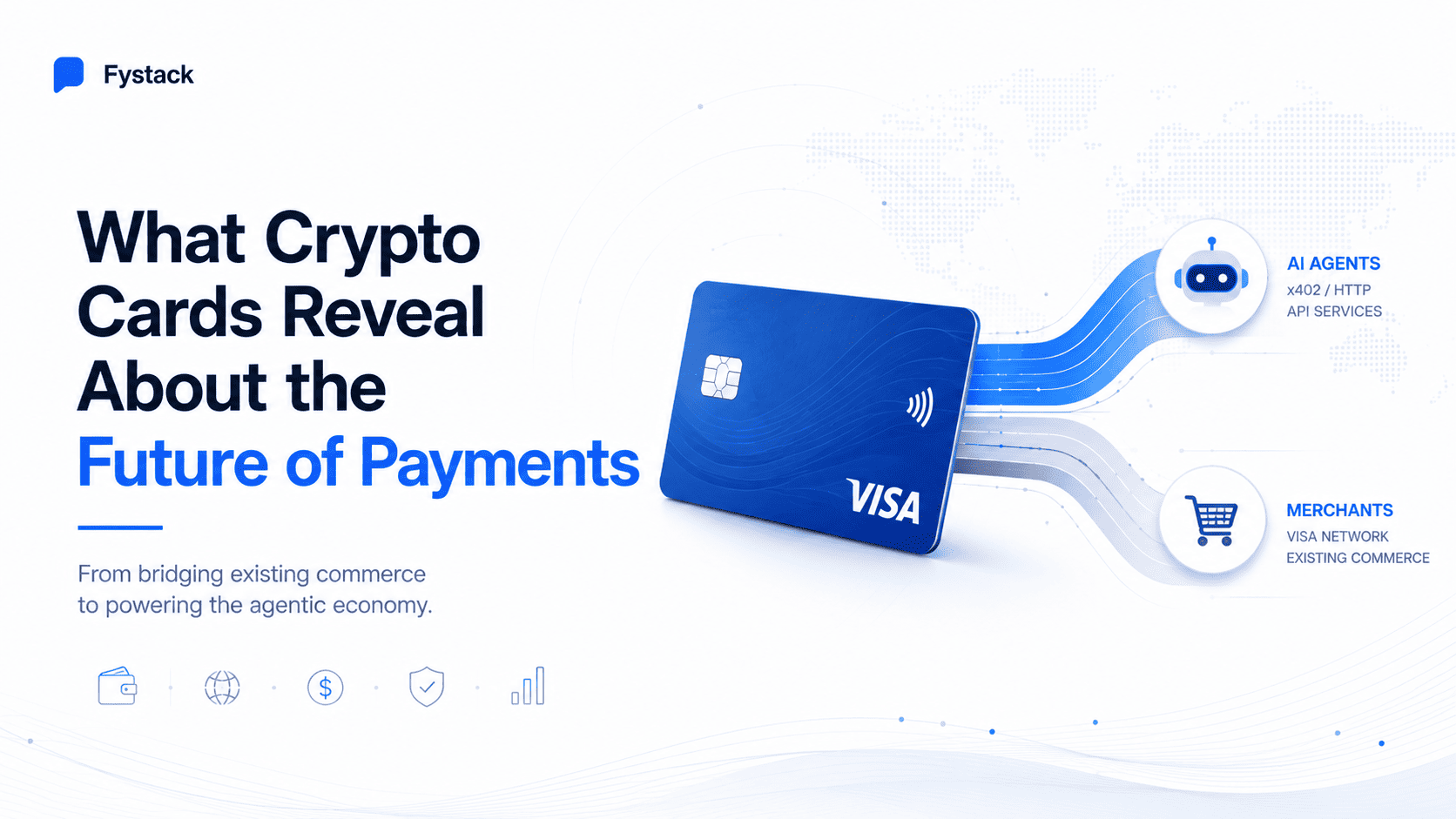
Crypto card monthly volume grew 106% annually from early 2023, driven almost entirely by programs that run on Visa. Mastercard is running two separate strategies at once: consumer card agents and a B2B settlement infrastructure acquisition. The card works as a bridge for existing merchants. For new ones with no entity and no processing history, protocols like x402 are the only option that works today
Introduction
Artemis Research reported in January 2026 that total crypto card monthly volume grew from $100 million in early 2023 to over $1.5 billion by late 2025, a 106% compound annual growth rate. Annualized, the market reached $18 billion — close to the $19 billion in peer-to-peer stablecoin transfers over the same period.
By July 2026, Paymentscan tracked $691.7 million in a single month from on-chain settled card programs alone, with $8.094 billion in cumulative volume across 128.7 million transactions and 467,000 wallet addresses.
How Much People Are Spending on Crypto Cards
The biggest program by monthly volume is RedotPay at roughly $380 million per month. KAST ranks third. Both run on Visa. Paymentscan's July 2026 data shows Visa at 98.5% of on-chain crypto card volume. Mastercard at 1.5%.

Visa built its position by partnering early with infrastructure providers like Rain and Reap, which issue cards for many downstream programs at once. One Visa infrastructure deal covers many products. Mastercard built its crypto card presence through direct partnerships with centralized exchanges — Bybit, Revolut, Gemini — which ties its volume more closely to exchange trading cycles.
Table 1: Visa vs Mastercard — Crypto Card Comparison (July 2026)
How Visa and Mastercard Compete on Crypto
Both networks are extending card infrastructure to AI agents. Noah Levine at a16z noted in March 2026 that Mastercard Agent Pay is live for US cardholders and Visa's Intelligent Commerce framework is in pilot. The Agentic Commerce Protocol, built by Stripe and OpenAI, has Etsy live with over one million Shopify merchants set to follow.
At the consumer layer, both networks are converging on the same approach. At the settlement layer, they are not. Mastercard announced in March 2026 that it would acquire BVNK for up to $1.8 billion, including $300 million in contingent payments. BVNK processes $30 billion annually for clients including Worldpay, Deel, and Rapyd. The stated goal: 24/7 stablecoin settlement for processors and acquirers, and stablecoin checkout within Mastercard's payment gateway.

How Crypto Cards Work as a Bridge
A crypto card does one job: it converts a wallet balance into what a merchant already accepts. The cardholder pays from USDC. The merchant receives a standard card transaction. Artemis confirmed that the vast majority of crypto card transactions today settle in fiat at transaction time, so the merchant sees only local currency regardless of which stablecoin the user holds.

That job has real reach. RedotPay users in Southeast Asia, LATAM, and Africa can pay at any Visa-accepting terminal without the merchant needing to know anything about crypto.
But the card cannot serve every merchant. Levine at a16z put it directly:
“Cards serve every merchant a processor can underwrite. Stablecoins serve every merchant a processor cannot.”
A developer who builds an API tool in a weekend has no legal entity, no website, and no chargeback history — a profile that is very difficult to underwrite. Levine’s conclusion: “These merchants will not be choosing stablecoins over cards. They will be choosing stablecoins over nothing.”
What AI Agents Need That Cards Cannot Provide
In March 2026, a marketplace at mpp.dev opened with over 60 services built for AI agents: SEC filing search charges per query, image generation at fractions of a cent, physical letters printed and mailed from a document and address. The protocol powering it is MPP (Machine Payments Protocol), built by Stripe and Tempo, which lets agents pay using cards, stablecoins, or Lightning in a single HTTP request.
In its first week, 894 agents made 31,000 transactions at prices from $0.003 to $35 per request, according to a16z. No checkout page. Pricing embedded in the HTTP response. The agent reads the schema, pays, receives output.
Two protocols now make this model possible at the infrastructure level. x402 embeds stablecoin payments directly in HTTP requests with no merchant account or processor onboarding. MPP supports cards, stablecoins, and Lightning in the same request, with the mpp.dev marketplace as its live implementation. As a16z noted, "x402 and MPP each take a different approach, but both embed payments directly into HTTP requests."
MoonPay’s PayBox handles the full stack for agents — MPC key sharding in a trusted execution environment, policy limits before any transaction, virtual cards scoped per merchant for fiat rails when needed.
every Claude and ChatGPT user now has the power to trade anything on @solana by having a conversation
— MoonPay 🟣 (@moonpay) July 29, 2026
welcome to PayBox, the payment vault and non-custodial wallet that lets AI Agents securely transact across the open internet
prompt, approve, pay: https://t.co/isCEzCNoC6 pic.twitter.com/H4bnenMnEn
MoonPay Launches PayBox, a Payment Vault for Claude and ChatGPT
Conclusion
The card worked because neither side had to change anything. As Levine, a16z, wrote: “The next generation of merchants won’t have storefronts. They’ll have endpoints.” The card serves that well for the merchants that already exist. The infrastructure being built now is for the ones that do not.
About Fystack
Fystack is an enterprise-grade, self-hosted MPC custody platform for fintech teams and crypto businesses. The core signing infrastructure, mpcium, is open-source. Fystack supports multi-chain wallet operations across TRON, ETH, BNB, Solana, Polygon, and more, with a policy engine that enforces spend rules before any signing happens.
If you are building payment infrastructure that involves automated signing, wallet custody, or agent payment flows, Fystack has the full product overview. The policy engine source is on GitHub.
Frequently Asked Questions
Why does Visa dominate on-chain crypto card volume?
Visa partnered early with card issuers like Rain and Reap, which issue programs for many downstream products under a single infrastructure agreement. Mastercard grew through direct exchange partnerships, which scales differently.
What is the BVNK acquisition about?
Mastercard agreed to acquire BVNK for up to $1.8 billion, including $300 million in contingent payments. BVNK processes $30 billion annually for enterprise clients. The deal adds 24/7 stablecoin settlement for processors and acquirers and stablecoin checkout to Mastercard’s payment gateway. Mastercard completed the acquisition on August 3, 2026.
What are x402 and MPP, and how do they differ from card payments?
x402 and MPP are two separate protocols that both embed payments directly into HTTP requests. Both serve agent-to-service transactions: micropayments, per-call billing, and merchants with no legal entity or processing history that card processors cannot currently underwrite.