Why Solana Is Emerging as a Leading Chain for Global Payments in 2026

Ted Nguyen
Author
BD & Growth @Fystack
Solana has gained traction by delivering fast, low-cost execution that supports payments, consumer applications, and high-frequency on-chain activity. At the same time, newer ecosystems promote alternative design philosophies focused on execution models, safety, and decentralization.
Choosing a blockchain today requires recognizing that different chains optimize for different business realities. Infrastructure decisions should therefore be guided by product requirements, user profiles, and operational constraints
Solana vs. Traditional Banking Rails: The Economics of Instant Settlement
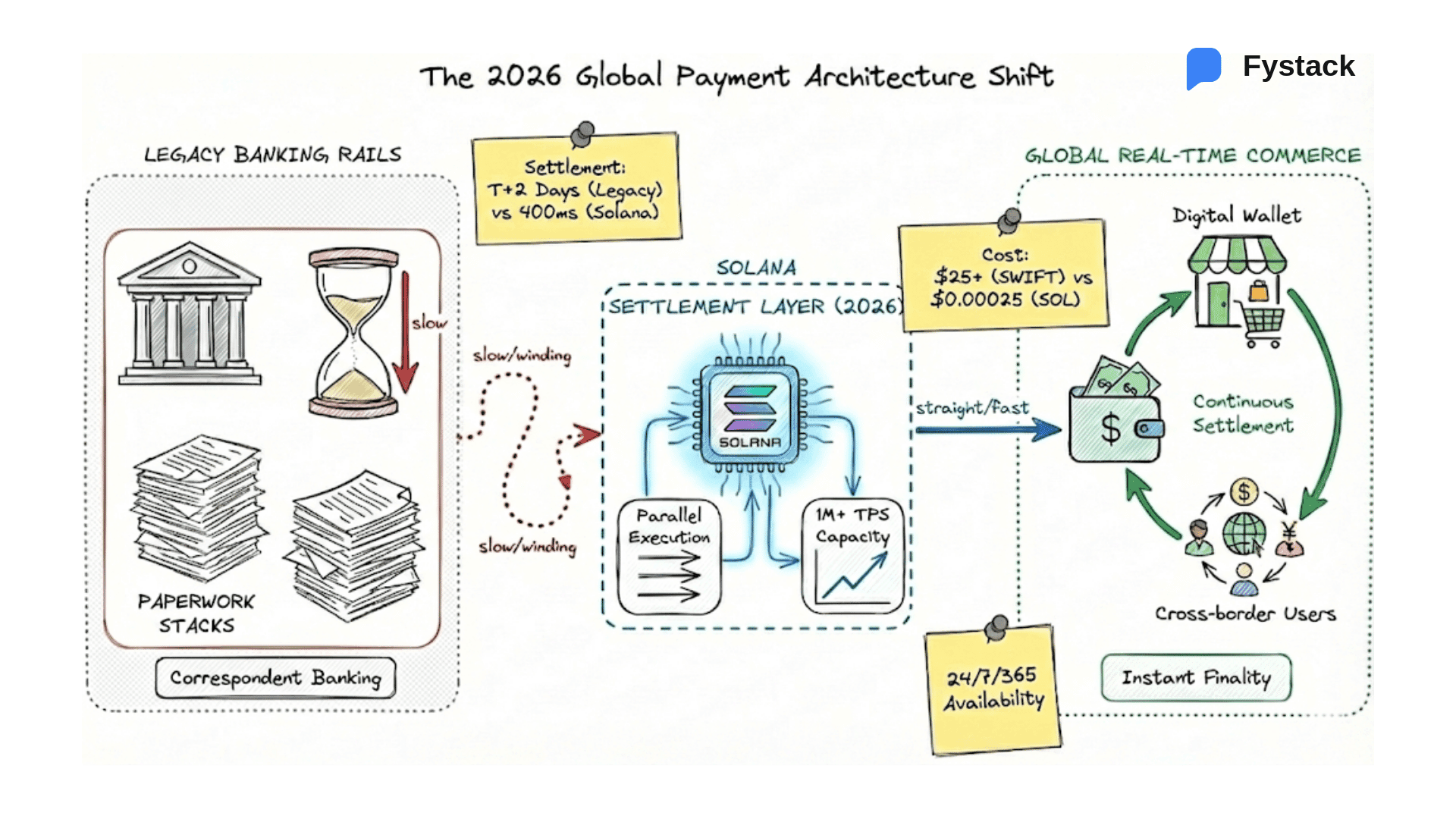
Global payments infrastructure was not designed for real-time commerce. Cross-border transfers still depend on layered correspondent banking relationships coordinated through messaging networks such as SWIFT.
Settlement can take days, fees accumulate across intermediaries, and liquidity must remain pre-positioned across jurisdictions. This model prioritizes reliability and compliance but imposes structural cost and latency constraints.

Public blockchains challenge these constraints by collapsing messaging and settlement into a single programmable layer. On Solana, transactions typically cost fractions of a cent, around $0.0001 to $0.00025, and are processed within seconds, with throughput reaching thousands of transactions per second in production conditions.
This performance profile is enabled by its parallel execution architecture and time-ordering mechanism, which together allow significantly higher throughput than traditional Layer-1 networks.

This is a shift in economic feasibility. When marginal transaction cost approaches zero and settlement occurs in near real time, use cases that were previously impractical such as micropayments, streaming transfers, and machine-driven financial interactions become viable.
Solana Reliability Improvements and the Impact of Firedancer
Reliability is critical for payment infrastructure. Systems that move value globally must remain online and avoid single points of failure. Solana’s early growth exposed weaknesses, including several network halts between 2021 and 2024 caused by congestion or software bugs. No funds were lost, but these events highlighted the risk of relying on one dominant validator client.
By 2026, the introduction of Firedancer marks Solana’s transition from a high-performance experiment to institutional-grade infrastructure. Rather than just a redundancy measure, Firedancer provides the network resilience required for global financial flows, effectively addressing previous concerns around single-client dependency and bringing Solana’s uptime standards in line with traditional banking systems. Its purpose is to reduce systemic risk by ensuring the network does not depend on a single software implementation. If one client encounters a fault, others can continue operating.
Adoption has progressed quickly. As of early 2026, roughly 15–20% of network stake operates through hybrid Firedancer deployments. In controlled testing, Firedancer has demonstrated processing capacity exceeding one million transactions per second, indicating substantial scalability headroom beyond current real-world usage levels of thousands of TPS.
Since the introduction of client diversity, network availability has remained consistently strong, and discussion around Solana’s suitability for institutional workflows has shifted accordingly.

Solana Micropayments and the Rise of AI Payments (x402)
Solana’s low fees and fast execution make it well suited for micropayments driven by AI agents. These payments often involve fractions of a cent, so infrastructure cost determines whether the model works at all.
First, typical x402 payments cost about $0.00025 on Solana compared with $0.01 to $0.05 on Ethereum Layer 2 networks such as Base. Solana also processes over 1,000 transactions per second with block times near 400 milliseconds. This allows high-frequency agent interactions that would be uneconomical or slow on higher-fee networks.
Second, Solana captured about 67 percent of x402 transactions in Q3 2025 and surpassed Base in daily activity by January 2026, handling roughly 518,000 transactions versus 505,000. These shifts indicate developers and automated agents are selecting infrastructure based on execution efficiency.
Together, cost structure and routing behavior position Solana as a practical settlement layer for machine-driven payments.

Solana Institutional Adoption 2026: Payments, Stablecoins, and Tokenized Assets
Large financial and commerce platforms are actively using Solana infrastructure in specific production workflows.
Their activity provides observable signals about cost, settlement speed, and programmability, even though total allocation remains small relative to traditional financial systems.
Payments and Commerce Infrastructure
Visa enabled USDC treasury settlement for partner banks, processing billions in annualized volume, PayPal expanded PYUSD supply on Solana past $1 billion, and thousands of Shopify merchants use Solana Pay to avoid card processing fees.

These deployments focus on cost reduction and instant settlement.
Tokenized Capital Markets
JPMorgan arranged commercial paper issuance on Solana, while asset managers including State Street and WisdomTree launched tokenized liquidity and money market structures.
These deployments test continuous settlement, programmable ownership, and operational cost reduction. Activity remains limited in scale relative to traditional issuance but indicates infrastructure evaluation within regulated environments.
Investment Exposure and Treasury Positioning
Corporate and portfolio exposure to SOL has grown. As of early 2026, 22 publicly listed companies collectively hold about 18 million SOL, valued near $1.6 billion and representing just over 3% of circulating supply.
However, market sensitivity is visible. A recent 40% decline in SOL’s price created large unrealized losses across corporate treasuries. Additionally, spot Solana ETFs have attracted roughly $765 million in cumulative inflows, but assets under management fluctuate with market cycles and represent under 2% of total network market value.
Overall, the evidence points to growing institutional attention. Capital is entering through treasury positions and ETFs, yet allocations remain small and responsive to price cycles.
The Real Cost of Multi-Chain Payments: Why Simplicity Wins in 2026
Launching blockchain payments introduces operational complexity beyond transaction performance. Each network uses different address formats, signing schemes, fee tokens, and token standards. Treasury teams must reconcile balances across chains, rebuild compliance monitoring, and manage liquidity fragmented between stablecoin variants.
These differences reflect fundamental design variation between ecosystems. A transfer that looks identical to the end user requires distinct custody policies, audit trails, and recovery procedures depending on the chain. As support expands, operational workload increases and capital becomes harder to coordinate across environments.
Many institutions limit deployment scope to reduce this overhead. Others adopt abstraction infrastructure that standardizes key management and approval workflows across networks.
This is where frameworks like Fystack become essential for operational scale. By leveraging MPC (Multi-Party Computation), Fystack bridges the gap between Solana’s raw execution speed and the rigorous governance needs of a corporate treasury.
It allows firms to capitalize on sub-cent settlement without compromising on the multi-layered approval workflows and security audits internal compliance mandates.
MPC-based custody systems provide unified key management across supported networks while eliminating single points of failure through distributed signing.
Policy engines automate approvals and controls, and self-hosted deployments allow institutions to meet internal governance and regulatory requirements. Broader account and chain abstraction layers further reduce complexity by routing transactions and managing fees transparently.

Solana vs Ethereum and Sui: Performance Tradeoffs and Competitive Risks
No network dominates across all dimensions, and Solana carries meaningful constraints that strategic readers should understand.
Reliability History and Decentralization Tradeoffs
Solana experienced over 60 hours of major downtime across multiple outages between 2021 and 2022, with additional halts through 2024. Uptime has improved since, yet these events shaped institutional risk perception.
Validator distribution also reflects a speed tradeoff. The network operates roughly 1,500 validators globally, far fewer than Ethereum’s hundreds of thousands. This improves coordination efficiency but raises concerns about governance concentration and correlated failures.
Industry research frequently frames this as an inherent design compromise: performance optimization can increase operational sensitivity under stress.
However, in the 2026 landscape, economic gravity often outweighs architectural purity.
While other chains offer compelling alternative designs, Solana’s established 'network effect' - anchored by Visa, PayPal, and Shopify - creates a liquidity moat that is difficult to ignore. For most enterprises, the decision isn't just about TPS; it’s about being where the settlement volume already resides.
Architectural Competition From Alternative Designs
Competing networks pursue scalability differently. Sui separates state into independent objects processed in parallel, avoiding shared bottlenecks. This enables faster finality under load and strong developer growth, even with a smaller ecosystem.
Ethereum expands through rollups, distributing execution across layered environments while maintaining deep liquidity and security credibility. Its stablecoin dominance and validator scale anchor financial gravity despite lower base-layer throughput.
It's funny i have the opposite conclusion - i guess that's what makes markets!
— RYAN SΞAN ADAMS - rsa.eth 🦄 (@RyanSAdams) November 25, 2025
Solana is in a middle ground - neither a sovereign resistant SoV nor long-term competitive as high TPS chain (e.g. MegaETH, Lighter) - the monads and tempos compete more Solana than Ethereum
And BTC…
Ecosystem and Economic Exposure
Solana’s real-world TPS advantage has translated into user activity, but execution speed alone does not guarantee adoption durability. Stablecoin share remains around 4 to 5 percent versus Ethereum’s majority control, and price volatility continues to influence institutional confidence.
Recent forecasts lowered valuation expectations amid slower micropayment adoption and market drawdowns, reinforcing that usage growth must convert into durable economic capture.
Developer Ecosystem Depth
Ethereum remains the largest developer base with about 3,770 monthly active contributors and over 5,000 total developers. Growth is steady and retention is strong. Most developers remain single ecosystem focused, which signals maturity and tooling depth.
Solana hosts about 1,235 monthly developers and attracts strong inflows of new builders. Over half work across chains, showing experimentation and migration patterns.

Conclusion
Solana’s advantage lies in performance and expanding adoption, alongside tradeoffs in ecosystem competition and decentralization. Infrastructure selection should be grounded in workload requirements and risk considerations. Treating chain choice as a product strategy leads to more durable decisions.
Frequently Asked Questions (FAQs)
What makes Solana useful for global payments compared to traditional systems?
Solana confirms transactions in seconds and costs fractions of a cent per transfer. Traditional cross-border payments pass through multiple banks, which increases fees and settlement time. Because execution is cheap and fast, businesses can move funds frequently, automate payouts, or handle small-value transfers that would be uneconomical on legacy rails.
Why do reliability and validator diversity matter for payment systems?
Payment infrastructure must stay online. Past outages showed the risk of depending on one dominant validator software implementation. Multiple independent clients reduce the chance that a single bug stops the network. Greater operator diversity also spreads operational risk.
Are micropayments or AI-driven payments actually happening?
They exist mostly as experiments. Low fees make frequent small transfers feasible, which enables things like pay-per-API-call pricing or automated agent settlement. Adoption is still early and not widely deployed at scale. However, developers are actively building in this area because execution cost no longer blocks the idea economically.
Does institutional experimentation mean Solana will dominate?
No. Testing by financial firms shows interest, not commitment. Institutions typically evaluate several networks simultaneously and deploy cautiously. Most activity is pilot-level and small in scope. The signal is that performance characteristics are worth examining, but long-term dominance depends on reliability, regulation, liquidity, and ecosystem depth.
About Fystack
Fystack is a digital asset custody platform built on secure Multi-Party Computation (MPC) technology, designed to help organizations manage and safeguard digital assets without single points of failure. With enterprise-grade security, Fystack enables businesses to operate confidently across evolving blockchain ecosystems.
Join our community to stay updated on industry insights and product developments.
Explore more perspectives on digital asset infrastructure on the Fystack blog.