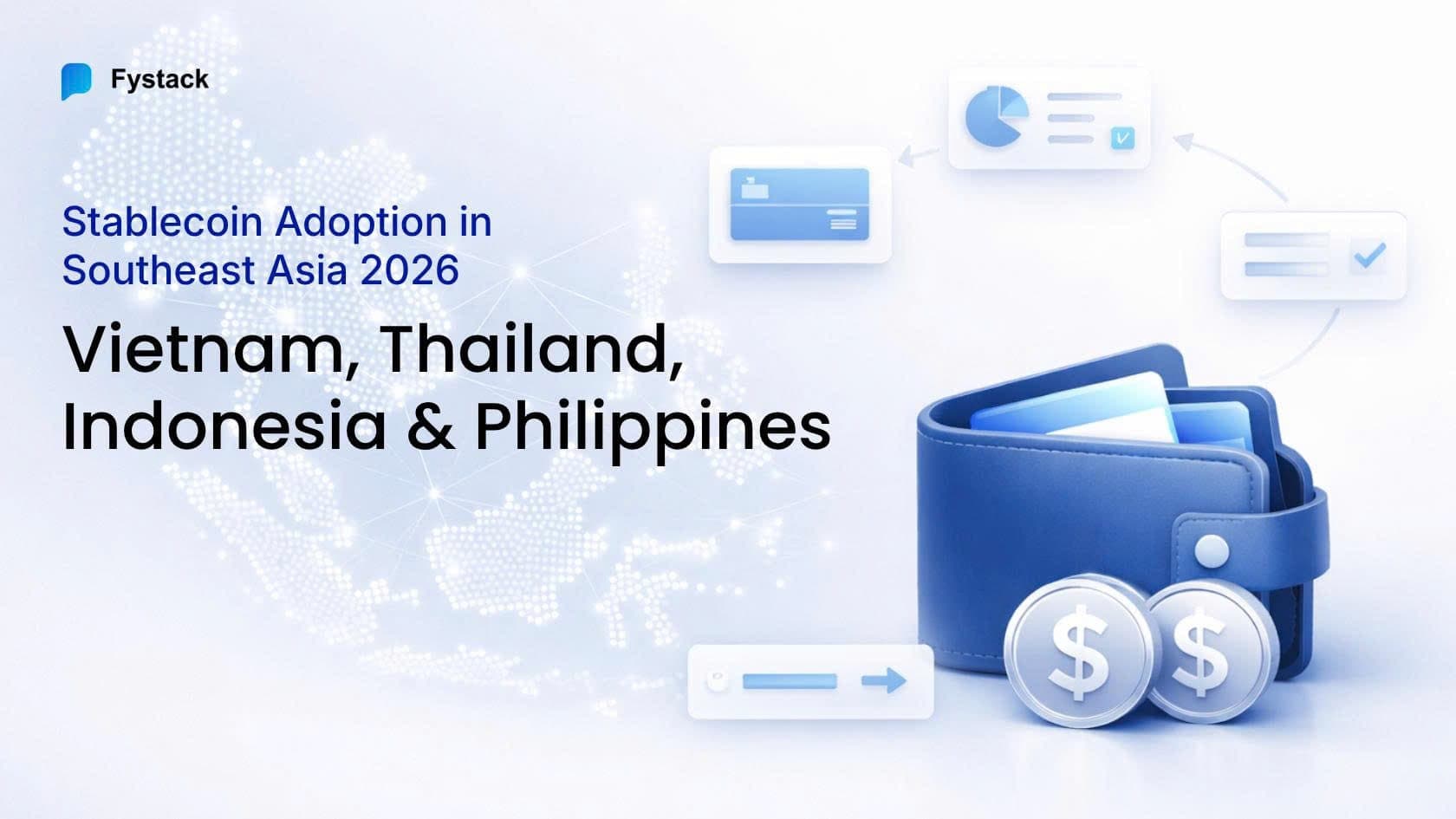
Stablecoin Adoption in Southeast Asia 2026: Vietnam, Thailand, Indonesia & Philippines

For many years, stablecoins were perceived as a supporting layer within the crypto market a place to park capital during volatility, an intermediary medium for trading, and something that existed primarily within the digital asset ecosystem rather than being connected to the real economy. However, when observing Southeast Asia in 2026, this perspective is no longer sufficient to describe what is actually happening.
What stands out is not simply that stablecoins are becoming more popular, but that their role has fundamentally changed. Stablecoins are no longer used primarily for speculation. Instead, they are gradually becoming a real financial infrastructure layer where salaries are paid, goods are transacted, and assets are stored in the context of monetary instability.
In other words, while stablecoins were once considered a financial primitive in crypto, by 2026 in Southeast Asia, they are evolving into a financial rail a system that moves money across borders with a level of speed and cost efficiency that traditional systems struggle to compete with.
Digital Dollar: When users don’t need local currency stablecoins
One of the most important insights when observing the Southeast Asian market is that users are not actually looking for a digital version of their local currency. They do not need a “VND on-chain” or an “IDR stablecoin” if those assets fail to solve the core problem: price stability and global interoperability.

Instead of developing toward local currency tokenization, the market has converged toward a more practical choice: USD. Data from Tiger Research shows that ~99% of stablecoin market share in the region belongs to USDT and USDC. This number reflects not only liquidity dominance, but also a clear user preference for usability.
This reality is driving a phenomenon known as Currency Substitution in the Web3 era. Users no longer need foreign currency bank accounts with complex approval processes. With just a self-custody wallet, they can hold a Digital Dollar, completely removing geographical barriers and dependence on intermediaries.
While efforts to build local currency stablecoins face limitations in liquidity and lack of integrated ecosystems, USD stablecoins have naturally become the de facto standard. As a result, they are no longer just financial tools, but are increasingly acting as a parallel banking system a layer of infrastructure that enables asset storage and value transfer in a way that is resilient, transparent, and borderless.
Stablecoins and the Gig Economy: Powering Cross-Border Payments
If the Digital Dollar is the foundation, then the freelance and gig economy is the driving force that brings stablecoins into everyday life in a tangible way. Data reveals a striking reality
- 35% of freelancer income in APAC is now paid via stablecoins.
- 28% velocity, meaning most of this capital is not held for speculation, but is spent almost immediately.
These two numbers signal a critical shift: stablecoins are no longer “assets to hold”, but have become money to use.
The reason behind this shift is not technological preference, but a purely economic decision. For a freelancer in Vietnam, receiving payments via SWIFT typically takes 3 to 5 days, with costs reaching 5 to 10% including transfer fees and FX spreads. Stablecoins remove this friction, enabling payments within minutes at near-zero cost.
However, for businesses, managing stablecoin payroll across hundreds of freelancers in multiple countries introduces significant operational complexity. This is where infrastructure solutions like Fystack change the game:
- Treasury and payout automation
Instead of sending funds manually to each wallet, businesses can use Fystack to set up automated payout flows via API. Payments to 100 freelancers across 5 countries can now be executed within seconds. - Operational control with policy-based systems
With structured approval workflows, every payroll transaction must go through predefined authorization processes for example, 2 out of 3 managers must approve before execution via MPC ensuring maximum fund security. - Deployment speed: days, not months
Startups and agencies in Southeast Asia no longer need months to build custody systems. With Fystack, they can integrate and launch stablecoin payroll operations immediately, meeting real-time income expectations of the workforce.
As money is received and spent in real time, the concept of “waiting for salary” gradually disappears. It is replaced by a more continuous and flexible financial model. With the support of infrastructure like Fystack, stablecoins are becoming a cross-border frictionless payment layer, where geography and settlement delays are no longer barriers to the value of labor.
Southeast Asia Market Breakdown: A Bottom-Up Adoption Model
If we look at each country individually, stablecoin adoption in Southeast Asia may appear fragmented each market has its own drivers, behaviors, and level of maturity. However, when these pieces are viewed together, a clear pattern emerges: stablecoins are being adopted bottom-up, driven by real-world needs such as remittance, freelance income, and hedging not speculation.

This diversity creates a fundamental challenge for businesses: how to build a financial infrastructure that is fast enough for Vietnam, secure enough for Indonesia, and compliant enough for Thailand?
Four “necessity-driven” patterns across Southeast Asia
Southeast Asia does not evolve through top-down policy, but through bottom-up demand.
| Market | Core Driver | Key Insight | Fystack Infrastructure Solution |
|---|---|---|---|
| Vietnam | Utility and Hedging | ~7.8% remittance via stablecoin; OTC/P2P premium 3 to 5% | Hyper Wallets for high-frequency transactions |
| Philippines | Default Remittance | Replacing Western Union and SWIFT for OFW workers | Treasury Automation for large remittance flows |
| Indonesia | Defensive Asset | Hedging against IDR volatility and geographic fragmentation | MPC Vaults for secure long-term storage |
| Thailand | B2B/B2C Pilot | Transition toward merchant adoption in tourism and services | Policy-based controls for compliance |
Vietnam: High-frequency usage and stablecoin as “money to use”
In Vietnam, stablecoins are not only held but actively used with high transaction frequency and fast capital rotation, particularly in freelance payouts, international service payments, and USD-based value storage.
A notable behavior is its highly practical nature: users often acquire stablecoins through P2P or OTC channels, sometimes at a 3 to 5% premium, reflecting real demand for USD access. Stablecoins have also begun to account for a meaningful share of remittance flows estimated at around 7 to 8% in certain recent periods indicating that they are no longer outside the financial system.
More importantly, stablecoins in Vietnam are typically not held long-term for speculation. Instead, they are continuously circulated with high velocity: freelancers, e-commerce operators, and service providers often spend or rotate the funds shortly after receiving them - aligning with the broader regional trend where stablecoins function as “money to use” rather than just a store of value. This high-frequency usage is especially evident in gig economy payouts and peer-to-peer business transactions, where funds move within minutes at near-zero cost compared to traditional SWIFT transfers that can take days and incur 5-7% fees.

This practical, everyday utility has helped Vietnam maintain its strong position in global crypto adoption. According to Chainalysis 2025 Global Crypto Adoption Index, Vietnam ranks 4th worldwide, driven largely by grassroots on-chain activity in remittances, payments, and savings rather than pure trading.
Philippines: Stablecoin as the default remittance rail
The Philippines is one of the clearest examples of stablecoins transforming remittance flows. As one of the world’s largest remittance markets, receiving approximately $35.6-38.3 billion annually from Overseas Filipino Workers (OFWs), any solution that brings greater efficiency gains immediate traction.
In this context, stablecoins (primarily USDT and USDC) are gradually becoming a default option for a growing segment of users 0 particularly tech-savvy OFWs and the country’s estimated 1.5 million freelancers. Instead of relying solely on traditional channels like Western Union or SWIFT, users are increasingly turning to stablecoins for cross-border transfers, corporate payouts, contractor payments, and supplier disbursements.
Local platforms such as Coins.ph play a critical role in last-mile delivery. Coins.ph dominates with 75-80% of peso-to-stablecoin liquidity in the country and reported a strong 20% surge in overall trading volume in 2025, with one month seeing a remarkable 327% year-on-year increase in spot trading volume, breaching the $500 million mark. Much of this growth was driven almost entirely by stablecoin activity for remittances and real-world payments. The platform also saw stablecoin deposits grow by 64%, reflecting a clear shift toward using stablecoins as practical financial infrastructure.
This adoption extends strongly into the gig economy: recent data shows that approximately 35% of freelancer and gig worker income in APAC (including a significant portion in the Philippines) is now received via stablecoins, allowing workers to receive international payments more seamlessly.
With crypto ownership rising to 22-23% (roughly 16 million users), and the Philippines ranking #9 globally in the Chainalysis 2025 Global Crypto Adoption Index, stablecoins are moving beyond speculation to become an essential rail, delivering faster, more transparent, and more accessible cross-border value transfer for millions of families and workers.
Indonesia: A defensive asset and a gateway to the global digital economy
Indonesia presents a unique dual dynamic: stablecoins act both as a defensive asset against local currency volatility and a gateway to the global digital economy.
In a context where the Indonesian Rupiah (IDR) faces recurring depreciation pressure, users and businesses increasingly turn to USDT and USDC as a safe haven to preserve purchasing power over the long term. Stablecoin adoption in Indonesia grew 340% year-on-year, reaching $12.3 billion in transaction volume in 2025, driven by hedging needs and cross-border activity.
At the same time, stablecoins serve as a powerful enabler for younger users, tech startups, and manufacturers in cities like Jakarta and Bali. With Indonesia’s archipelagic geography and fragmented banking system spanning over 17,000 islands, stablecoins allow direct connection to global capital flows without restrictive foreign exchange processes. They are commonly used to pay for international SaaS services, receive foreign investments, and settle B2B transactions.
Notably, the Singapore-Indonesia corridor is one of Southeast Asia’s most active stablecoin routes, processing approximately $45 billion in annual cross-border flows, of which 89% is B2B transaction volume. Indonesian manufacturers have reported significant cost savings - up to 73% - when using stablecoins instead of traditional letters of credit for trade finance and supply chain payments.This dual role has helped Indonesia maintain a strong position in global crypto adoption.
According to the Chainalysis 2025 Global Crypto Adoption Index, Indonesia ranks #7 worldwide, with particularly strong performance in centralized service value received and institutional activity.
Thailand: Merchant adoption and the shift toward B2C and B2B payments
Thailand represents a different stage of adoption, where stablecoins are beginning to move beyond individual peer-to-peer transfers into the merchant layer and B2C/B2B payment flows - particularly in tourism and international services.
Although the regulatory environment remains relatively cautious, meaningful pilot use cases are emerging. A notable initiative is the TouristDigiPay sandbox, an 18-month pilot launched by the Thai Securities and Exchange Commission (SEC) in collaboration with the Ministry of Tourism and Sports.

The project allows foreign tourists to convert digital assets (including stablecoins) into Thai Baht for spending via the country’s electronic payment systems and QR codes, while merchants receive funds in THB - eliminating volatility risk for local businesses.
This marks a key transition: stablecoins are no longer just a transfer tool, but are gradually becoming a real payment method within the service economy. High-end hotels in certain areas have started accepting USDT and USDC directly, and informal OTC merchants also facilitate stablecoin usage. On regulated exchanges like Bitkub, USDT remains one of the most actively traded pairs, reflecting strong underlying demand.
According to the Chainalysis 2025 Global Crypto Adoption Index, Thailand ranks #17 worldwide, with solid performance across retail and centralized service metrics. These developments, combined with ongoing SEC pilots on asset tokenization, custody, and B2B digital payments (expected to run into 2026), signal Thailand’s careful but progressive move toward broader merchant and enterprise adoption of stablecoins.
Southeast Asia: A blueprint for the future of global finance
When viewed as a whole, Southeast Asia is not just a region with high adoption it is gradually becoming a real-world blueprint for how stablecoins can reshape financial systems in emerging markets.
This is a system where:
- money is global-first, no longer constrained by national borders
- payments are real-time, eliminating delays of legacy systems
- trust comes not only from institutions, but from proven real-world utility
While Southeast Asia is emerging as a real-world adoption hub, the broader Asian landscape reveals a highly fragmented regulatory environment.
From Singapore’s structured issuance framework to China’s full private ban, stablecoin regulation across Asia is far from unified creating both opportunities and operational challenges for enterprises scaling across markets.

More importantly, this is not a distant future scenario. It is already happening quietly but consistently until it reaches a point where stablecoins are no longer seen as a “new technology”, but simply how money works in the digital economy.
Despite different national drivers, all markets are converging toward a shared need: modern financial infrastructure. The strength of Fystack lies not only in its technology, but in its deep understanding of these regional nuances. It provides a one API, multi-chain platform, enabling businesses to launch wallet operations in days instead of months, adaptable to any economic model whether it is payroll in Vietnam or remittance in the Philippines.
Fystack: The infrastructure layer that makes stablecoin scalable for enterprises
The rapid growth of stablecoins in Southeast Asia is no longer about demand. With ~99% dominance of USD stablecoins and increasing enterprise adoption in cross-border payments, the core question has shifted:
how to deploy stablecoins quickly, securely, and at scale?

Time-to-Market: From 6 to 12 months to days
In practice, the biggest barrier is not whether to use stablecoins, but the complexity of building infrastructure from scratch:
- custody systems require 6 to 12 months of R&D
- high security risks when managing private keys internally
- multi-chain integration is resource-intensive
Fystack solves this bottleneck by turning stablecoins from a technical challenge into a deployable capability.
- Launch in days, not months without a dedicated custody team
- One API, all chains with a single integration
This is critical in a fast-moving market where a six-month delay can mean losing competitive advantage.
High Velocity vs Security: No trade-off required
With 28% of stablecoins being spent almost immediately, payment systems must be both fast and secure a challenge traditional models struggle with:
- cold wallets are secure but slow
- hot wallets are fast but risky
Fystack addresses this with a hybrid custody architecture:
- MPC Vaults for secure long-term storage, eliminating single points of failure
- Hyper Wallets for high-speed, scalable transaction execution
This enables businesses to operate with fintech-level speed and near-banking-grade security, essential for payment apps and stablecoin platforms in Southeast Asia.
From manual operations to programmable treasury
With 35% of freelancers receiving income in stablecoins, the challenge shifts from sending money to managing capital at scale.
Manual processes lead to:
- human errors
- lack of control
- inability to scale
Fystack transforms treasury into a programmable layer:
- automated flows for payouts and fund movements via API
- approval workflows with quorum models such as 2 out of 3 or 3 out of 5
- policy controls for transaction limits and role-based permissions
This allows startups and fintech companies to operate like institution-grade financial organizations from day one, instead of scaling first and fixing later.
No vendor lock-in: Infrastructure for the long term
When 77% of users only trust stablecoins through reputable platforms, businesses need not only fast deployment, but also long-term flexibility.
The biggest risk is not outdated technology, but being locked into a single vendor.
Fystack solves this with a technology-agnostic architecture:
- flexible integration across MPC, HSM, and hardware wallets
- ability to change security models without rebuilding systems
- full infrastructure control retained by the business
In a region like Southeast Asia where regulation is still evolving, the ability to adapt without rebuilding is critical for long-term survival.
Final Note
If stablecoins are the new financial rail of the region, the real value does not lie in who adopts them first, but in who has the infrastructure to scale them sustainably.
Fystack is not positioned as an application, but as the underlying layer where businesses can deploy, operate, and scale stablecoins without having to rebuild the entire infrastructure stack from scratch.
Not ready yet?
Join our Telegram to follow architecture updates and product discussions. https://t.me/+9AtC0z8sS79iZjFl