How to Add Solana, TRON & Arbitrum to a Crypto Card Without Rebuilding Your Wallet Stack

A card program's most common feature request isn't a new reward tier. It's a support ticket: "why can't I top up with USDT on TRON?" The instinct is to treat that as adding a button. It isn't. Everything underneath that button has to support the new rail too: reading deposits, generating addresses, signing transactions, sweeping funds, and reconciling balances with the card ledger. For most teams that instinct turns into a new blockchain hire per chain. Multi-chain crypto card integration doesn't have to work that way.
Key takeaway
- Ethereum and TRON account for roughly 80% of stablecoin supply. Solana is smaller but growing fast, so these three chains already matter for card programs.
- Supporting a chain means solving three problems: data access, asset operations, and transaction signing. EVM chains are broadly similar; TRON differs in data and asset operations, while Solana differs across all three.
- A unified wallet layer can abstract chain-specific operations from the card application, while the infrastructure handles chain-specific connectivity and monitoring.
- To scale a card program across rails, keep the card stack unchanged and make the wallet and infrastructure layer multi-chain.
Why Multi-Chain Crypto Card Support Matters
Ethereum and TRON together account for roughly 80% of stablecoin supply, making them the two dominant settlement rails by a wide margin. TRON in particular has become one of the most important rails for cross-border stablecoin transfers, especially for USDT, largely on the strength of low, predictable fees. Solana is smaller today but growing quickly, while L2s such as Arbitrum are also expanding their stablecoin footprint.
The pattern that matters for a card program is that this demand already shows up in regions where USD-pegged stablecoins dominate everyday activity, covered in more depth in stablecoin adoption across Southeast Asia. A cardholder who wants to fund from TRON or Solana today either routes around the gap, usually through an off-platform swap that adds friction and a drop-off point, or moves to a competitor that already supports the rail they use. Multi-chain support is quickly becoming a baseline product expectation, not a differentiator.
Why "Just Add the Chain" Doesn't Work
Supporting a new chain isn't one problem. It's three, and they don't move together across chains. In practice, a card program needs to answer three questions: Can we see the money? Can we move it? And can we sign the transaction securely?
- Chain connectivity. Can the backend reliably read balances and transactions, which depends on node access, indexing, and monitoring for that specific network.
- Asset and transaction operations. Can the backend generate deposit addresses, initiate transfers, sweep deposits, and consolidate funds, in the specific transaction format that chain expects.
- Signing and key management. Can the backend securely sign transactions using the cryptography that chain requires.
| Term | What it means |
|---|---|
| EVM | Ethereum’s execution environment, also used by chains such as Arbitrum, BNB Chain, and Polygon. |
| RPC | The interface applications use to communicate with a blockchain node. |
| Finality | The point at which a transaction is considered irreversible or highly unlikely to be reverted. |
| ECDSA / secp256k1 | The cryptographic scheme and elliptic curve used for signing transactions on Ethereum and other EVM chains. |
| Ed25519 | The signature scheme used by Solana for transaction signing. |
| Sequencer | The component that orders and processes transactions on an L2 such as Arbitrum. |
| Bandwidth & Energy | TRON's resource model for processing transactions, instead of Ethereum-style gas. |
EVM-compatible chains share a common execution model and the same underlying ECDSA/secp256k1 signing curve, which is why adding one more EVM chain tends to feel incremental. That said, "EVM-compatible" doesn't mean identical: Arbitrum, for example, runs its own sequencer feed and node roles (sequencer, batch poster, validator) on top of a shared execution engine, so RPC behavior and finality timing still differ chain to chain.
TRON breaks the EVM pattern on the connectivity and operations layers: it runs its own node software and its own API, and its transactions use a different format and fee model (bandwidth and energy, not gas), even though TRON's keys are close enough to Ethereum's that a TRON address is really a re-encoded EVM address rather than a separately generated one (more on that in the FAQ below). Solana introduces differences across all three layers: its own node stack, its own transaction model, and Ed25519 as the scheme it uses to sign its own transactions, a scheme no EVM chain or TRON wallet uses for that purpose.
Blockchain Infrastructure Requirements for Multi-Chain Cards
| Layer | EVM | TRON | Solana |
| Execution environment | EVM | TRON VM | Solana runtime |
| Signing | ECDSA (secp256k1) | ECDSA (secp256k1) | Ed25519 |
| Node stack | Chain-specific per network | Chain-specific, its own client and API | Chain-specific, its own client and API |
| Application integration | Familiar across the EVM family | Different node and API, same signing curve | Different node, different signing |
The infrastructure profile behind that table varies by workload, but the direction is consistent. TRON's own documentation recommends 64 or more CPU cores, 64GB or more of RAM, and 20TB or more of disk for a full node at scale, well above a typical Ethereum or Bitcoin full node's footprint.
The differences aren't just in APIs and transaction formats. They also affect the infrastructure required to run and monitor each network.
A Solana node built to serve live RPC or validator traffic reliably needs a comparably demanding profile: 256GB of RAM at Solana's own stated minimum, with 512GB or more common in 2026 production setups, plus high core counts and enterprise NVMe storage, since Solana's ledger grows quickly and state has to stay fast to query.
Exact requirements vary significantly by node type, workload, and whether the infrastructure serves RPC traffic, validation, or archival needs (an archive node, which keeps full history, needs far more storage again), so treat these as directional rather than a fixed spec to provision against.
Solana infrastructure also needs active operational attention beyond hardware. The network hasn't suffered a full halt in some time, but it does require monitoring validator and client health: an August 2026 routing failure at a shared infrastructure provider knocked roughly 102 of the network's 699 validators offline at once, pushing affected stake close to, but not past, the roughly one-third threshold beyond which the network can still produce blocks but stops treating them as final. The network kept producing and confirming blocks throughout, and validator connectivity was restored within about 40 minutes. The operational lesson isn't that Solana is unreliable, it's that running your own node means tracking client upgrades, node health, and infrastructure concentration continuously, not deploying once and walking away.
Every chain a program connects to also becomes its own ledger to reconcile. A team running EVM, TRON, and Solana connectivity in-house is operating three systems that each need their own reconciliation against the card's ledger, which is where per-chain engineering work tends to compound.
The Architecture That Prevents Headcount From Scaling With Chains

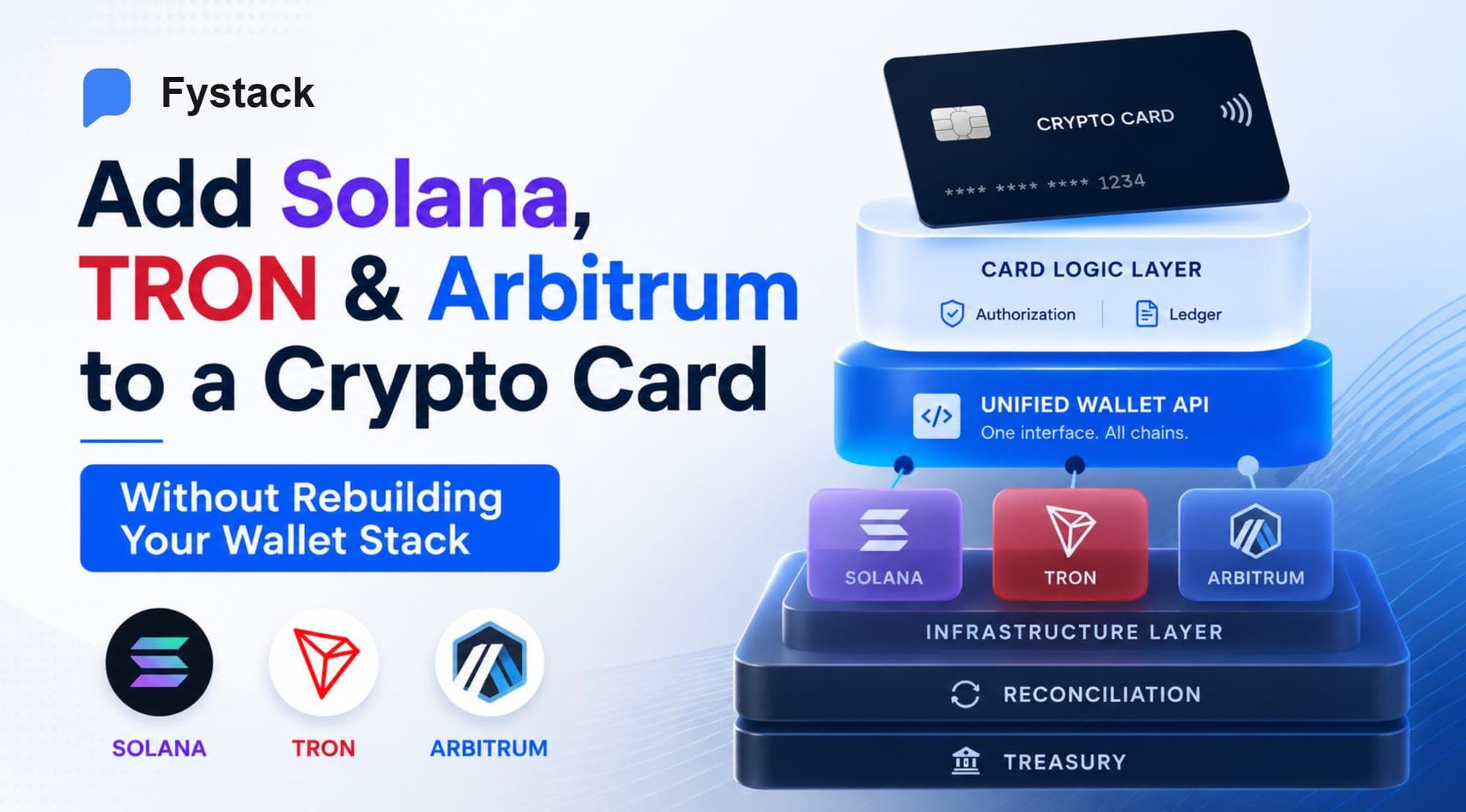
The fix isn't a single technology that magically erases chain differences. A unified wallet layer can abstract chain-specific signing and transaction operations away from the card application, but the underlying infrastructure still has to handle chain-specific node connectivity, indexing, and monitoring somewhere. What changes is where that complexity lives.
What the card sees, and what shouldn't change: Cardholder → Card Authorization → Card Ledger
What sits underneath, and where a new chain gets added: Card Ledger → Wallet API → chain-specific connectivity (EVM / TRON / Solana) → Reconciliation → Treasury
A single logical wallet can expose chain-specific addresses while keeping the application-facing wallet object consistent, so the card application never has to know whether a given address belongs to an EVM chain, TRON, or Solana; it just calls the same API. That pattern is already running in production, not just in theory: a payment gateway built this way generates addresses across EVM chains, Solana, and TRON from one wallet object, with sweep automation and webhook notifications handled the same way regardless of chain.
The cryptographic side of that abstraction, signing across ECDSA and Ed25519 from one cluster, is covered in more depth in how the signing layer actually differs across Bitcoin, Ethereum, and Solana.
The thesis worth holding onto: a new chain should get added below the card logic, not inside it.

How to Add a New Blockchain to a Crypto Card Program
With the wallet and infrastructure layer already abstracted, the sequence for turning on a new chain is short:
- Confirm the new chain's address type is supported by the wallet layer, and generate a test wallet to verify address derivation. For Solana specifically, this also means accounting for program-derived addresses (PDAs), which have no private key and shouldn't be used as deposit addresses.
- Point the existing sweep and consolidation logic at the new chain's addresses, reusing the same webhook and reconciliation pipeline the program already runs for its current chains.
- Test end to end on testnet: deposit detection, sweep timing, and how a funded balance shows up in the card's spend logic.
- Roll the chain out to a subset of users, watch decline rates and settlement timing, then open it to the full cardholder base.
What stays unchanged: card authorization logic, the card ledger, the cardholder-facing experience, and existing settlement logic for chains already live.
What actually changes: chain configuration, address and transaction handling for the new chain, connectivity and monitoring for that chain's node, and the testing and rollout work above.
With the wallet and infrastructure layer already in place, adding a chain can become an integration and testing project rather than a new infrastructure build, the pattern behind multi-chain platforms that support launching new wallet operations without a new team per market. The actual timeline still depends on the chain, compliance requirements, testing scope, and how cautious the production rollout needs to be, which is a very different starting point than scoping a new node, a new signer, and new reconciliation code from zero.
When to Use Multi-Chain Wallet Infrastructure
It makes more sense when:
- You expect to support three or more chains over time, not just the one you're adding now.
- Stablecoin deposits already come from multiple ecosystems, not a single chain.
- You operate your own custody rather than relying entirely on a third party for it.
- Your engineering team is small relative to the number of chains you want to support.
- You don't want card logic coupled to chain-specific code as the chain list grows.
It matters less when:
- You only need to support a single chain for the foreseeable future.
- Transaction volume is small enough that manual, per-chain processes are still manageable.
- You're comfortable relying entirely on third-party custody infrastructure for chain support.
How Fystack Supports Multi-Chain Crypto Card Infrastructure
This architecture is what Fystack is designed to provide: a wallet and infrastructure layer that separates chain-specific complexity from the application layer. Fystack's multi-chain wallet infrastructure is built around the split from section 2, connectivity, operations, and signing, so a card program doesn't have to solve all three separately for every chain it adds.
Signing
mpcium, Fystack's open-source MPC signing core, handles ECDSA (secp256k1) and EdDSA (Ed25519) from a single MPC node cluster, so EVM chains, TRON, and Solana are signed through the same infrastructure instead of separate signer implementations per chain. Signing runs behind a policy engine, so spend rules, approval thresholds, and role separation apply consistently across every chain rather than being reimplemented each time a new one is added.
Operations
A single logical wallet object exposes chain-specific deposit addresses across EVM chains, TRON, and Solana, with sweep automation and webhook notifications feeding the same reconciliation pipeline regardless of which chain a deposit came from, the pattern already covered in how to build a payment gateway on this architecture.
Connectivity
Node and RPC access for each supported chain, TRON, ETH, BNB, Solana, Polygon, and more, is handled as a platform capability rather than something each program has to build from scratch: in a self-hosted deployment, the operator runs the underlying nodes on top of Fystack's connectivity layer; in Fystack's managed infrastructure, Fystack runs them.
The choice between self-hosted and managed deployment is a separate decision from which chains are supported, covered in more depth in the self-hosted vs. SaaS wallet infrastructure tradeoff. Either way, the chain list is a configuration surface, not an infrastructure rebuild.
FAQ
Do I need a separate wallet for each chain?
Not with a unified wallet layer. A single logical wallet object can expose chain-specific addresses for EVM, TRON, and Solana while the application only ever interacts with one wallet ID.
Does Solana require a different signing system?
Yes. Solana signs with Ed25519 instead of the ECDSA scheme every EVM chain and TRON use, so a wallet stack built only for ECDSA needs a separate signing implementation to support it.
Can TRON reuse EVM keys?
TRON uses the same ECDSA signing scheme and elliptic curve as EVM chains, so the cryptography is compatible. TRON still requires its own node stack, its own address format, and its own transaction encoding, so it isn't a drop-in EVM integration even though the signing math is shared.
Does multi-chain support require running a node for every chain?
It requires connectivity to every chain you support, whether through self-hosted nodes or a managed provider, but it doesn't require building a separate wallet, signing, and reconciliation stack for each one if that layer is already abstracted.
What parts of a crypto card backend actually need to change to add a chain?
Chain configuration, address and transaction handling, and testing. The card's authorization logic and ledger don't need to change, since a new chain is added at the wallet and infrastructure layer below them, not inside the card stack itself.
How long does a new chain integration take?
With the wallet and infrastructure layer already in place, adding a chain can become an integration and testing project rather than a new infrastructure build. The actual timeline still depends on the chain, compliance requirements, testing scope, and production rollout.
The scalable way to add blockchain rails to a crypto card isn't to make the card stack multi-chain. It's to make the wallet and infrastructure layer multi-chain, and keep everything the card already does untouched.
If your team is weighing whether the next chain on the roadmap needs a new hire or just a new integration, Fystack's multi-chain wallet infrastructure abstracts chain-specific signing and wallet operations so your team can add new rails without rebuilding the wallet layer each time.
About Fystack: Fystack is a self-hosted, open-source custody platform for fintech teams. Its core signing infrastructure, mpcium, is open source on GitHub, and supports TRON, ETH, BNB, Solana, Polygon, and more.
If you are evaluating your custody and compliance infrastructure, the Fystack team would be happy to discuss your requirements and explore the right implementation approach.