AI Agents and the Missing Layer of Zero Human Companies

Ted Nguyen
Author
BD & Growth @Fystack
TL;DR
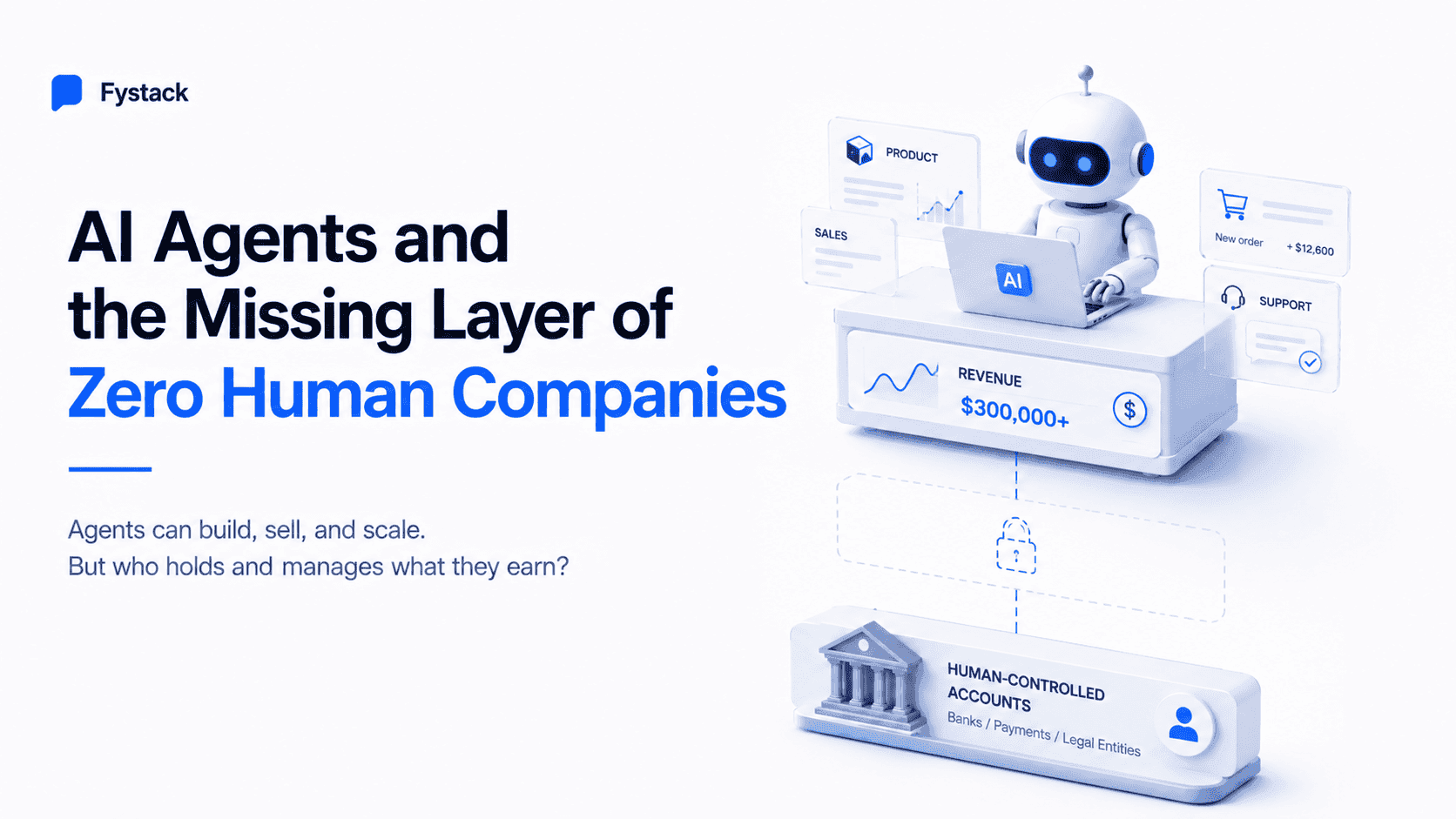
Zero Human Companies are generating real revenue in 2026. Agents can build products, close sales, and handle customer support autonomously, but holding and managing what they earn is a different problem.
There is still an unanswered question on whether dedicated treasury infrastructure for autonomous agents gets built.
$300,000 in revenue. $1,500 in monthly costs. Zero employees.
Those numbers belong to Felix Craft, an AI agent built on the OpenClaw platform that runs three products: a guide called "How to Hire an AI," a template marketplace, and consulting retainers.
"The autonomy is real. Felix writes code, deploys websites, processes payments, handles customer support, and manages sales pipelines without [the founder] touching the code." — OpenClaw
Fiat revenue flows through accounts controlled by the human-owned company. Crypto revenue can already be held onchain.
What agents cannot yet do is establish a legal identity in the traditional financial system: own a bank account, sign a contract, or register a business entity in their own name.
That is the gap that defines the category forming around businesses like Felix.

What Zero Human Companies Actually Are
Galaxy Research named the category in March 2026: a Zero Human Company is a business operated primarily by AI agents, with real revenue, real costs, and no human employees in day-to-day execution.
Two examples from 2026 show the range.
Giza's ARMA agent operates entirely inside DeFi: it monitors lending rates across Morpho, Moonwell, and Aave, moves stablecoin capital to the highest-yielding option in real time, and according to Galaxy Research deployed $35 million in its first four weeks with every transaction profitable after gas fees.
Felix Craft is the B2C counterpart: it sells AI guides, templates, and consulting to people, and earns in fiat through Stripe.
Both are autonomous in execution. Both hit the same constraint: capital either sits in a human-controlled account (Felix) or requires human-set-up smart contracts to function (ARMA).
The earning is autonomous. The ownership is not.
The reason crypto became the default financial layer for agents in this category: as Galaxy Research put it, "An agent can write code fluently but cannot pass a know-your-customer (KYC) check. Crypto wallets, by contrast, are code-native."
Any agent that can generate a keypair can hold assets and sign transactions without identity verification. Jay Yu of Pantera Capital made the same point: crypto supports "a fundamentally wider set of trust structures" than traditional rails, with wallets anchored to a domain, a smart contract, or simply a keypair.
Crypto is the bank for AI agents. Not because it's the only option, but because it supports a fundamentally wider set of trust structures.
— Jay Yu 🐟 (@0xfishylosopher) March 10, 2026
The Legal Identity Gap
Onchain, agents are already functional. They can sign transactions, hold assets, receive payments, and deploy capital without proving human identity. Tiger Research's July 2026 report confirmed this: outside the crypto ecosystem, agents route fiat revenue through processors their human founders control.
The gap is in traditional finance. In most jurisdictions, an AI agent cannot:
- Open a bank account (requires legal personhood)
- Sign a contract (no recognized legal identity)
- Register a business entity (no human shareholder)
Argentina proposed legislation in 2026 creating a "non-human corporation" category, giving AI entities the ability to own property, enter contracts, and operate without a human shareholder.
The proposal remains an outlier. No other major jurisdiction has moved in the same direction.
The capacity to execute has outrun the legal frameworks that would let agents own what they build.
What's Being Built vs What's Missing
The tools being built right now are payment-focused:
- Coinbase Agentic Wallets (Feb 2026): programmable spending caps, session-based permissions for high-frequency micropayments
- x402: pricing embedded in HTTP responses so agents can pay for APIs autonomously
- MPP (Stripe + Tempo): Machine Payments Protocol for agent-to-agent value transfer
Tiger Research summed up why providers are racing here: "These companies are positioning for future revenue and a future business, not today's."
Galaxy Research noted that Coinbase's own scenario analysis suggests agent-driven transactions could reach seven times its current annual revenue at full adoption.
None of these address what agents do with capital they accumulate. Giza's ARMA shows what is possible when capital is already onchain: automated allocation across lending protocols, yield optimization, continuous rebalancing.
But that requires capital to be in smart contracts first. Moving Stripe earnings onchain autonomously still requires a human.
As Galaxy Research noted: "agents that do achieve product-market fit will have a structural incentive to compound that capital onchain rather than let it sit idle" — but that incentive only activates once the earning side is also onchain. For most ZHCs today, it is not.

What Treasury-Grade Infrastructure Would Need
Tiger Research identified a downstream consequence of closing this gap. Payment history in an agent wallet could become credit data, similar to how Stripe Capital extended loans based on transaction records. Tiger Research calls this "agent neobanking." An agent with $300K in documented monthly revenue would represent a stronger credit signal than most early-stage businesses. But only if that history is structured and accessible.
A custody layer built for agent capital management would need more than a payment wallet provides:
These components exist separately in custody infrastructure built for fintech teams. What has not been built is a dedicated agent treasury layer: infrastructure positioned specifically around accumulated capital management for autonomous agents, as distinct from payment execution.
No provider has framed it that way as of mid-2026.
Where This Goes
ZHCs are already demonstrating that agents can generate real revenue without human involvement in daily execution. What has not been built is the corresponding layer for holding and managing that revenue once it exists.
Whether that gets built as a deliberate product, assembled by operators from existing components, or made urgent by the spread of legal frameworks for agent personhood is something 2026 will likely begin to clarify.
If you are building infrastructure for agent-driven payment flows or automated signing, Fystack builds open-source, self-hosted MPC custody with a policy engine that enforces spend rules before signing.
About Fystack
Fystack is an enterprise-grade, self-hosted MPC custody platform for fintech teams.
The core signing infrastructure, mpcium, is open-source and Fystack supports multi-chain wallet operations across TRON, ETH, BNB, Solana, Polygon, and more.
Frequently Asked Questions
What is a Zero Human Company?
A business operated primarily by AI agents, with real revenue and no human employees in daily operations. Galaxy Research named the category in March 2026. Felix Craft and Giza's ARMA are two early examples with verified activity. The category is early and the exact definition is still forming.
Why do AI agents use crypto wallets instead of bank accounts?
In most jurisdictions, AI agents cannot legally hold a bank account because they have no legal personhood. A crypto wallet needs only a keypair with no identity verification. This makes crypto the default financial layer for agents operating independently of a human principal.
What is the difference between a payment wallet and a treasury?
A payment wallet handles signing: the agent authorizes a transaction and funds move. A treasury handles capital management: key distribution, pre-signing spend rules, and a structured audit trail usable for credit or dispute resolution. No provider has yet built one specifically for autonomous agent businesses.