Tokenized Bank Money Explained: Project Agorá, Partior, mBridge and the Race for Cross-Border Settlement

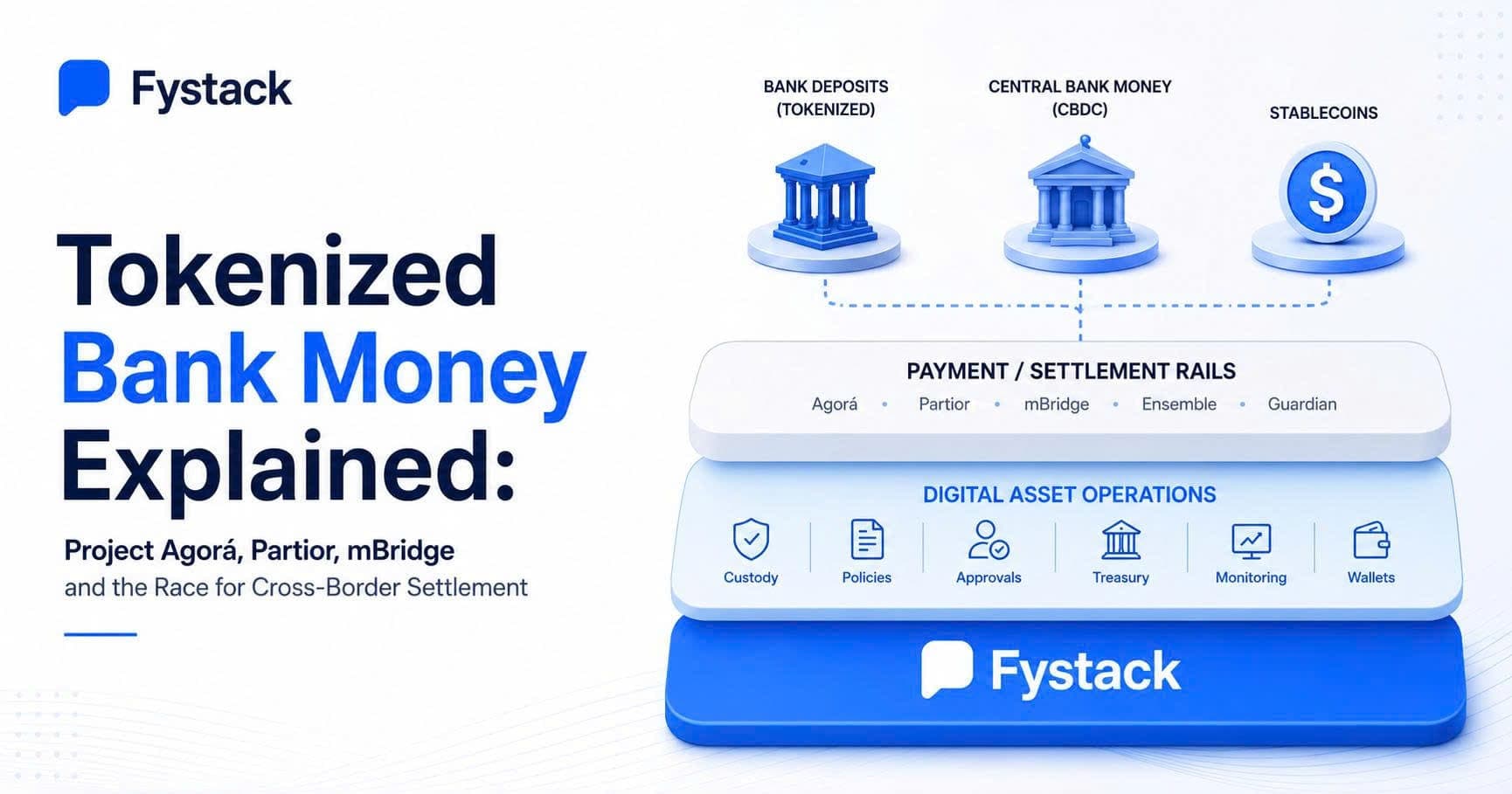
Banks are tokenizing deposits. Central banks are testing tokenized reserves. Stablecoins are already moving value on-chain.
But the bigger question is not whether money can move on-chain.
It is whether different forms of digital money can settle against each other without recreating the intermediaries, reconciliation and settlement risk of today's cross-border payment system.
Project Agorá, Partior, mBridge, Project Ensemble and Project Guardian are testing different answers to that problem.
TL;DR
- Project Agorá tests whether tokenized commercial bank deposits and tokenized central bank reserves can settle atomically across jurisdictions.
- Its July 2026 real-value testing involved 28 financial institutions and central banks, 30 transactions and approximately CHF 800,000, with settlement averaging around 80 seconds.
- Partior focuses on institutional payments using tokenized commercial bank money and is expanding into multi-asset settlement.
- mBridge focuses on wholesale central bank digital currency, or CBDC, for cross-border settlement. The BIS later stepped back from the project after it reached minimum viable product stage.
- Project Ensemble explores how tokenized deposits can support tokenized financial-market transactions.
- Project Guardian takes a broader approach to institutional asset tokenization and programmable financial markets.
- For fintechs, the opportunity is moving beyond the settlement rail itself. Custody, transaction policies, treasury automation and multi-chain orchestration become critical once digital money operates across multiple networks.
- This is where infrastructure providers such as Fystack become relevant. Fystack provides self-hosted custody, MPC wallet infrastructure, policy enforcement, transaction automation and multi-chain operations for fintechs and digital-asset businesses.
What Is Tokenized Bank Money?
Tokenized bank money is a digital representation of existing bank money that can be transferred and programmed using distributed ledger infrastructure.
There are two main forms of tokenized bank money.
Tokenized commercial bank deposits
A tokenized deposit represents a claim on a commercial bank.
The technology changes how the deposit is represented and transferred, but the underlying liability remains with the bank.
This is the model associated with institutional settlement networks such as Partior, which is building infrastructure around tokenized commercial bank money.
Tokenized central bank reserves
Tokenized central bank reserves represent central bank money in programmable form.
These are primarily relevant to wholesale financial institutions rather than consumers.
Projects such as mBridge have explored how central bank digital currencies (CBDCs) can support cross-border payments and foreign exchange settlement.
Stablecoins are different from both.
A stablecoin is a privately issued digital asset designed to maintain a stable value against an underlying asset or reference currency.
The three therefore have different issuers, liabilities, regulatory frameworks and settlement characteristics.
The challenge is making them work together.
Why Cross-Border Payments Are Still Difficult
Consider a company in Singapore paying a supplier in Japan.
The payment instruction may travel quickly, but the underlying funds can still pass through correspondent banks, meaning banks that hold accounts with one another to process payments on behalf of customers in different countries.
That can involve separate ledgers, FX processes, operating windows and reconciliation.
The problem is that different legs of a transaction do not necessarily settle at the same time.
In foreign exchange, this creates Herstatt risk, where one currency can be delivered while the counterparty's currency has not yet settled.
Banks manage this risk through prefunding, correspondent accounts and other controls.
Tokenization does not automatically remove these problems.
What programmable settlement can change is the structure of the transaction itself.
Instead of:
Payment A settles → Payment B settles
the system can attempt:
Payment A + Payment B settle together
If one side cannot settle, neither side settles.
That is atomic settlement.
And atomic settlement is one of the most important ideas behind the current wave of institutional tokenization.

Project Agorá Explained
Project Agorá is a BIS-led public-private initiative testing how tokenized commercial bank deposits and tokenized central bank reserves can work together for wholesale cross-border payments.
BIS stands for the Bank for International Settlements, an international organization that works with central banks and financial authorities.
Agorá was convened by the BIS and the Institute of International Finance with central banks and more than 40 private-sector financial institutions.
According to the BIS Project Agorá report, the prototype combines tokenized commercial bank deposits with tokenized central bank reserves on programmable infrastructure and enables atomic, multi-currency settlement.
The important idea is that Agorá does not require every form of money to become the same thing.
Instead:
- Commercial bank deposits remain commercial bank liabilities.
- Central bank reserves remain central bank liabilities.
- A programmable platform coordinates the settlement between them.
This makes Agorá different from simply launching another blockchain payment network.
It is testing whether different forms of institutional money can become interoperable without changing their underlying legal character.
What Did Project Agorá's 2026 Test Prove?
Project Agorá's July 2026 real-value testing involved 28 financial institutions and central banks.
Participants completed 30 transactions across 17 scenarios, moving approximately CHF 800,000 across six currencies. Transactions averaged around 80 seconds from payment submission to settlement.
The scenarios included:
- Corporate payments
- Interbank transfers
- Dual-currency transactions
- Payment-versus-payment settlement
- Intragroup transfers
But the most important result was not the speed.
It was the demonstration that tokenized commercial bank deposits and tokenized central bank reserves could participate in atomic settlement.
The test also demonstrated end-to-end visibility into payment status and routing, which is important for banks operating complex cross-border flows.
There are important limitations.
The transaction values were small compared with global institutional payment volumes, and the prototype was not connected directly to participants' live real-time gross settlement systems or core banking systems.
RTGS, or real-time gross settlement, is the infrastructure banks use to settle payments individually and in real time at the central-bank or settlement-system level.
So Agorá should not be interpreted as:
"Cross-border payments have moved to blockchain."
A more accurate interpretation is:
"A multi-jurisdictional test demonstrated that commercial bank money and central bank money can participate in programmable atomic settlement."
That is the important milestone.

Agorá vs Partior vs mBridge vs Ensemble vs Guardian
These projects are often grouped together, but they are solving different problems.
| Project | Main focus | Main asset / scope | Why it matters |
|---|---|---|---|
| Project Agorá | Cross-border wholesale payments | Tokenized deposits + central bank reserves | Tests interoperability between different forms of institutional money |
| Partior | Institutional payments | Tokenized commercial bank money | Moves tokenized bank settlement toward commercial use |
| mBridge | Cross-border CBDC | Wholesale multi-CBDC | Demonstrated multi-central-bank settlement |
| Project Ensemble | Tokenized financial markets | Tokenized deposits + tokenized assets | Tests programmable money and asset settlement |
| Project Guardian | Institutional asset tokenization | Tokenized funds, bonds, deposits and other financial assets | Explores broader programmable capital-market infrastructure |
Partior: Commercial Bank Money
Partior is focused on institutional clearing and settlement using digital money.
Its infrastructure is designed around continuous settlement and interoperability with existing financial systems.
In July 2026, Partior and OpenAssets demonstrated atomic delivery-versus-payment involving digital assets, regulated stablecoins and tokenized deposits, using tokenized deposits as the settlement asset.
That is important because it shows how tokenized bank money can move beyond simple payments and become part of multi-asset settlement workflows.
You can explore Partior's latest institutional settlement work on its official platform and updates.
mBridge: Central Bank Money
mBridge takes a different approach.
It focuses on multi-CBDC infrastructure and cross-border settlement using wholesale central bank digital currencies.
The project reached minimum viable product stage in 2024. The BIS later stepped back from mBridge, leaving the participating partners to continue the work. BIS General Manager Agustín Carstens described the project as having reached a stage where the partners could carry it forward independently, while also emphasizing that the platform was not yet mature enough for production operation.
The key distinction is:
mBridge asks what cross-border settlement looks like when central bank money is the settlement asset.
Agorá asks what happens when central bank money and commercial bank money need to settle together.
Project Ensemble: Tokenized Financial Markets
Project Ensemble, led by the Hong Kong Monetary Authority, focuses on tokenized financial-market infrastructure.
Its current work is narrower than a general-purpose tokenized securities market. The HKMA's EnsembleTX pilot is exploring real-value transactions involving tokenized deposits, including tokenized money-market funds and treasury or liquidity-management use cases.
That makes Ensemble important for understanding how programmable money can eventually connect with programmable financial assets.
The HKMA's Project Ensemble updates provide the latest details on its pilot work.
Project Guardian: The Broader Tokenization Layer
Project Guardian, led by the Monetary Authority of Singapore, has a broader scope.
Rather than focusing on one settlement mechanism, it explores how tokenization can transform institutional financial markets, including tokenized funds, fixed income, FX and other capital-market use cases.
This makes Guardian less of a direct competitor to Agorá and more of an exploration of what financial markets could look like once money and assets become programmable.
The MAS Project Guardian program provides the broader framework.
Tokenized Deposits vs Stablecoins: Why Do Banks Need Both?
This is one of the most important questions in tokenized finance.
If stablecoins already move dollars on-chain, why tokenize bank deposits?
Because they represent different claims.
A tokenized deposit remains a claim on a commercial bank.
A stablecoin is a privately issued digital asset.
That difference affects:
- Regulatory treatment
- Liquidity management
- Credit exposure
- Banking relationships
- Treasury operations
- Integration with financial infrastructure
Stablecoins may be useful for open digital-asset ecosystems and programmable transactions.
Tokenized deposits may fit more naturally into institutional banking infrastructure.
Wholesale CBDC serves another role by representing central bank money.
The likely future is therefore not:
Stablecoins vs tokenized deposits vs CBDC
It may be:
Stablecoins + tokenized deposits + wholesale CBDC
The important infrastructure question becomes:
How can these different forms of money interact safely and efficiently?
What Does Tokenized Bank Money Mean for Banks?
For banks, tokenization is not simply about putting deposits on a blockchain.
The bigger change is that banks may eventually need to manage multiple forms of digital settlement assets across multiple networks.
That creates several infrastructure requirements.

Multi-asset liquidity management
Treasury teams may need to manage traditional deposits, tokenized deposits, CBDC access and stablecoin liquidity across different markets.
Interoperability
Banks cannot assume every counterparty will use the same network.
If each institution creates a closed tokenized deposit system, fragmentation simply moves from correspondent banking into blockchain infrastructure.
Programmable compliance
Compliance rules, transaction limits and counterparty eligibility can potentially become part of the settlement workflow itself.
Digital custody
Banks and fintechs need secure infrastructure for managing wallets, permissions, approvals and assets across multiple networks.
Core banking integration
New settlement infrastructure still needs to work alongside existing banking systems.
This is why tokenized finance is increasingly becoming a bank infrastructure problem rather than simply a crypto problem.
Where Fystack Fits
The emergence of multiple digital settlement rails creates a second infrastructure problem.
Who controls the assets and decides whether a transaction is allowed to execute?
A bank or fintech may eventually interact with tokenized deposits, stablecoins and other digital assets across several networks.
The settlement rail determines where value settles.
But the institution still needs infrastructure to determine:
- Who can initiate a transaction
- Which assets can move
- Which addresses are approved
- How much can be transferred
- When additional approval is required
- How funds move between wallets
- How transactions are monitored
- Where cryptographic signing happens
- How the organization retains control of its keys
This is the operational layer around digital-asset settlement.
Fystack operates in this layer.
Fystack provides self-hosted custody and wallet infrastructure for fintechs and digital-asset businesses, including MPC-secured wallets, policy-driven transaction controls, approval workflows, treasury automation, monitoring and multi-chain wallet management.
That distinction is important.
Fystack is not another Agorá, Partior or mBridge settlement rail.
It sits closer to the institution's operational boundary, helping teams control and automate the digital assets that move across those rails.
As financial institutions connect to more networks, this operational layer becomes increasingly important.
The problem changes from:
"How do we put an asset on-chain?"
to:
"How do we safely operate thousands of digital-asset transactions across multiple networks while keeping control, policy and auditability inside the organization?"
That is the infrastructure gap Fystack is built to address.
The Emerging Opportunity: Transaction Orchestration
If banks eventually connect to multiple digital money networks, another infrastructure layer becomes important:
transaction orchestration.
Imagine a bank receiving a cross-border payment instruction.
Its infrastructure could determine:
- Which settlement asset should be used?
- Which network should process the transaction?
- Which liquidity source is available?
- Is the counterparty eligible?
- Which compliance rules apply?
- Which settlement mechanism provides the required finality?
Instead of one fixed payment rail, the institution could have an operational layer coordinating multiple settlement options.
That creates a stack around:
Money + assets + liquidity + compliance + custody + networks
The biggest opportunity may therefore not be another blockchain.
It may be the infrastructure that allows financial institutions to use multiple settlement networks without losing control of their assets or operational policies.
What Needs to Happen Before Tokenized Settlement Goes Mainstream?
The technology is progressing.
The harder problems are increasingly institutional.
1. Legal finality
When exactly does a transaction become legally final when multiple jurisdictions are involved?
2. Regulatory interoperability
Tokenized deposits, CBDC and stablecoins are governed differently across jurisdictions.
3. Liquidity
A settlement network only works if participants have sufficient liquidity in the currencies and assets they need.
4. Core banking integration
Banks cannot replace their entire infrastructure overnight.
5. Network effects
A technically superior settlement network is not useful if the counterparties a bank needs are not connected to it.
6. Operational control
As more value moves across programmable networks, institutions need stronger controls around custody, approvals, transaction policies and automated treasury operations.
This final point is easy to overlook.
The future financial stack is not just about settlement infrastructure.
It is also about the infrastructure sitting above settlement that decides what can move, who can move it and under what conditions.
The Race Is Not Really About Which Blockchain Wins
It is tempting to frame Agorá, Partior, mBridge, Ensemble and Guardian as competing blockchain projects.
That misses the bigger trend.
Commercial banks are exploring tokenized deposits.
Central banks are exploring wholesale CBDC.
Private issuers are building stablecoins.
Financial institutions are tokenizing assets.
The next challenge is making these systems work together.
Project Agorá is important because it tests one of the hardest versions of that problem: coordinating commercial bank money and central bank money across jurisdictions.
Partior demonstrates the commercial potential of tokenized bank settlement.
mBridge demonstrates the potential of multi-CBDC infrastructure.
Ensemble explores programmable money and tokenized financial assets.
Guardian explores the broader transformation of institutional financial markets.
And companies such as Fystack are addressing another layer of the transition: how institutions securely custody, control and automate the digital assets moving through an increasingly multi-rail financial system.
The race is therefore not simply:
Who puts money on-chain first?
It may ultimately be:
Who builds the infrastructure that lets different forms of institutional money settle together, while giving financial institutions the control to operate those assets safely?
Frequently Asked Questions
What is tokenized bank money?
Tokenized bank money is a digital representation of existing commercial bank deposits or central bank money that can be transferred and programmed using distributed ledger infrastructure.
What is Project Agorá?
Project Agorá is a BIS-led initiative exploring how tokenized commercial bank deposits and tokenized central bank reserves can settle together for wholesale cross-border payments.
Is Project Agorá a CBDC?
No. Agorá is a programmable settlement architecture that coordinates tokenized commercial bank deposits and tokenized central bank reserves. It is not a retail CBDC.
How is Agorá different from Partior?
Partior focuses on institutional payment and settlement infrastructure using tokenized commercial bank money. Agorá specifically tests coordination between commercial bank money and central bank reserves across jurisdictions.
How is Agorá different from mBridge?
mBridge focuses on multi-CBDC cross-border settlement. Agorá focuses on combining commercial bank deposits and central bank reserves within the same programmable settlement architecture.
Are tokenized deposits replacing stablecoins?
Not necessarily. Tokenized deposits and stablecoins represent different types of claims and may serve different institutional and digital-asset use cases.